Key takeaways
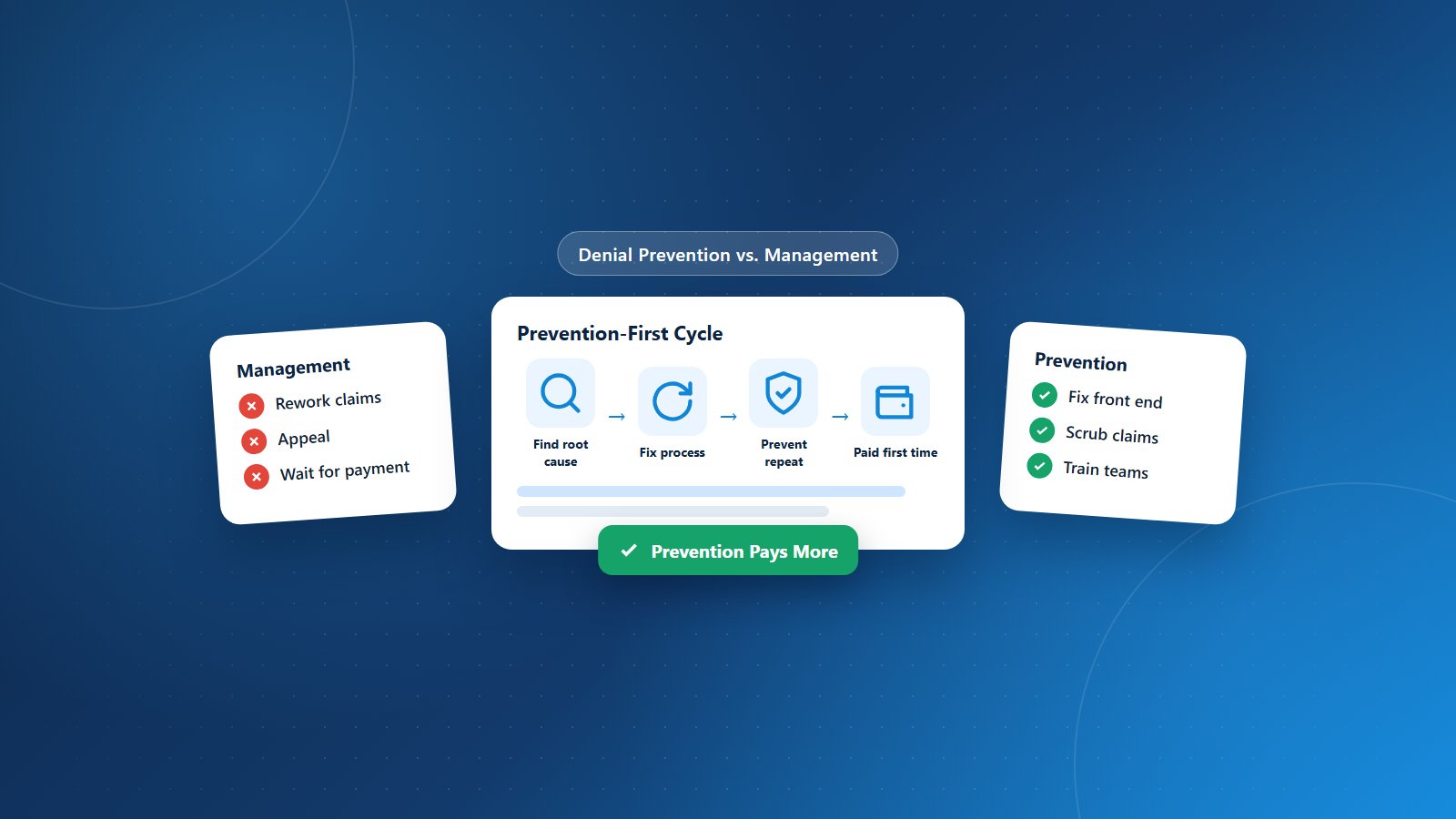
- Denial management fixes claims after they’re denied; denial prevention stops them from being denied at all. The strongest practices do both, with prevention first.
- Every denial costs staff time and delays payment, and some are never recovered.
- Most denials trace back to a handful of sources: front desk, authorization, coding, documentation, credentialing and submission.
- Track every denial by root cause, fix the workflow behind it and feed results back into training.
- Measure progress with denial rate, first-pass resolution, clean claim rate, appeal success and cost to collect.
Many practices think of denial management as the work of appealing denied claims. That work matters, but it’s only half the story. Every denial costs time and money to rework, and some are never recovered at all. The practices with the strongest revenue cycles focus first on preventing denials, and then manage the ones that still occur quickly and systematically.
This guide explains the difference between denial management and denial prevention, where denials come from, how to build a prevention-first program, how to work and appeal the denials that remain, and how to measure progress.
Denial Management vs. Denial Prevention
Denial management is reactive: identifying denied claims, correcting them, resubmitting or appealing and tracking outcomes.
Denial prevention is proactive: finding the root causes of denials and fixing the processes that create them so claims are paid the first time.
| Factor | Denial management | Denial prevention |
|---|---|---|
| Timing | After the denial | Before the claim is submitted |
| Focus | Individual claims | Processes and patterns |
| Cost | Rework on every claim | One-time fixes that scale |
| Cash flow | Delayed payments | Faster first-pass payments |
| Result | Recovers some revenue | Protects revenue at the source |
Why Prevention Pays More
- Rework is expensive: every denied claim requires research, correction and follow-up.
- Not all denials are recovered: some are never reworked, and some appeals fail.
- Delays hurt cash flow: even recovered claims are paid weeks or months later.
- Deadlines create risk: appeal and timely filing windows close quickly.
- Patients are affected: denials can lead to confusing bills and frustration.
- Staff burnout: constant rework drains billing teams.
Rejections vs. Denials
It helps to separate two problems that are often confused:
- Rejections happen before the payer accepts the claim, usually at the clearinghouse or payer front end, because of errors such as missing information or invalid data. Rejected claims haven’t been processed, so they must be corrected and resubmitted quickly.
- Denials happen after the payer processes the claim and decides not to pay all or part of it. Denials require correction, resubmission or a formal appeal.
Both should be tracked, because rejections that sit unworked can turn into timely filing denials.
Where Denials Come From
Most denials trace back to a handful of sources. Mapping each denial to its source shows where to focus:
| Source | Typical denial causes | Prevention |
|---|---|---|
| Front desk | Demographic errors, outdated insurance, inactive coverage | Standardized registration and eligibility checks |
| Authorization | Missing, expired or mismatched authorizations | Authorization lists, tracking and pre-service checks |
| Coding | Invalid codes, modifier errors, bundling issues | Certified coders and claim scrubbing |
| Documentation | Medical necessity not supported | Provider education and templates |
| Credentialing | Rendering provider not enrolled | Credentialing before patients are seen |
| Submission | Late claims, duplicates, missing information | Prompt submission and daily rejection work |
| Payer policy | New rules and edits | Policy monitoring and workflow updates |
For a detailed list, see our guide to the most common claim denial reasons.
Building a Prevention-First Program
Step 1: Track every denial by root cause
Categorize denials by reason code and trace each back to where it originated. A simple monthly summary by source, payer, provider and service reveals patterns quickly.
Step 2: Fix the front end
Most preventable denials begin before the visit. Strengthen registration, eligibility verification and authorization workflows:
- Verify eligibility before every visit. Read our eligibility verification best practices.
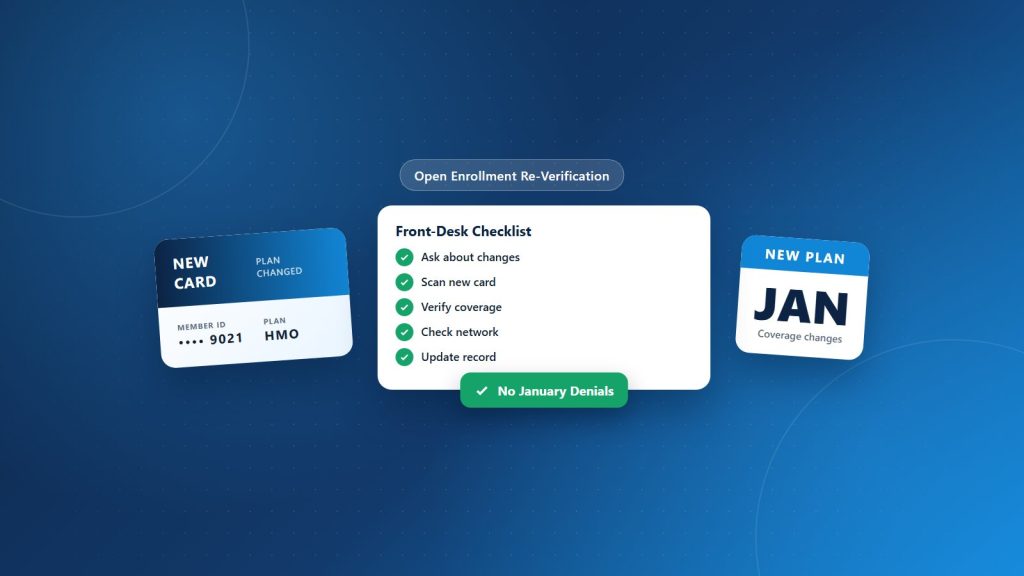
- Scan insurance cards and confirm demographics at every visit. See front-desk errors that cause denials.
- Build an authorization workflow. Read how to streamline prior authorizations.
Step 3: Improve coding and documentation
Provide targeted education based on denial data, update templates and conduct periodic coding reviews. Learn about E/M coding accuracy.
Step 4: Use claim scrubbing
Catch errors before submission with updated edits and custom rules for recurring payer-specific issues. Our guide to raising your clean claim rate explains how.
Step 5: Keep credentialing current
Provider enrollment problems cause denials that are often difficult to recover. Track every provider’s enrollment, revalidation and re-credentialing dates.
Step 6: Monitor payer policy changes
Update workflows quickly when payers change rules. Read about staying ahead of payer policy changes.
Step 7: Close the loop
Every resolved denial should answer one question: what will stop this from happening again? Record the fix and confirm it worked the next month.
Example: Turning a Denial Pattern Into a Fix
Suppose a practice notices a steady stream of denials for imaging services with one payer. Root-cause analysis shows that authorizations were obtained, but for a different code than the one ultimately performed. Instead of appealing claims one by one, the practice adds a pre-service check that compares the scheduled service with the approved authorization, and a process for updating authorizations when the plan changes. Denials for that issue drop, and the appeals workload shrinks with them.
Managing the Denials That Still Happen
Prioritize
Work denials in order of value, deadline and likelihood of success. High-dollar claims close to their appeal deadline come first.
Correct or appeal?
- Correct and resubmit when the denial was caused by an error on your side, such as a wrong code or missing information.
- Appeal when the claim was correct and the payer’s decision should be overturned.
- Write off only after appropriate review and according to your policies.
Write effective appeals
A strong appeal typically includes:
- Claim and patient identifiers and the denial reason
- A concise explanation of why the claim should be paid
- Supporting documentation such as notes, authorizations and test results
- References to payer policy or contract terms where relevant
- Submission within the payer’s appeal deadline
Templates for common denial types save time and improve consistency.
Escalate systemic issues
When a payer repeatedly denies correct claims, escalate through provider relations with data on volume and impact. Fixing the payer’s processing error is far more efficient than appealing every claim. Related issues such as payer downcoding and underpayments deserve the same approach.
Measuring Progress
| Metric | What it shows |
|---|---|
| Denial rate | How often claims are denied, by reason |
| Preventable denial share | How much of the problem is within your control |
| First-pass resolution rate | Claims paid on first submission |
| Clean claim rate | Claims accepted without errors |
| Appeal success rate | Effectiveness of appeals by payer and reason |
| Days to resolve denials | Speed of denial work |
| Cost to collect | Overall efficiency of the revenue cycle |
Prevention efforts should show steady improvement over several months. See our guide to revenue cycle KPIs.
A 90-Day Denial Reduction Plan
- Days 1–30: Pull six months of denial data, group by root cause and identify the top five causes.
- Days 31–60: Fix the workflows behind the top causes, add claim scrubber rules and train staff.
- Days 61–90: Measure results, work remaining backlog by priority and set the next round of fixes.
Related Guides
- The Most Common Claim Denial Reasons and How to Fix Them
- Patient Intake Errors: The Hidden Root Cause of Claim Denials
- Prior Authorization Best Practices
- Timely Filing Limits: A Year-End A/R Rescue Plan
- How to Raise Your Clean Claim Rate
- How Payer Policy Changes Impact Your Revenue
- Accounts Receivable Aging: What Your A/R Report Is Telling You
Frequently Asked Questions
What denial rate should we aim for?
Lower is always better, but focus on your trend and on the share of denials that are preventable. Benchmarks vary by specialty and payer mix.
Should every denial be appealed?
No. Prioritize by value, likelihood of success and deadlines, and correct and resubmit when an error was simply made.
How long does it take to see results from prevention?
Some fixes, such as eligibility workflow changes, show results within weeks. Coding and documentation improvements may take a few months.
Who should own denial prevention?
Billing leadership should own the process, but prevention involves the front desk, schedulers, coders, providers and credentialing staff.
Prevention-First Revenue Cycle With PRCM
Physicians Revenue Cycle Management handles denial management and payment appeals while working upstream to eliminate root causes. Our revenue cycle management and medical billing services help practices get paid the first time.
Want the complete picture? Read our guide: How to Choose a Medical Billing Company: 12 Questions to Ask.
Ready to stop denials before they start? Let’s connect.