
Physicians Revenue Cycle Management
Medical Billing Audit
Independent reviews of coding, documentation and billing that uncover lost revenue and compliance risk, with clear findings and a practical action plan.
Audit & consulting
Find revenue leaks and compliance risks before payers do
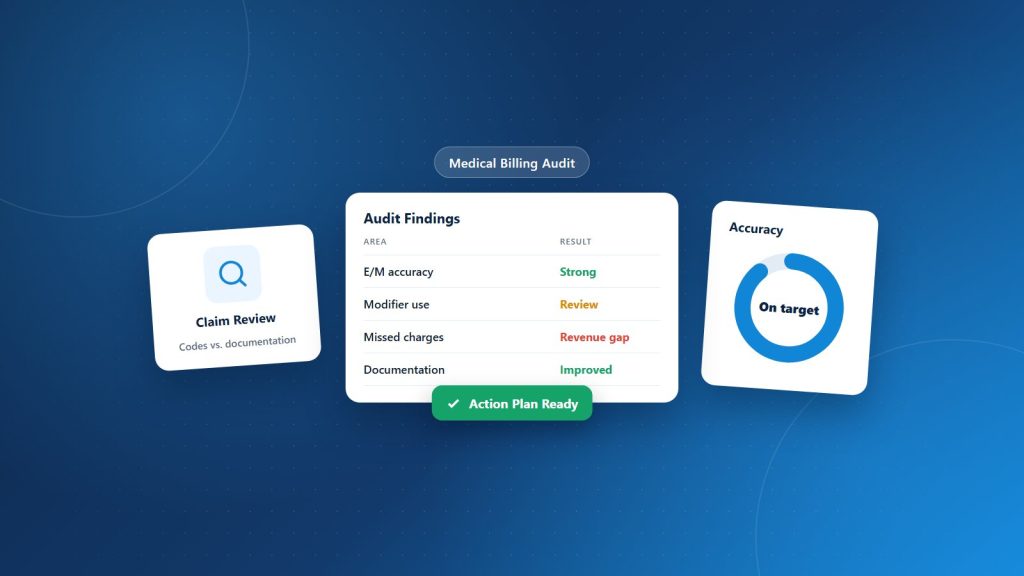
A medical billing audit examines the reliability and accuracy of your clinical documentation, coding and billing. We compare claims against medical records and payer rules to show where your practice is losing revenue, where risk exists and how to fix both.
PRCM has expertise in advising and guiding healthcare organizations to make business decisions that promote growth and benefit their patients. Our audits deliver clear findings, specific education and a practical action plan.
What we review
- E/M level accuracy and documentation
- Procedure, diagnosis and modifier coding
- Medical necessity support
- Missed charges and unbilled services
- Denial patterns and root causes
- Payer underpayments and downcoding
- Specialty-specific billing rules
Who benefits
An audit helps every part of your practice
Coding benefits
Audits help coding staff identify and correct problem spots before government or insurance payers challenge inappropriate coding.
Administrative benefits
Administrative staff gain confidence that claims are true, accurate and correctly submitted.
Clinical benefits
Audits support better patient care by tracking services and procedures and educating physicians on documentation.
Our approach
How a PRCM audit works
- Define the scopeProviders, services, payers and time period based on your goals and concerns.
- Sample claimsA representative sample of claims selected for detailed review.
- Review recordsClaims compared with documentation, coding guidelines and payer policies.
- Report findingsAccuracy rates, error types, financial impact and compliance risks.
- Educate and improveProvider and staff education plus a corrective action plan and follow-up.
Warning signs
When to schedule an audit
Many practices schedule an audit every year. Others wait until something feels wrong. If you recognize any of these signs, an audit can pinpoint the cause.
- Rising denial rates or slower payments
- Collections falling while patient volume holds steady
- A growing share of A/R over 90 days
- E/M patterns that differ from specialty norms
- New providers, services, systems or billing staff
- Payer record requests or recoupment letters
Questions
Billing audit FAQs
How often should a practice be audited?
Many practices benefit from an annual external audit, supported by periodic internal reviews. Practices with major changes or warning signs may need more frequent reviews.
Will an audit only look for overcoding?
No. Audits identify both overcoding, which creates compliance risk, and undercoding or missed charges, which leave earned revenue uncollected.
What’s the difference between internal and external audits?
Internal audits are performed by your own staff and are useful for ongoing monitoring. External audits provide an objective, independent review with broader benchmarking. Many practices use both.
What do we receive at the end?
A clear report of findings by provider, service and error type, the financial impact, education materials and a practical action plan.
Insights
Related reading
Get a clear view of your billing health
Schedule an audit and find out exactly where your practice stands.