Key takeaways
- Internal audits are frequent, low-cost and great for ongoing monitoring, but can lack objectivity and specialty depth.
- External audits bring independent, benchmarked findings that carry more weight for compliance.
- Most practices get the best results by combining an annual external audit with periodic internal reviews.
- Any audit is only as useful as the education and corrective actions that follow it.
Coding audits are one of the best tools a practice has for protecting revenue and reducing compliance risk. But not all audits are the same. Some practices rely on internal reviews by their own staff, while others bring in independent auditors. Both approaches have value, and the right choice depends on your goals, resources and risk.
This guide compares internal and external coding audits, explains when each makes sense and shows how to combine them into an effective audit program.
What Is an Internal Coding Audit?
An internal audit is performed by your own staff, often a coding lead, compliance officer or billing manager, who reviews a sample of claims against documentation.
Advantages
- Lower direct cost
- Can be performed frequently as part of routine quality control
- Reviewers understand practice workflows and providers
- Fast feedback to providers and coders
Limitations
- Reviewers may lack objectivity, especially when auditing their own work or colleagues
- Expertise may be limited for complex specialties or unusual services
- Staff time spent auditing takes away from other work
- Findings may carry less weight with leadership or in compliance reviews
What Is an External Coding Audit?
An external audit is performed by an independent firm or consultant with coding and compliance expertise.
Advantages
- Objective, unbiased review
- Broad experience across practices and specialties
- Benchmarking against industry patterns
- Credible findings that support compliance efforts
- Detailed reports with education and action plans
Limitations
- Higher direct cost per audit
- Typically performed less frequently
- Requires coordination and records access
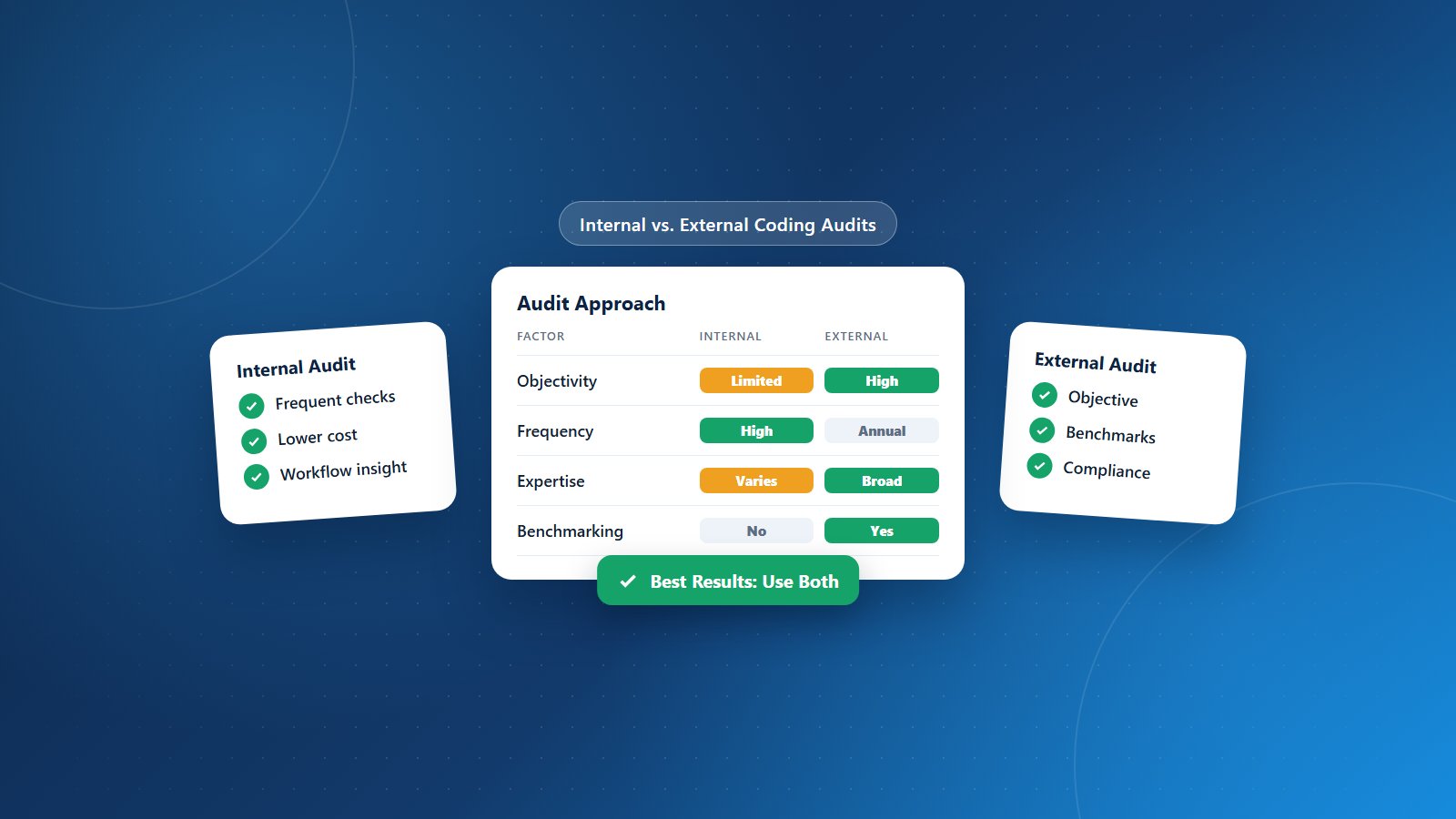
Side-by-Side Comparison
| Factor | Internal audit | External audit |
|---|---|---|
| Objectivity | Limited | High |
| Frequency | Monthly or quarterly | Typically annual or as needed |
| Cost | Staff time | Project fee |
| Specialty depth | Varies by staff | Broad |
| Benchmarking | Rarely | Usually included |
| Best for | Ongoing monitoring and follow-up | Baselines, high-risk areas and compliance |
When You Need an Internal Audit
- Ongoing monitoring of coding quality
- Spot-checking new coders or providers
- Following up on corrective actions from a prior audit
- Reviewing specific denial patterns
- Checking claims after a template or workflow change
When You Need an External Audit
- An annual independent review as part of a compliance program
- Concerns about coding accuracy or unusual coding patterns
- Payer requests for records, recoupment letters or audits
- Major changes, such as new specialties, providers or systems
- Preparing for a practice sale, merger or new payer contract
Building an Audit Program That Uses Both
Many practices combine both approaches into a simple annual cycle:
- External baseline audit early in the year to establish accuracy rates and priorities.
- Provider education based on findings.
- Quarterly internal reviews focused on the error types found in the baseline.
- Targeted external reviews for high-risk services or when warning signs appear.
- Annual re-audit to measure improvement and set new priorities.
What a Good Audit Includes
- A clearly defined scope and sample
- Review against current coding guidelines and payer policies
- Findings by provider, service and error type
- Financial impact of errors, both under- and overcoding
- Education for providers and coders
- A corrective action plan and follow-up
Common Mistakes in Audit Programs
- Auditing without acting on findings
- Focusing only on overcoding and ignoring lost revenue from undercoding
- Using samples too small to reveal patterns
- Delivering findings in a punitive way that discourages provider engagement
- Never re-auditing to confirm improvement
Frequently Asked Questions
How often should we audit?
Many practices perform an external audit annually and internal reviews quarterly, with additional reviews when warning signs appear or after major changes.
Who should perform internal audits?
Ideally someone with coding credentials who doesn’t code the claims being reviewed, to preserve as much objectivity as possible.
What should we do if an audit finds overpayments?
Work with qualified advisors to address overpayments appropriately and promptly, and correct the process that caused them.
Audit Services From PRCM
Physicians Revenue Cycle Management provides independent medical billing and coding audits with clear findings, education and action plans. We also help practices set up internal review processes. Learn more about the benefits of an annual audit, the warning signs that call for one and E/M coding accuracy.
Not sure which audit your practice needs? Let’s connect.