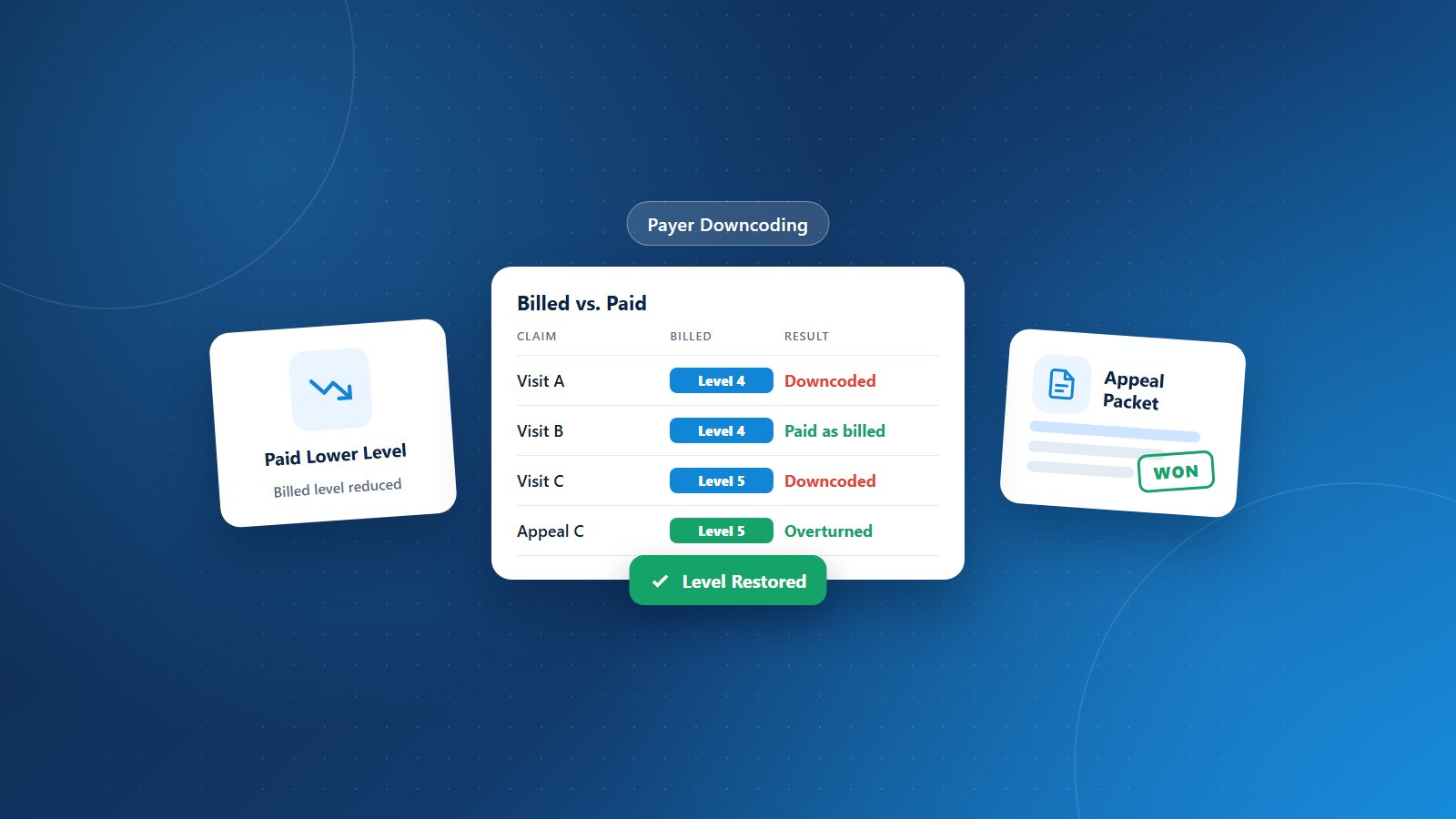
Downcoding happens when a payer reduces the level of a service you billed, such as paying a high-level office visit as a lower-level one, often without requesting records first. Unlike a denial, a downcoded claim is still paid, so it often goes unnoticed. Over time, systematic downcoding can quietly reduce practice revenue.
Here’s how to identify payer downcoding and build strong appeals.
How Downcoding Works
Payers may adjust claim levels based on internal policies, claim analysis or algorithms that compare billed codes with diagnosis codes, patient history or provider patterns. Sometimes downcoding is applied automatically to certain combinations of codes and diagnoses, without review of the medical record.
Signs You’re Being Downcoded
- Remittances show a different procedure code paid than the one billed.
- Payments for higher-level visits consistently match lower-level rates.
- Remark codes indicate the service was adjusted or recoded.
- Your E/M distribution in payments differs from what you billed.
Step 1: Monitor Paid vs. Billed Codes
Configure payment posting to flag claims where the paid code differs from the billed code or payment is below the expected amount. Report on these variances regularly by payer.
Step 2: Review the Documentation
Before appealing, confirm that documentation supports the level billed. If it does, you have a strong case. If not, use the finding as an education opportunity.
Step 3: Understand the Payer’s Policy
Look for published payer policies on code-level adjustments. Some payers announce downcoding programs and describe how to request reconsideration.
Step 4: Submit a Clear Appeal
An effective appeal includes:
- The claim details and the code billed versus paid.
- The medical record for the date of service.
- A concise explanation of how documentation supports the billed level, referencing the applicable coding guidelines (such as medical decision making or total time).
- References to contract terms, if applicable.
Step 5: Track Outcomes
Track appeal success rates by payer. High overturn rates are strong evidence when escalating systemic issues with payer representatives.
Step 6: Escalate Patterns
If a payer consistently downcodes claims that are later overturned, escalate through provider relations or your contracting contact. Document the volume and financial impact.
Preventing Downcoding
- Document clearly: Make medical decision making or time obvious in every note.
- Code accurately: Avoid patterns of overcoding that invite scrutiny.
- Use specific diagnoses: Diagnosis codes that reflect complexity support higher-level services.
- Audit regularly: Internal reviews confirm coding accuracy before payers question it.
Read more about E/M coding accuracy.
Fight Downcoding With PRCM
Physicians Revenue Cycle Management’s billing audit and revenue cycle management teams monitor payments, identify downcoding and file well-documented appeals to recover revenue.
Are payers paying the level you billed? Let’s connect.