Key takeaways
- Until a provider is credentialed and enrolled with a payer, claims for that payer may be denied.
- Credentialing commonly takes several months, so start as soon as a new physician’s agreement is signed.
- Gather every document up front and keep information identical across applications, CAQH and licenses.
- Follow up consistently and confirm effective dates before the first claim.
- Credentialing never really ends: revalidation, re-credentialing and renewals keep providers in network.
Hiring a new physician is an exciting milestone for any practice, but it comes with a challenge that’s often underestimated: credentialing. Until a provider is credentialed and enrolled with each payer, the practice may not be able to bill for that provider’s services, or claims may be denied outright. Delays of even a few weeks can mean significant lost revenue and frustrated patients.
This guide covers the full credentialing lifecycle: what credentialing is, why it takes so long, a step-by-step timeline, payer-specific considerations, how to manage the gap before enrollment is complete, and the ongoing maintenance that keeps providers in network.
What Is Physician Credentialing?
Credentialing is the process of verifying a provider’s qualifications, including education, training, licensure, board certification, work history and professional background. Payer enrollment, often discussed alongside credentialing, is the process of joining an insurance company’s network so the provider can be reimbursed for services to that payer’s members.
Several organizations may credential the same provider: hospitals and health systems for privileges, and each insurance company for network participation. Each has its own forms, requirements and timelines.
Credentialing vs. Enrollment vs. Privileging
| Process | Who performs it | Purpose |
|---|---|---|
| Credentialing | Payers, hospitals, organizations | Verify qualifications and history |
| Payer enrollment | Insurance companies and government payers | Join networks and receive payment |
| Privileging | Hospitals and facilities | Authorize specific services at that facility |
Why Credentialing Takes So Long
Credentialing timelines vary widely by payer and state, and the process commonly takes several months from start to finish. Delays usually come from:
- Incomplete or inconsistent applications
- Missing documents such as licenses, certificates or malpractice coverage
- Gaps in work history that aren’t explained
- Slow responses to payer requests for information
- Primary source verification that depends on outside organizations
- Payer panels that are closed to new providers in certain areas
The best defense is to start early and stay organized.
A Sample Credentialing Timeline
| When | What to do |
|---|---|
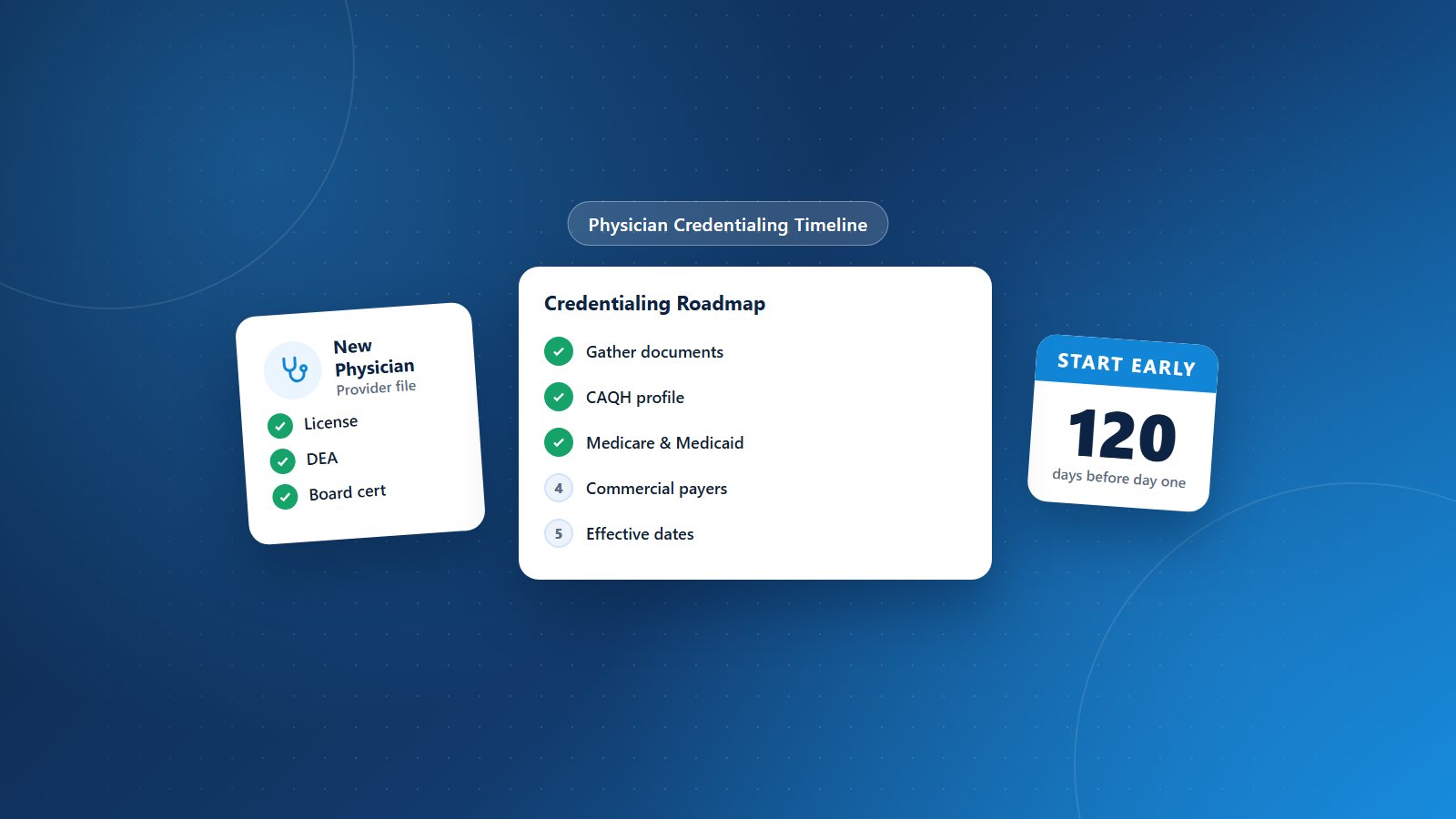
| As soon as the agreement is signed | Collect documents and personal information; open a credentialing file |
| Week 1–2 | Complete and attest the CAQH profile; confirm NPI and licenses |
| Week 2–3 | Submit Medicare and Medicaid enrollment and reassignment |
| Week 2–4 | Submit commercial payer applications |
| Ongoing | Follow up with each payer regularly and respond to requests quickly |
| Before first claims | Confirm effective dates, provider numbers and fee schedules |
Actual timelines vary, which is why starting three to four months before a provider’s start date is a common recommendation.
Step 1: Start as Soon as the Contract Is Signed
Waiting until the provider arrives almost guarantees a gap in billable revenue. Begin credentialing as soon as employment terms are finalized, in parallel with onboarding.
Step 2: Gather Documents
Collect everything you’ll need up front:
- State medical license(s) and DEA registration
- Board certification and specialty certificates
- Medical school diploma and residency/fellowship certificates
- Curriculum vitae with complete, month-and-year work history
- Malpractice insurance certificate and claims history
- National Provider Identifier (NPI) information
- Hospital privileges or admitting arrangements, if applicable
- Government-issued ID and other personal identifiers required by payers
- Continuing education and life support certifications where required
Step 3: Complete or Update the CAQH Profile
Many commercial payers rely on CAQH ProView to access provider data. Make sure the profile is complete, documents are uploaded, the practice location is correct and the profile is attested. Grant access to the payers you’re applying to. See our CAQH profile maintenance guide.
Step 4: Enroll With Medicare and Medicaid
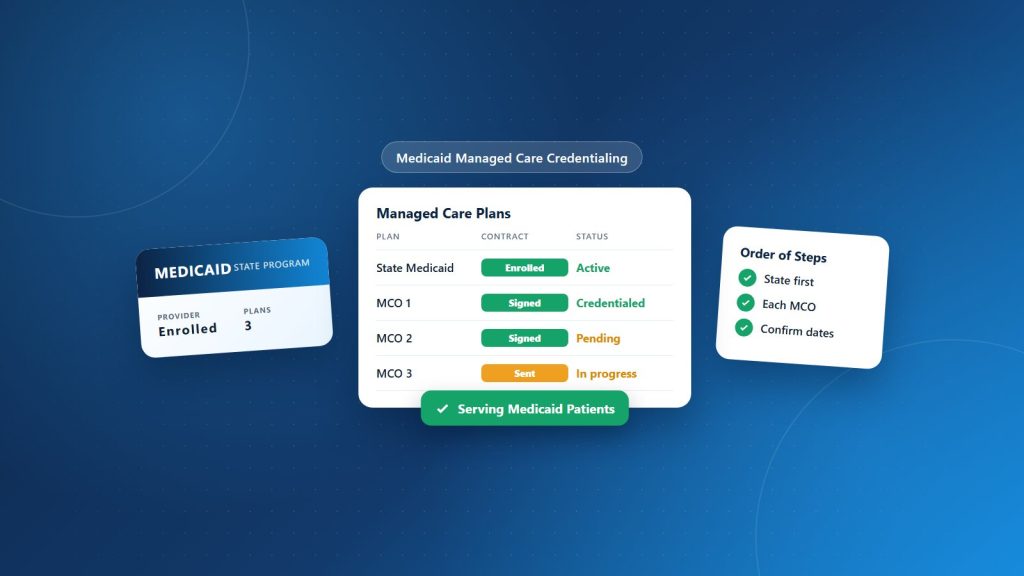
Government payers have their own enrollment systems and requirements. Submit Medicare enrollment and reassign benefits to your group so payments reach the practice, and complete state Medicaid enrollment as required. Medicaid managed care plans usually require separate credentialing after state enrollment. Read about credentialing with Medicaid managed care plans.
Step 5: Apply to Commercial Payers
Submit applications to each commercial payer you participate with. Some payers allow new providers to be added to an existing group contract, while others require separate applications. Confirm whether each payer’s panel is open for your specialty and location.
Step 6: Follow Up Consistently
Credentialing applications rarely move forward on their own. Follow up with each payer regularly, respond quickly to requests for additional information and keep a log of every contact, reference number and status update.
Step 7: Confirm Effective Dates and Load Contracts
Once approved, confirm the provider’s effective date with each payer, obtain provider numbers and make sure fee schedules are loaded in your practice management system. Only then should claims be submitted under the new provider.
Special Situations
Telehealth and multi-state providers
Providers generally need licenses in the states where patients are located, plus payer enrollment covering those patients. See our guide to telehealth credentialing across states.
New practices
A brand-new practice must also establish group enrollment, identifiers and contracts. Read our payer enrollment roadmap for new practices.
Provider moves and location changes
When providers change locations, join a new group or the practice changes ownership, enrollment records must be updated with every payer.
Planning for the Gap
If a new physician starts before every enrollment is complete, plan ahead: schedule patients covered by payers where the provider is already enrolled, and communicate clearly with patients about network status. Never assume claims can simply be held indefinitely, because timely filing limits still apply.
Credentialing Doesn’t End After Enrollment
Once a provider is in network, ongoing maintenance is required:
- CAQH re-attestation on a recurring cycle
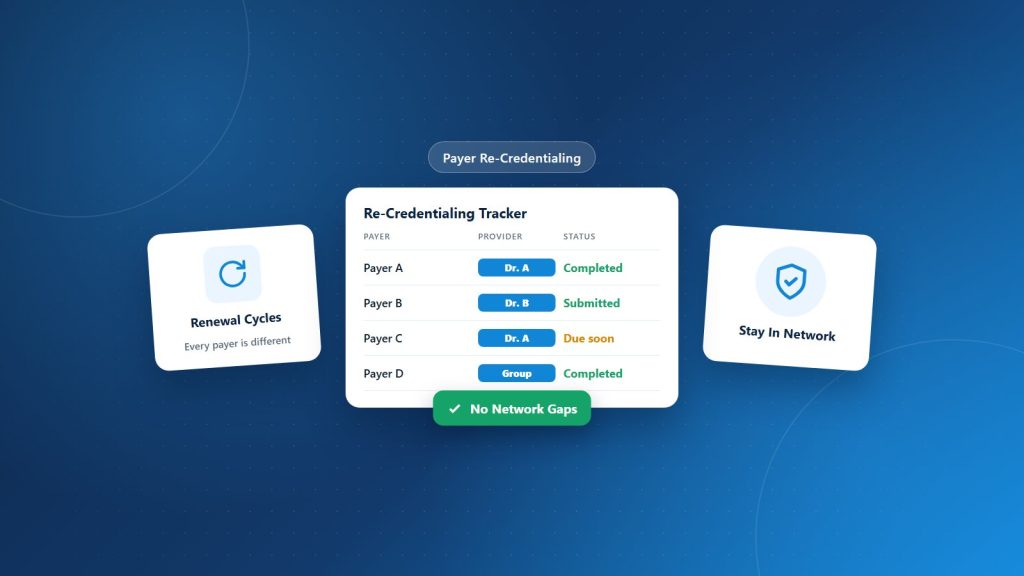
- Payer re-credentialing every few years. See how to never miss a payer renewal.
- Medicare revalidation. Read our Medicare revalidation guide.
- License, DEA and board certification renewals
- Malpractice policy renewals
Missing these can interrupt payments just as surely as a delayed initial application. A single annual credentialing calendar and a periodic credentialing audit keep everything on track.
Common Credentialing Mistakes
- Starting too late
- Incomplete or inconsistent applications
- Expired documents and lapsed CAQH attestations
- No follow-up on pending applications
- Billing before effective dates are confirmed
Read more in 7 credentialing mistakes that delay your revenue.
Related Guides
- CAQH Profile Maintenance: Keeping Your Credentialing Current
- Medicare Revalidation: How to Avoid Billing Interruptions
- 7 Credentialing Mistakes That Delay Your Revenue
- Credentialing Telehealth Providers Across Multiple States
- Launching a New Practice: Your Payer Enrollment Roadmap
- Annual Credentialing Calendar
- Re-Credentialing Cycles: How to Never Miss a Payer Renewal
- Credentialing With Medicaid Managed Care Plans
Frequently Asked Questions
How long does physician credentialing take?
It varies by payer and state, but several months is common. Starting early is the most effective way to avoid revenue gaps.
Can a new physician see patients before credentialing is complete?
They can often see patients, but claims to payers where they aren’t yet enrolled may not be paid. Plan schedules and patient communication accordingly.
What is CAQH and why does it matter?
CAQH ProView is a database many commercial payers use for credentialing. An incomplete or unattested profile can stall applications.
Do we need to credential with every payer separately?
Generally yes. Each payer has its own process, although CAQH reduces duplicate paperwork for many commercial plans.
Should we outsource credentialing?
Many practices do, especially when adding several providers or lacking dedicated staff. A credentialing partner tracks applications, deadlines and renewals so nothing is missed.
Let PRCM Handle Credentialing for You
Physicians Revenue Cycle Management provides complete provider credentialing services, including Medicare, Medicaid, commercial and workers’ compensation enrollment. We manage applications, CAQH profiles and payer follow-up so your new physicians can start billing sooner, and we track renewals so they stay in network. Pair credentialing with our medical billing services for a seamless start from day one.
Bringing on a new provider? Let’s connect and get credentialing started early.