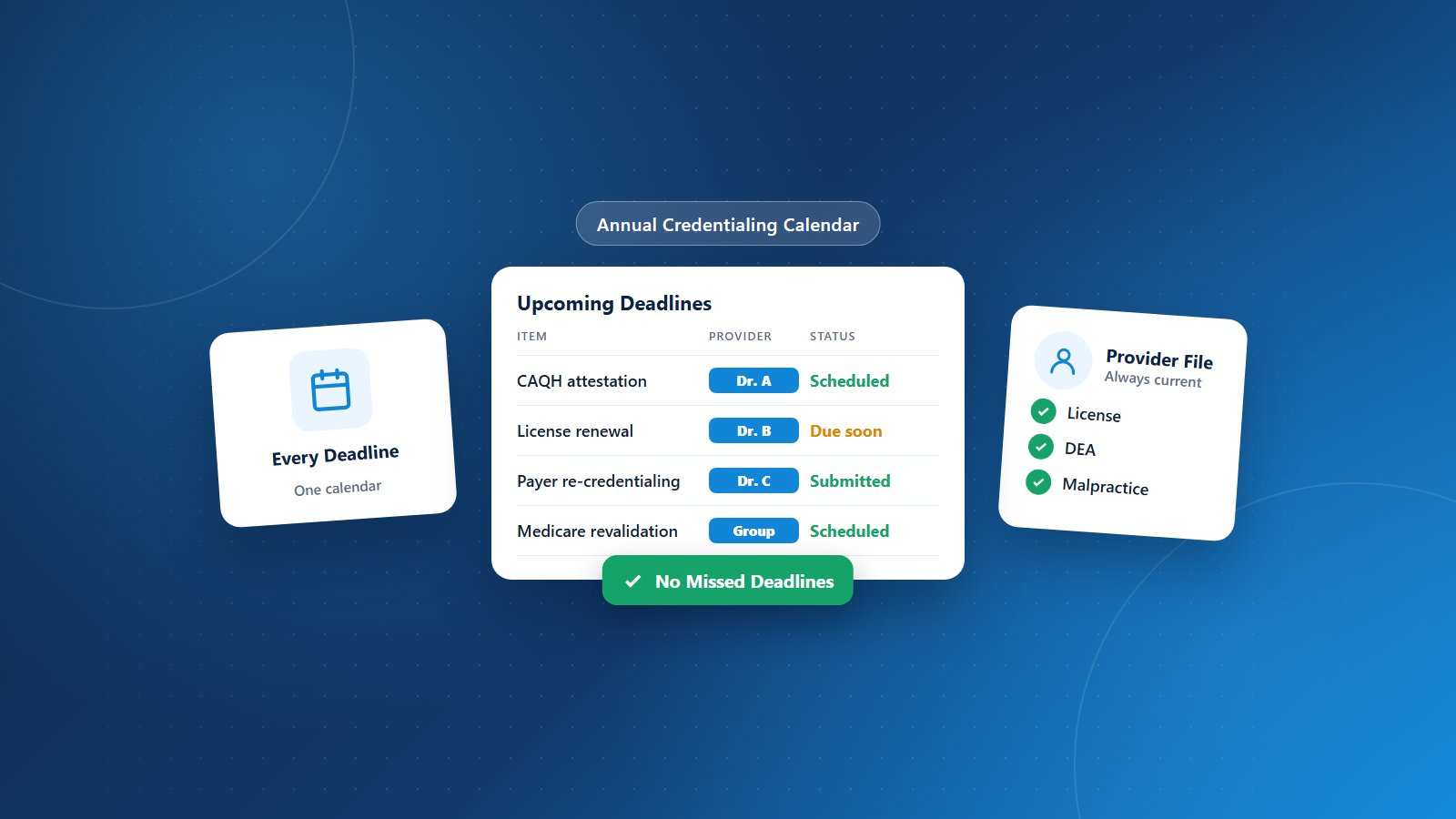
Credentialing deadlines don’t arrive all at once. They’re scattered throughout the year across every provider: license renewals, DEA registrations, board certifications, malpractice policies, CAQH attestations, payer re-credentialing and Medicare revalidation. Miss one, and a provider may be unable to bill a payer until the issue is resolved.
An annual credentialing calendar brings all of these deadlines into one place. Here’s how to build one.
What to Include
For every provider, track:
- State medical licenses for every state, including telehealth states.
- DEA and state controlled substance registrations.
- Board certification and maintenance requirements.
- Malpractice insurance renewal dates.
- CAQH re-attestation dates.
- Payer re-credentialing cycles for each commercial plan.
- Medicare revalidation due dates for individuals and groups.
- Medicaid revalidation or re-enrollment requirements.
- Hospital privileges reappointment dates.
- Certifications such as life support training.
Step 1: Gather Current Data
Collect current documents and expiration dates for every provider. A credentialing audit is a good starting point.
Step 2: Choose a System
Use credentialing software or a well-organized shared spreadsheet with calendar reminders. The system should support multiple reminder dates for each deadline.
Step 3: Set Lead Times
Set reminders well in advance, since many renewals require time for applications, continuing education or payer processing. Longer processes need longer lead times.
Step 4: Assign Ownership
Every deadline needs an owner. Whether it’s an in-house coordinator or a credentialing partner, someone must be accountable for each item.
Step 5: Plan for New Providers
Add new providers to the calendar as soon as they’re hired, starting with initial credentialing timelines. See our step-by-step credentialing guide.
Step 6: Track Practice-Level Changes
New locations, ownership changes, tax ID changes and provider departures all require payer updates. Add them to the calendar when they occur.
Step 7: Review Monthly
Review upcoming deadlines monthly so nothing is missed during busy periods.
Benefits of a Credentialing Calendar
- No surprise payment interruptions.
- Less last-minute stress for staff and providers.
- Accurate payer directories.
- Better compliance and audit readiness.
Credentialing Management From PRCM
Physicians Revenue Cycle Management’s provider credentialing services track every license, registration, attestation and re-credentialing deadline for your providers. We handle renewals and payer updates so your billing keeps flowing.
Start the new year organized. Let’s connect.