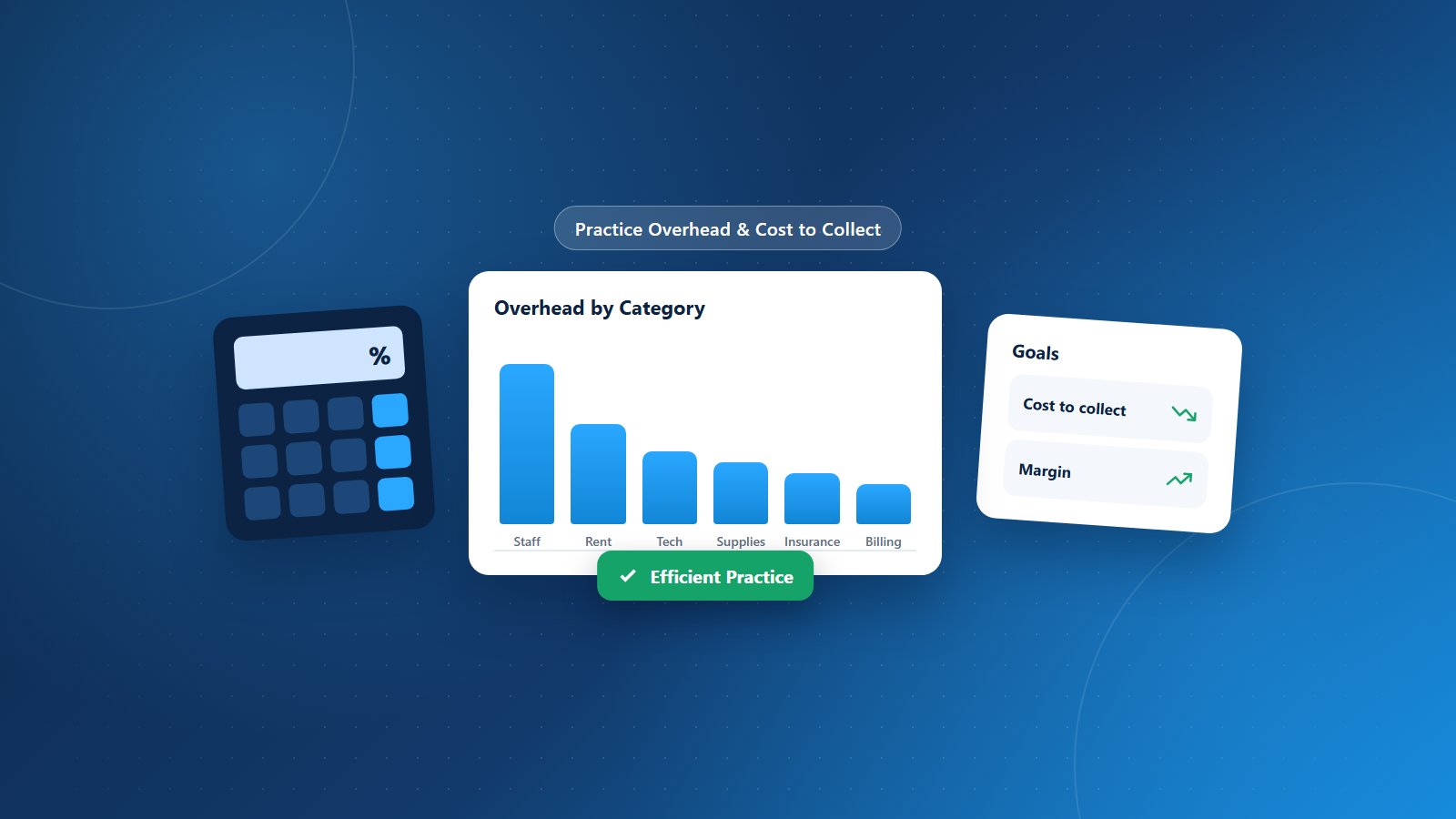
Overhead is everything it costs to run your practice apart from physician compensation: staff, rent, supplies, technology, insurance, billing and more. When overhead grows faster than revenue, practice profitability shrinks. One of the most useful ways to evaluate efficiency is your cost to collect: how much you spend to collect each dollar of revenue.
Here’s how to measure overhead and cost to collect, and where practices can trim expenses wisely.
Understanding Overhead
Overhead is often expressed as a percentage of collections. Comparing your overhead ratio with prior years and with practices of similar specialty and size helps you understand whether costs are in line. Benchmarks vary widely by specialty, so compare carefully.
Common overhead categories
- Non-physician staff salaries and benefits.
- Rent, utilities and facility costs.
- Medical and office supplies.
- Technology: EHR, practice management, IT and phones.
- Malpractice and business insurance.
- Billing, accounting and professional services.
- Marketing.
What Is Cost to Collect?
Cost to collect measures what the practice spends on billing and collection activities relative to total collections. It includes billing staff, software, clearinghouse fees, statement costs, outsourced billing fees and related expenses.
Why it matters: A high cost to collect means billing is inefficient: too much rework, too many denials or too much manual effort.
How to Calculate Cost to Collect
- Total all billing-related costs for a period.
- Divide by total collections for the same period.
- Track the result over time.
What Drives a High Cost to Collect
- High denial rates requiring rework.
- Manual eligibility verification and payment posting.
- Paper statements and repeated patient follow-up.
- Staff turnover and training costs.
- Multiple disconnected software systems.
Where to Trim Expenses Wisely
Reduce rework
Preventing denials through better front-end processes lowers cost to collect more than almost any other change. Read about front-desk errors that cause denials.
Automate routine tasks
Batch eligibility, electronic remittances, auto-posting and electronic statements reduce manual work.
Review technology spending
Eliminate overlapping tools and unused subscriptions.
Optimize staffing
Align staff roles with workload, cross-train and consider outsourcing specialized functions.
Negotiate supply and vendor costs
Compare suppliers and renegotiate contracts periodically.
Don’t Cut What Drives Revenue
Some expenses, such as skilled billing support, credentialing and patient experience, generate revenue. Cutting them can reduce collections more than it saves. Focus on efficiency, not just lower spending.
Financial Insight From PRCM
Physicians Revenue Cycle Management’s accounting services help practices track overhead and financial performance, while our revenue cycle management lowers cost to collect by reducing denials and automating routine work.
Want the complete picture? Read our guides: Revenue Cycle KPIs Every Practice Should Track and Outsourced vs. In-House Medical Billing: A True Cost Comparison.
Is your overhead eating into your margins? Let’s connect.