Key takeaways
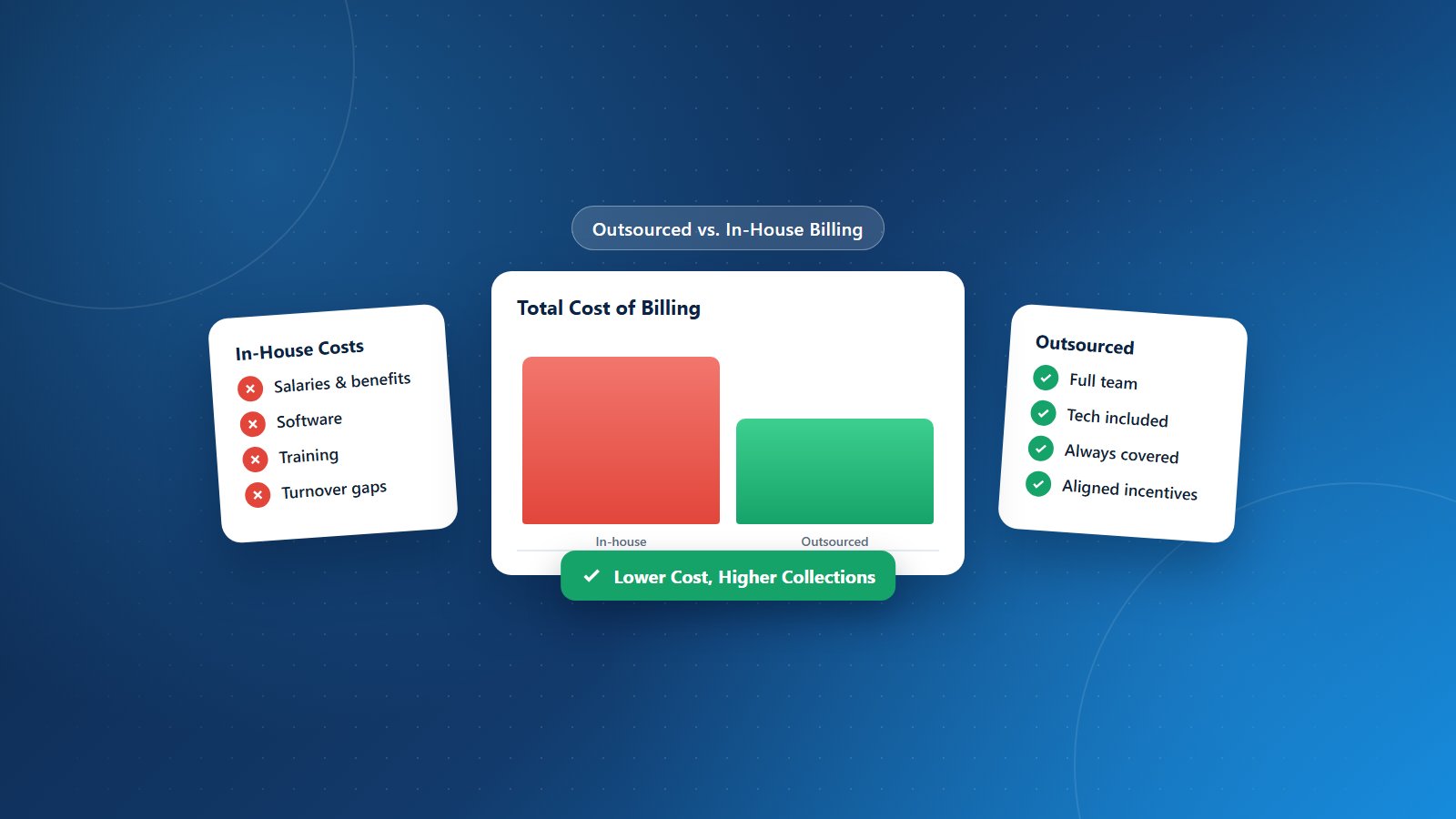
- In-house billing costs far more than salaries: benefits, software, training, turnover, management time and lost revenue all count.
- Outsourced billing bundles a trained team, technology and specialty expertise, often for a fee tied to collections.
- In-house can work well for larger practices with stable, experienced billing leadership and strong metrics.
- Make the decision with your own numbers: total billing cost, cost to collect, net collection rate, denial rate and days in A/R.
- Hybrid models, where some work stays in-house, are common and often the best fit.
Every practice eventually faces the question: should we keep billing in-house or outsource it to a medical billing company? Many practices compare only the obvious costs, such as a biller’s salary versus a billing company’s fee, and stop there. But the true cost of billing includes much more: benefits, software, training, turnover, management time and, most importantly, the revenue that never gets collected.
This guide breaks down the real costs and trade-offs of outsourced vs. in-house medical billing, walks through a cost comparison you can run with your own numbers, and explains when each model, or a hybrid, makes the most sense.
What Billing Actually Involves
Before comparing models, it helps to list the work that has to happen no matter who does it:
- Eligibility and benefits verification before visits
- Prior authorization requests and tracking
- Charge entry and coding
- Claim scrubbing and submission
- Clearinghouse rejection work
- Payment posting and reconciliation
- Denial management and appeals
- A/R follow-up with every payer
- Patient statements, calls and payment plans
- Credentialing and payer enrollment maintenance
- Reporting and performance analysis
In a small practice, one or two people may be expected to do all of this. That’s where gaps appear.
The True Cost of In-House Billing
Staffing costs
Salaries are only the start. In-house billing also requires payroll taxes, health insurance, retirement contributions, paid time off and overtime during busy periods. Most practices need more than one person to cover the work above, and specialized skills such as certified coding often command higher pay.
Recruiting and turnover
Experienced billers and coders are in demand. Recruiting takes time and money, and every departure creates a gap. During that gap, follow-up slows, denials go unworked and knowledge about payers and workflows walks out the door. New hires often need months to reach full productivity.
Training and certification
Coding guidelines, payer policies and billing rules change every year. Staff need ongoing education, certification maintenance and time away from daily work to stay current. Without it, errors creep in.
Technology
- Practice management and billing software
- Clearinghouse fees
- Claim scrubbing, eligibility and reporting tools
- Hardware, IT support and security
Space and management time
Billing staff need workspace, equipment and supervision. Office managers and physicians often spend significant time managing billing issues, time that could go to operations or patient care.
The hidden cost: lost revenue
The biggest cost is often invisible. Missed charges, undercoding, denials that are never reworked, underpayments that go unnoticed and claims that pass timely filing limits all reduce collections. A small in-house team stretched thin rarely has time to chase every dollar.
The Cost of Outsourced Billing
Most billing companies charge a percentage of collections, a per-claim fee or a flat monthly fee. With a percentage-of-collections model, the billing company earns more only when you collect more, which aligns incentives.
Outsourcing typically includes:
- A trained team of billers, coders and A/R specialists
- Technology, clearinghouse connections and reporting
- Ongoing training and compliance updates
- Coverage during vacations, illness and staff changes
- Specialty knowledge across many payers
Check what’s included and what costs extra, such as statements, credentialing or old A/R projects.
Side-by-Side Comparison
| Factor | In-House | Outsourced |
|---|---|---|
| Staffing and benefits | Your responsibility | Included |
| Recruiting and turnover risk | High for small teams | Absorbed by the partner |
| Training and certification | Your responsibility | Included |
| Software and clearinghouse | Often separate costs | Often included |
| Coverage during absences | Gaps likely | Team-based continuity |
| Specialty expertise | Depends on hires | Broad experience |
| Control | Direct oversight | Shared through reporting and communication |
| Incentives | Salary regardless of results | Typically tied to collections |
| Scalability | Hire as you grow | Scales with volume |
Run the Comparison With Your Own Numbers
A fair comparison takes about an hour with your financial reports. Work through these steps:
- Add up direct costs: billing salaries, payroll taxes, benefits, software, clearinghouse fees, statement printing and postage, and IT support.
- Add indirect costs: office space, training, recruiting, and the share of manager and physician time spent on billing issues.
- Calculate cost to collect: divide total billing cost by total collections.
- Review performance: net collection rate, days in A/R, denial rate and A/R over 90 days. See our guide to revenue cycle KPIs.
- Estimate the revenue gap: if your net collection rate or denial rate lags well-run practices, the difference represents revenue a stronger process could recover.
- Compare with proposals: outsourcing cost minus any recovered revenue, versus your current total cost.
Worksheet
| Line | In-house (your numbers) | Outsourced (proposal) |
|---|---|---|
| Staff salaries, taxes and benefits | __________ | Included |
| Software, clearinghouse, IT | __________ | Included / ______ |
| Training and recruiting | __________ | Included |
| Space and management time | __________ | Reduced |
| Billing fee | — | __________ |
| Estimated revenue recovered | — | __________ |
| Net annual cost | __________ | __________ |
When practices complete this exercise, they often find that in-house billing costs more than expected, and that improved collections from a stronger process can offset much or all of an outsourcing fee.
When In-House Billing Makes Sense
- Larger practices with enough volume to support a full, specialized billing department.
- Practices with experienced, stable billing leadership and strong performance metrics.
- Organizations that have invested heavily in billing technology and processes that are working well.
When Outsourcing Makes Sense
- Small and mid-sized practices that can’t justify a full billing team.
- Practices with rising denials, aging A/R or declining collections.
- Practices struggling with billing staff turnover.
- Practices adding specialties, providers or locations.
- Physicians who want to spend less time on administration. Read about how outsourced billing reduces physician burnout.
The Hybrid Option
Some practices keep certain functions in-house while outsourcing others. Common hybrid arrangements include:
- Front desk in-house, billing outsourced: staff handle check-in, eligibility and time-of-service collections; the partner handles claims, denials and A/R.
- Coding in-house, follow-up outsourced: internal coders keep clinical relationships while the partner works A/R and appeals.
- Project-based help: outsourcing old A/R cleanup, credentialing, audits or coding backlogs while daily billing stays in-house.
What Happens to Your Billing Staff?
Outsourcing doesn’t have to mean layoffs. Many practices move billing staff into patient-facing roles where their knowledge of payers and patients is still valuable: front-desk financial counseling, scheduling, prior authorizations or care coordination for chronic care management programs.
Risks to Manage When Outsourcing
- Visibility: insist on monthly KPI reporting and dashboard access.
- Data security: require a business associate agreement and clear security practices.
- Transition: agree on how existing A/R will be worked during the handover.
- Fit: choose a partner with experience in your specialty and payer mix.
- Exit: make sure the contract allows a reasonable exit and returns your data.
Related Guides
- National Doctors’ Day: How Outsourced Billing Reduces Physician Burnout
- Revenue Cycle KPIs Every Practice Should Track
- Accounts Receivable Aging: What Your A/R Report Is Telling You
- The Most Common Claim Denial Reasons and How to Fix Them
- Building a Business Continuity Plan for Your Billing Operations
- How to Choose a Medical Billing Company: 12 Questions to Ask
- Business Associate Agreements: What to Expect From Your Billing Partner
- AI in Medical Billing: Where Automation Helps and Where Experts Matter
- Holiday Season Staffing: Keeping Your Billing Cycle Moving
- Practice Overhead Benchmarks: Is Your Cost to Collect Too High?
Frequently Asked Questions
Will outsourcing mean laying off staff?
Not necessarily. Many practices reassign billing staff to patient-facing roles where their knowledge is still valuable.
How do we keep visibility into our revenue?
Choose a partner that provides regular reports and dashboard access. You should know your collections, A/R and denial trends at any time.
Is our data safe with a billing company?
Reputable billing companies follow HIPAA requirements and sign business associate agreements. Ask detailed questions about security before signing.
How long does a transition take?
It depends on your systems and payers, but a structured onboarding plan typically gets new claims flowing within weeks while existing A/R is worked in parallel.
Can we try outsourcing for part of our billing first?
Yes. A project such as old A/R cleanup or credentialing is a low-risk way to evaluate a partner before outsourcing more.
Partner With PRCM
Physicians Revenue Cycle Management delivers end-to-end medical billing and revenue cycle management with dedicated staff who work directly with your practice. With more than 25 years of experience, we help practices decrease costs, increase revenue and get paid faster.
Want a side-by-side cost comparison for your practice? Let’s connect.