Key takeaways
- Your billing partner touches nearly every dollar your practice earns, so choose on value and fit, not on the lowest fee.
- Know your own numbers and goals before you talk to vendors; it makes every conversation sharper.
- Ask every candidate the same 12 questions and score the answers side by side.
- Hold your partner accountable with clear KPIs, regular reporting and a contract you can exit.
- Watch for red flags: guaranteed results, vague reporting, weak security answers and lock-in terms.
Choosing a medical billing company is one of the most important business decisions a practice can make. Your billing partner influences how quickly you’re paid, how many claims are denied, how patients experience your billing and how much time your physicians and staff spend on administrative work. The right partner can turn a struggling revenue cycle into a predictable one. The wrong one can create problems that take months, sometimes years, to undo.
Many practices make the decision on price alone, comparing percentage-of-collections fees and choosing the lowest. But a slightly lower fee means little if collections fall, denials pile up or communication breaks down. This guide walks through the full decision: when it’s time to look for a partner, the types of billing companies, how pricing really works, the 12 questions to ask, how to compare proposals, what a good transition looks like and how to hold your partner accountable once you’ve signed.
Signs It’s Time to Look for a Billing Partner
Practices usually start looking for a billing company, or a new one, when one or more of these patterns appear:
- Collections are flat or falling even though patient volume is steady.
- Denials are rising and the team can’t keep up with rework.
- A/R is aging, with a growing share of balances over 90 days.
- Staff turnover leaves gaps every time a biller leaves or takes leave.
- Physicians are pulled into billing problems during clinic hours.
- Reporting is unclear, so nobody can say exactly how the practice is performing.
- The practice is growing through new providers, specialties or locations, and billing can’t scale.
If several of these sound familiar, a billing partner may solve more than a staffing problem. For a cost breakdown, read our comparison of outsourced vs. in-house medical billing.
Before You Start: Know What You Need
Before talking with billing companies, take stock of your own practice. Clear answers to these questions will help you evaluate proposals and ask better follow-up questions:
- What’s not working today? Rising denials, aging A/R, staff turnover, slow payments, poor reporting or physician frustration?
- What are your current numbers? Gather days in A/R, denial rate, net collection rate and the percentage of A/R over 90 days. If you don’t know them, that itself is a sign your current process lacks visibility. See our guide to revenue cycle KPIs.
- What do you want to keep in-house? Some practices keep front-desk collections and scheduling; others want the billing partner to handle everything from eligibility to patient statements.
- What other help do you need? Credentialing, audits, MIPS reporting, care management programs or accounting support can often be handled by the same partner.
Types of Medical Billing Companies
Not every billing company works the same way. Understanding the main models helps you narrow the field:
| Type | How it works | Good fit for |
|---|---|---|
| Full revenue cycle partner | Handles front-end checks through payment, denials, A/R and reporting | Practices that want one accountable partner |
| Claims-only service | Submits claims and posts payments; limited follow-up | Practices with strong in-house front end and A/R staff |
| Software-bundled billing | Billing included with a practice management or EHR product | Practices that value one system over specialized service |
| Specialty-focused company | Deep experience in one or a few specialties | Specialties with complex rules |
| Project-based support | Old A/R cleanup, audits, credentialing or coding backlog | Practices that need targeted help |
Understanding Pricing Models
Billing companies typically charge in one of three ways:
- Percentage of collections: The company receives a percentage of what it collects. Incentives align with yours, because the company earns more only when you collect more.
- Per-claim fee: A set fee for each claim submitted. Predictable, but the company is paid whether or not claims are collected.
- Flat monthly fee: A fixed fee regardless of volume. Simple, but may not scale well as volume changes.
Whatever the model, ask what’s included and what costs extra. Common add-ons include setup fees, patient statement printing and postage, clearinghouse charges, credentialing, special reports and old A/R projects. Compare total cost, not just the headline rate.
Example: comparing two proposals
Imagine two proposals. One offers a lower percentage but excludes patient statements, credentialing and work on old A/R, and provides quarterly reports. The other has a slightly higher percentage but includes statements, credentialing support, old A/R follow-up and monthly reporting with dashboard access. Once the extra fees and the value of recovered A/R are counted, the second proposal may cost less and deliver more. Always compare like with like.
The 12 Questions to Ask
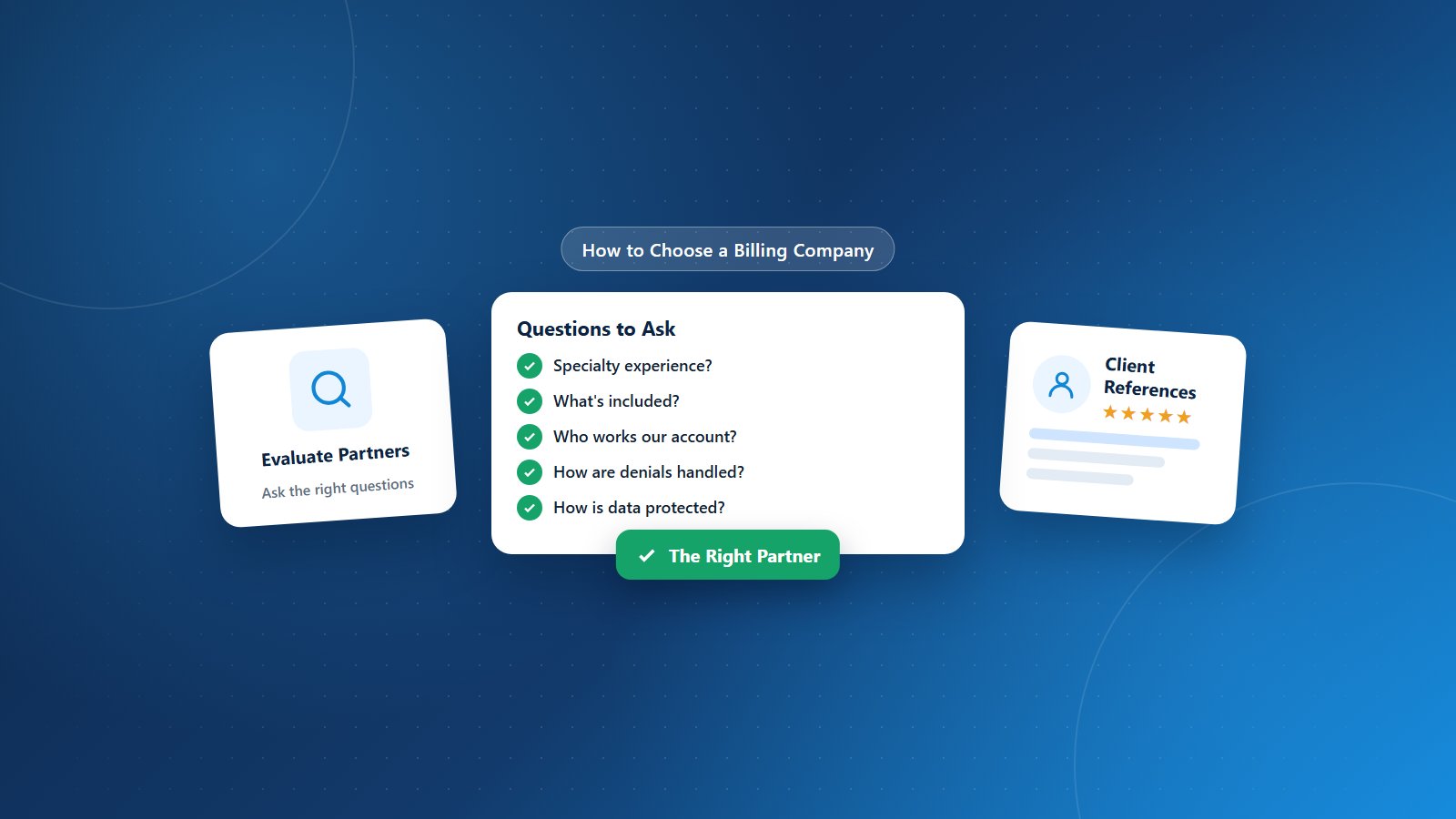
1. Do you have experience with our specialty?
Every specialty has its own codes, modifiers, authorization requirements and payer policies. Ask for examples of practices in your specialty they currently support and what specialty-specific problems they’ve solved.
2. What services are included?
Clarify whether the service covers eligibility verification, coding or coding review, claim submission, rejection management, payment posting, denial management and appeals, A/R follow-up, patient statements and calls, credentialing support and reporting.
3. How do you charge?
Get the pricing model in writing, along with every add-on fee and what triggers it.
4. Who will work on our account?
Ask whether you’ll have a dedicated account manager and consistent team, how often you’ll meet and how quickly they respond. Direct relationships with people who understand your practice make a measurable difference.
5. What are your coders’ qualifications?
Ask about certifications, specialty experience and how coders stay current with annual code updates and payer policies.
6. How do you handle denials?
A strong answer describes tracking denials by reason, working them quickly, appealing with documentation and fixing root causes. A weak answer focuses only on resubmitting claims. Learn what good looks like in our guide to denial prevention vs. denial management.
7. What reporting will we receive?
Expect regular reports on collections, A/R aging, denial rates, clean claim rates and other KPIs, ideally with dashboard access. Ask to see a sample report.
8. How do you protect patient data?
Ask about HIPAA compliance, security controls, staff training, subcontractors and whether they’ll sign a business associate agreement. Read what a BAA should cover.
9. What software and systems do you use?
Find out whether the company works within your existing practice management system, how it integrates with your EHR and who owns your data if you part ways.
10. How do you handle the transition?
Ask about the onboarding timeline, how existing A/R will be worked and how they’ll prevent claims from falling through the cracks.
11. What other services do you offer?
Credentialing, audits, MIPS reporting, care management programs and accounting support can simplify operations when one coordinated partner handles them.
12. Can you provide references?
Speak with current clients, ideally in your specialty and of similar size, about communication, responsiveness and results.
How to Compare Billing Companies Side by Side
Score each candidate from 1 to 5 on each factor, weighting the factors that matter most to your practice:
| Factor | What a strong answer looks like |
|---|---|
| Specialty experience | Current clients in your specialty and concrete examples |
| Scope of services | Full revenue cycle coverage, not just claim submission |
| Pricing transparency | All fees disclosed in writing |
| Team and communication | Named contacts and a regular meeting rhythm |
| Denial approach | Root-cause prevention plus fast, documented appeals |
| Reporting | Monthly KPI reports and dashboard access |
| Security | Signed BAA and clear security practices |
| Transition plan | Defined onboarding steps and A/R takeover process |
| References | Positive feedback from similar practices |
Red Flags to Watch For
- Guaranteed results. Promises of a specific collection increase before reviewing your data are unrealistic.
- Reluctance to share reporting or references. Good partners are proud to show their work.
- No clear contact person. If you can’t get straight answers during the sales process, it won’t improve later.
- Vague security answers. Data protection should never be an afterthought.
- Long contracts with difficult exit terms. Confident partners don’t need to lock you in.
- Pressure to decide quickly. This decision deserves proper evaluation.
What to Put in the Contract
- Scope of services, including what’s excluded
- All fees and how they’re calculated
- Reporting commitments and frequency
- Response time expectations
- Data ownership and access, including at termination
- Security responsibilities and a business associate agreement
- Handling of existing A/R at start and at termination
- Reasonable termination terms and notice periods
What the First 90 Days Should Look Like
- Discovery: The partner reviews your payers, fee schedules, workflows, A/R and denial patterns.
- Setup: System access, clearinghouse enrollment, payer connections and communication routines are established.
- Go-live: New claims flow through the partner’s process while existing A/R is worked in parallel.
- Stabilization: Early reports reveal quick wins and any issues that need attention.
- Optimization: Root causes of denials and delays are addressed, and KPIs begin to improve.
Holding Your Billing Partner Accountable
Once you’ve signed, a simple monthly review keeps the partnership on track:
- Review KPIs: net collection rate, days in A/R, denial rate, clean claim rate and A/R over 90 days.
- Review top denial reasons and the actions taken to prevent them.
- Review aged A/R by payer and the plan for each bucket. See our guide to reading your A/R aging report.
- Check payment accuracy against contracts. Read about detecting underpayments.
- Agree on next steps with owners and dates.
An annual independent check also helps. An annual billing audit confirms coding accuracy and documentation, whoever does your billing.
Related Guides
- Outsourced vs. In-House Medical Billing: A True Cost Comparison
- How Outsourced Billing Reduces Physician Burnout
- Revenue Cycle KPIs Every Practice Should Track
- Business Associate Agreements: What to Expect From Your Billing Partner
- AI in Medical Billing: Where Automation Helps and Where Experts Matter
- Coding Audits: Internal vs. External
- Credentialing a New Physician: A Step-by-Step Timeline
Frequently Asked Questions
Is outsourcing billing right for every practice?
Not every practice, but many. Small and mid-sized practices, practices with staff turnover and practices with declining collections often benefit most.
Will we lose control over our billing?
You shouldn’t. A good partner provides transparent reporting, regular communication and access to your data, so you have more visibility than before, not less.
How long does it take to see results?
Some improvements, such as faster claim submission, appear quickly. Others, such as lower denial rates and reduced aging A/R, build over the first several months as root causes are addressed.
Should we switch billing companies mid-year?
You can switch at any time with a solid transition plan. The key is making sure existing A/R is worked and no claims are dropped during the handover.
What if we’re unhappy with our current billing company?
Document the issues, review your contract terms and start evaluating alternatives with the questions above before giving notice, so there’s no gap in coverage.
Why Practices Choose PRCM
Physicians Revenue Cycle Management brings more than 25 years of experience across more than 40 specialties. Every member of our staff works directly with the practices they serve, because a partner who doesn’t understand your practice’s needs can’t truly support you. We offer end-to-end medical billing, revenue cycle management, credentialing, audits, MACRA services, care management and accounting.
Evaluating billing partners? Let’s connect and ask us all 12 questions.