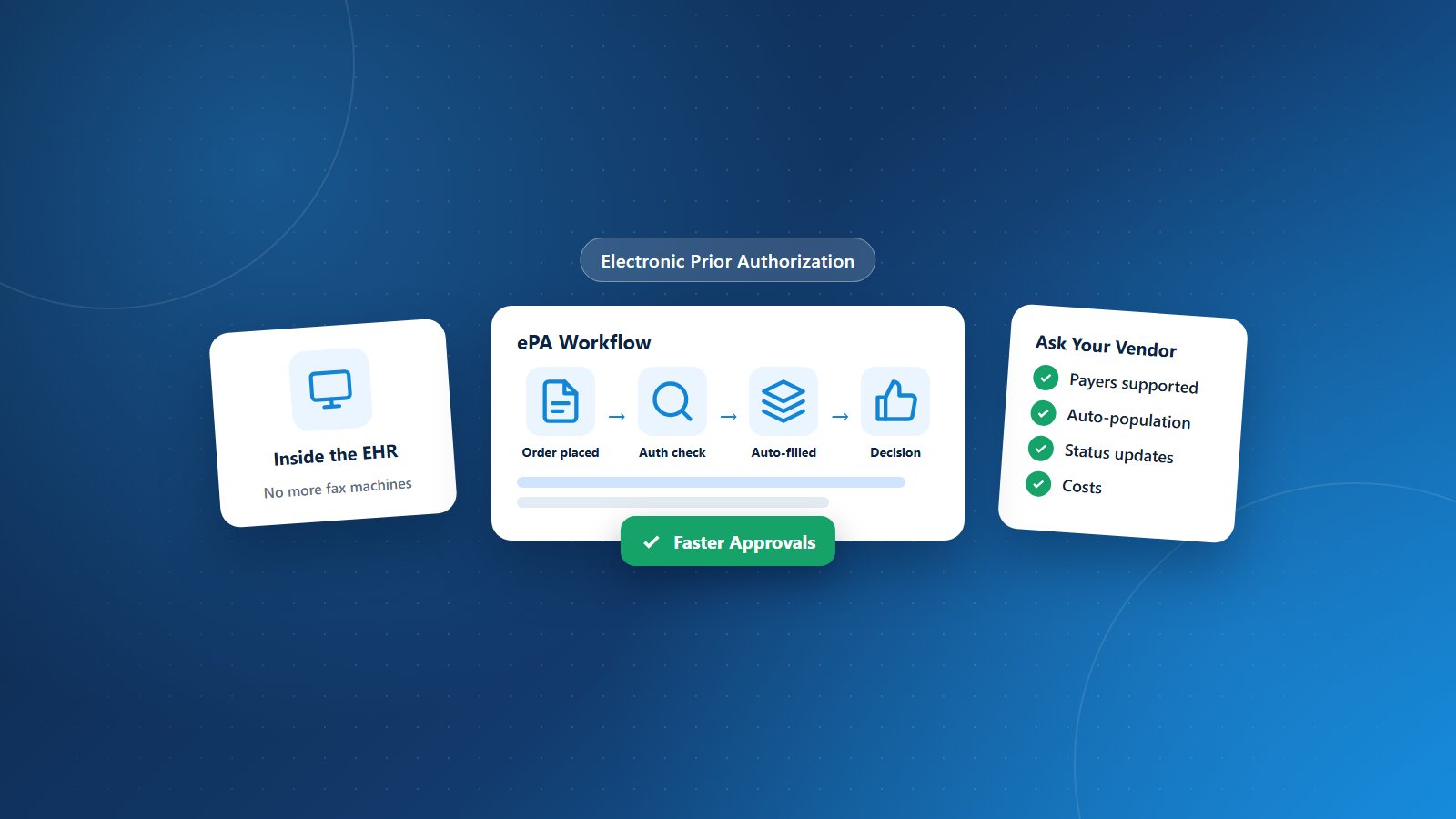
Prior authorization has long relied on fax machines, phone calls and payer portals that require staff to re-enter information already in the EHR. Electronic prior authorization (ePA) promises a better way: requests initiated from within the EHR, with payer requirements and documentation exchanged electronically and decisions returned faster. For many practices, ePA can save hours each week, but results depend on the tools and how they’re implemented.
Here are the questions to ask your EHR vendor before adopting electronic prior authorization.
What Is Electronic Prior Authorization?
ePA connects your EHR or practice management system with payer systems so staff can determine whether authorization is required, submit requests with supporting clinical information and receive decisions electronically. Some solutions automatically pull relevant documentation and payer criteria into the request.
Questions to Ask Your EHR Vendor
1. Which payers and services are supported?
ePA coverage varies. Ask which of your major payers are connected and whether both medical services and prescription drugs are supported.
2. Can the system tell us when authorization is required?
Look for tools that check payer requirements at the point of ordering, so staff don’t have to research rules manually.
3. How much documentation is auto-populated?
The biggest time savings come from automatically pulling diagnoses, notes, test results and medication history into requests.
4. Does it support payer questionnaires?
Some payers require specific clinical questions to be answered. Integrated questionnaires reduce back-and-forth.
5. How are status updates delivered?
Ask whether approvals, denials and requests for information appear in work queues automatically.
6. How does it integrate with scheduling?
Linking authorization status to scheduling prevents services from being performed without approval.
7. Are there additional costs?
Clarify licensing, transaction fees and implementation costs.
8. What reporting is available?
Reporting on turnaround times, approval rates and denials helps you measure the impact.
9. How is data secured?
Confirm HIPAA safeguards and business associate agreements for any third-party ePA vendors.
10. What training and support are provided?
Successful adoption depends on staff training and responsive vendor support.
Preparing Your Practice
- Map your current authorization workflow and volumes. See our prior authorization workflow guide.
- Identify the payers and services with the most authorization volume.
- Define who will manage ePA work queues.
- Set baseline metrics to measure improvement.
ePA Won’t Replace Expertise
Even with ePA, some requests will require phone calls, peer-to-peer reviews and appeals. Experienced authorization staff remain essential.
Authorization Support From PRCM
Physicians Revenue Cycle Management manages prior authorizations for practices across payers and helps optimize workflows, whether electronic or manual. Learn more about our practice management and revenue cycle management services.
Want the complete picture? Read our guide: Denial Prevention vs. Denial Management: Why Prevention Pays More.
Considering electronic prior authorization? Let’s connect.