Key takeaways
- Underpayments happen when payers reimburse less than your contract or fee schedule requires.
- Because the claim is still paid, underpayments often go unnoticed unless you compare payments with expected amounts.
- Load contracted rates into your system and review variance reports regularly.
- Look for patterns by payer, code and modifier, then fix them at the source.
Most practices watch denials closely, but underpayments often slip by unnoticed. A claim that’s paid, even if it’s paid less than it should be, typically gets posted and closed. Over thousands of claims, small shortfalls can add up to a meaningful amount of lost revenue every year.
This guide explains why underpayments happen, how to detect them and how to recover revenue you’re owed.
What Is an Underpayment?
An underpayment occurs when a payer reimburses less than the amount required by your contract or fee schedule. Common causes include:
- Outdated fee schedules loaded in the payer’s system
- Incorrect application of multiple procedure or bundling rules
- Modifiers processed incorrectly
- Wrong provider type or location rates applied
- Contract rate increases not implemented
- Processing errors on specific codes
Why Underpayments Go Unnoticed
- Many practices don’t have expected reimbursement loaded in their billing system.
- Payment posters focus on posting quickly, not comparing amounts.
- Contracts and fee schedules may be hard to find or interpret.
- Individual shortfalls look small.
Example: How Small Shortfalls Add Up
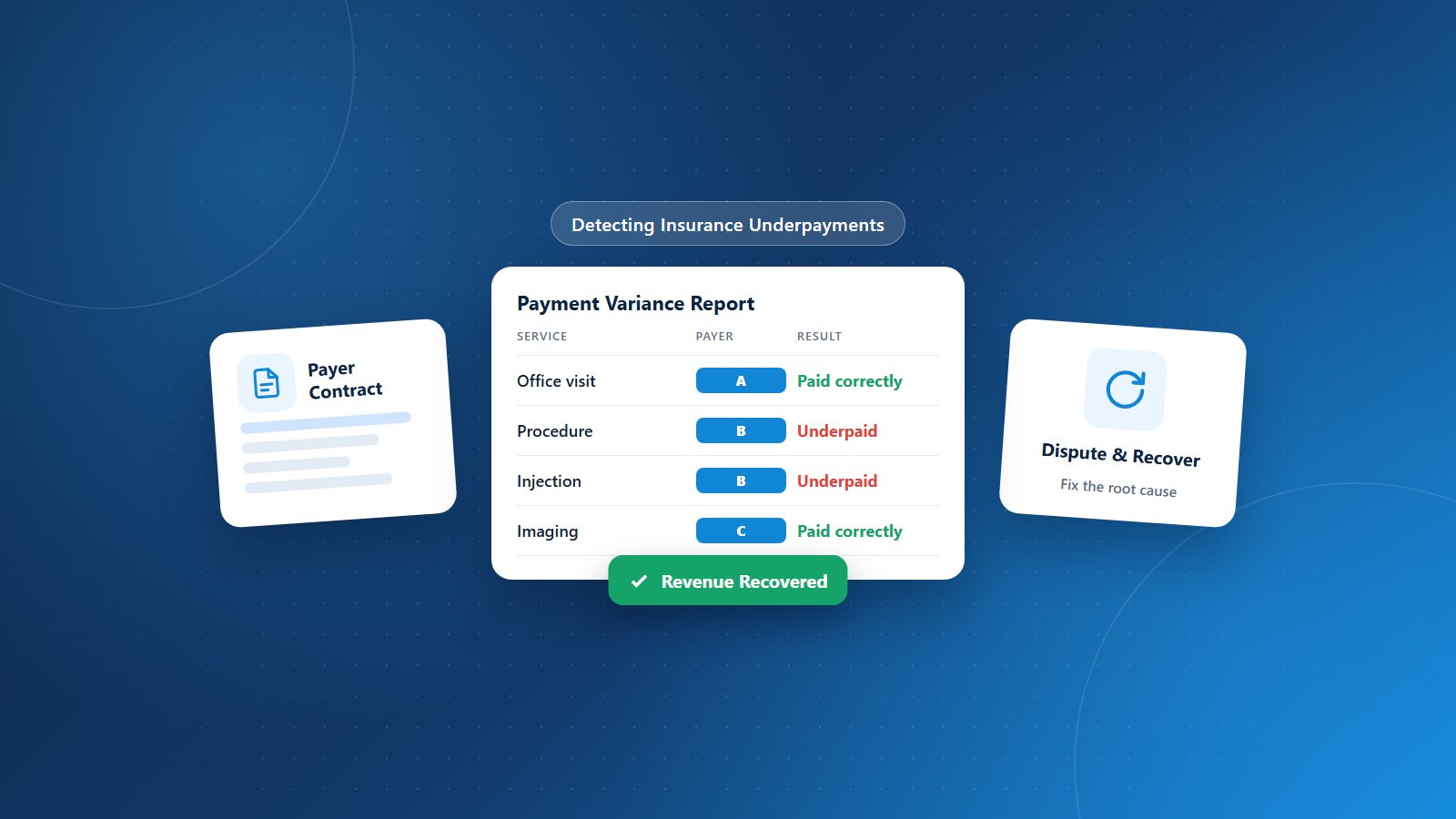
Imagine a payer that underpays a common office visit by a small amount because an old fee schedule is still loaded. Each payment looks reasonable, so nobody notices. But if that visit is billed hundreds of times a year to that payer, the shortfall becomes significant, and if the same error affects other codes, it multiplies. Variance reporting is what turns those invisible gaps into visible, recoverable revenue.
Step 1: Gather Contracts and Fee Schedules
Collect current contracts and fee schedules for each payer. If you can’t find them, request them from the payer. You can’t identify underpayments without knowing what you should be paid.
Step 2: Load Expected Reimbursement
Load contracted rates into your practice management system or a contract management tool so expected payments can be compared with actual payments automatically.
Step 3: Compare Payments to Expected Amounts
Run variance reports showing claims paid below the expected amount. Focus first on high-volume and high-dollar services.
Step 4: Look for Patterns
| Pattern | Likely cause |
|---|---|
| One code underpaid by one payer | Outdated rate or code-specific processing error |
| Many codes underpaid by one payer | Old fee schedule or missed contract increase |
| Claims with a specific modifier underpaid | Modifier processing rules |
| Second procedures underpaid | Multiple procedure reductions applied incorrectly |
| One provider or location underpaid | Enrollment or location rate setup |
Step 5: Dispute and Recover
Submit reconsideration or payment dispute requests with documentation of the contract terms. For systemic issues, contact your payer representative to correct the fee schedule and request reprocessing of affected claims.
Step 6: Watch Deadlines
Payers set time limits for disputing payments. Review payments promptly so you don’t lose the opportunity to recover.
Step 7: Monitor After Correction
After a payer fixes an issue, monitor future payments to confirm the correction holds.
Building an Underpayment Review Routine
- Daily: Payment posters flag payments that look unusually low.
- Monthly: Run variance reports by payer and code.
- Quarterly: Review patterns with leadership and escalate systemic issues.
- Annually: Confirm contract rate changes were implemented correctly.
Underpayments and Contract Negotiation
Underpayment analysis also reveals which payers pay least for your key services, valuable information for contract negotiations. Read our guide to payer contract negotiation.
Frequently Asked Questions
How common are underpayments?
They’re common enough that many practices find recoverable underpayments the first time they compare payments with contracts.
Can we recover past underpayments?
Often, within the payer’s dispute deadlines and contract terms. Act promptly and document the contracted rate.
Do we need special software?
Not necessarily. Many practice management systems can store expected amounts; contract management tools add more automation.
Recover What You’re Owed With PRCM
Physicians Revenue Cycle Management reviews payments against contracted rates as part of our revenue cycle management and audit services. We identify underpayments, dispute them and work with payers to fix the root cause. Learn which revenue cycle KPIs help catch payment problems early.
Are payers paying what they agreed to? Let’s connect.