Remote patient monitoring (RPM) and chronic care management (CCM) are two of the most effective ways for practices to support patients between visits. Both focus on chronic disease, both happen outside the office and both are reimbursable. But they’re not the same service, and choosing the right program, or using both together, depends on your patients and your practice.
Here’s a clear comparison of RPM vs. CCM to help you decide.
What Is Remote Patient Monitoring?
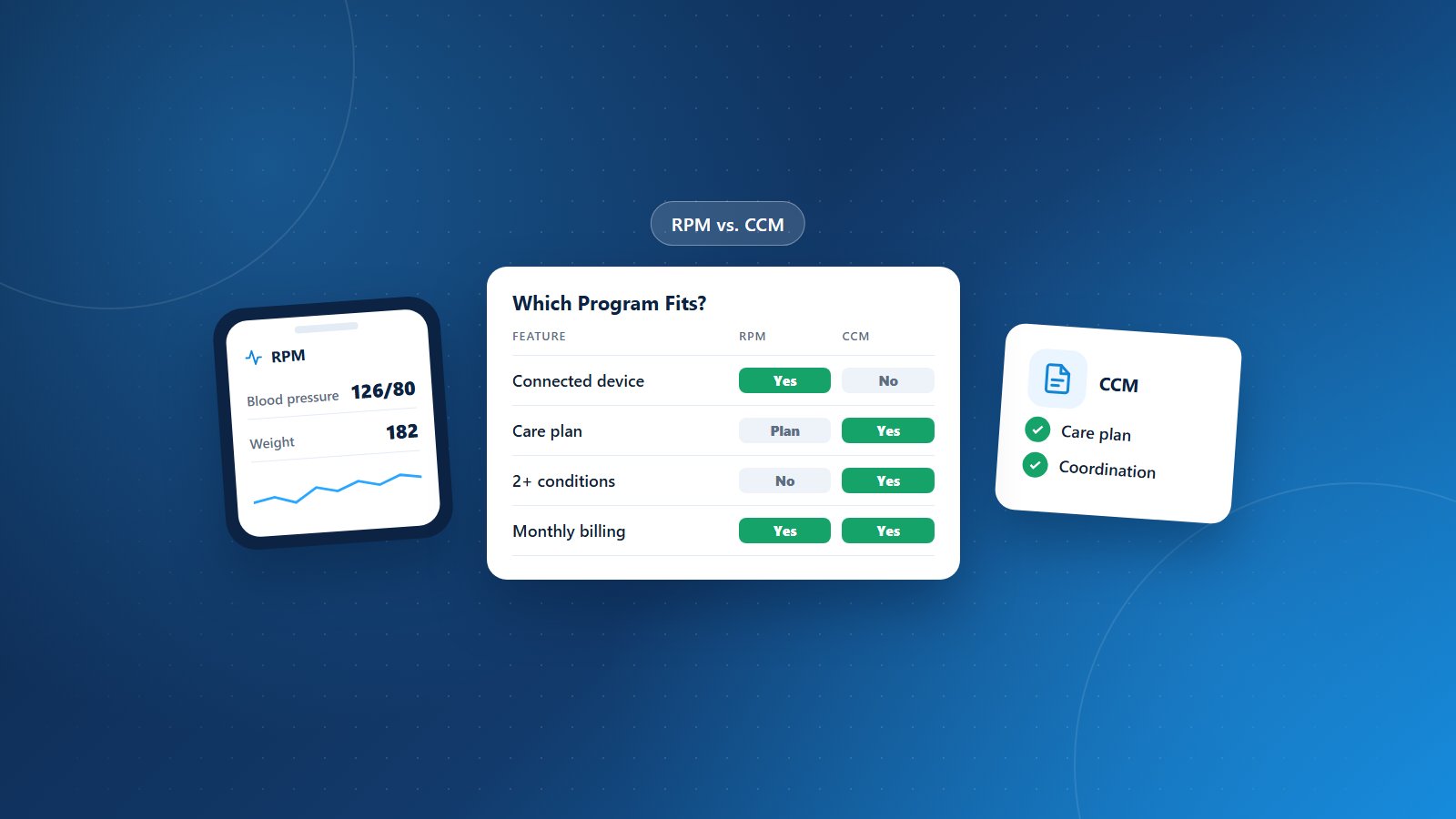
RPM uses connected medical devices such as blood pressure cuffs, glucometers, scales and pulse oximeters to collect physiological data from patients at home. The data is transmitted automatically to the care team, who review readings, identify trends and intervene when needed.
Focus: Physiological data and timely clinical response.
What Is Chronic Care Management?
CCM provides ongoing, non-face-to-face care coordination for patients with two or more chronic conditions. Care managers maintain a comprehensive care plan, manage medications, coordinate with other providers and check in with patients regularly.
Focus: Care coordination, planning and patient support.
Key Differences
| Factor | RPM | CCM |
|---|---|---|
| Core activity | Collecting and reviewing device data | Care planning and coordination |
| Patient eligibility | A condition that benefits from monitoring; can be one condition | Two or more qualifying chronic conditions |
| Devices | Required | Not required |
| Care plan | Monitoring plan tied to the condition | Comprehensive care plan required |
| Billing basis | Device supply, data days and management time | Clinical staff and practitioner time per month |
| Best for | Hypertension, diabetes, heart failure, COPD, weight | Complex patients with multiple conditions |
When RPM Is the Better Fit
- Patients need frequent readings to guide treatment, such as after medication changes.
- Your specialty focuses on a single measurable condition, such as hypertension or diabetes.
- Patients are comfortable using simple devices at home.
When CCM Is the Better Fit
- Patients have multiple chronic conditions and see several providers.
- Medication management and care coordination are major needs.
- Patients benefit from regular check-ins and education more than device data.
Can You Bill RPM and CCM Together?
In many cases, yes. RPM and CCM are distinct services, and eligible patients may receive both during the same period when each service’s requirements are met independently. The key is to avoid counting the same time toward both services and to document each program separately. Because payer rules can vary and change, confirm current requirements for each payer.
Used together, RPM provides the data and CCM provides the coordination, a powerful combination for managing complex chronic disease.
Implementation Considerations
- Staffing: Both programs require clinical staff time for outreach and documentation.
- Technology: RPM requires devices and a data platform; CCM requires care management software.
- Consent: Both require documented patient consent.
- Documentation: Accurate time tracking and records are essential for compliant billing.
Launch RPM, CCM or Both With PRCM
Physicians Revenue Cycle Management helps practices design and operate remote patient monitoring and chronic care management programs, including patient enrollment, workflows, documentation and billing.
Not sure which program fits your patients? Let’s connect.