Risk adjustment is how many payment models, including Medicare Advantage and value-based contracts, account for differences in patient health. Sicker patients are expected to need more care, so payments are adjusted based on documented diagnoses. When documentation doesn’t capture a patient’s true complexity, the result can be inaccurate risk scores, lower payments for plans and value-based arrangements, and misleading quality comparisons.
Here are documentation best practices to capture patient complexity accurately and compliantly.
How Risk Adjustment Works
Risk adjustment models use diagnosis codes, along with demographic factors, to estimate expected healthcare costs for each patient. Certain chronic and serious conditions carry more weight. Diagnoses generally need to be documented and coded from qualifying face-to-face encounters, and many must be documented each year to count.
Why Documentation Matters
- Accurate payments in risk-adjusted contracts depend on complete documentation.
- Quality and cost comparisons are fairer when patient complexity is captured.
- Audits review whether documentation supports submitted diagnoses.
Best Practice 1: Address Chronic Conditions Every Year
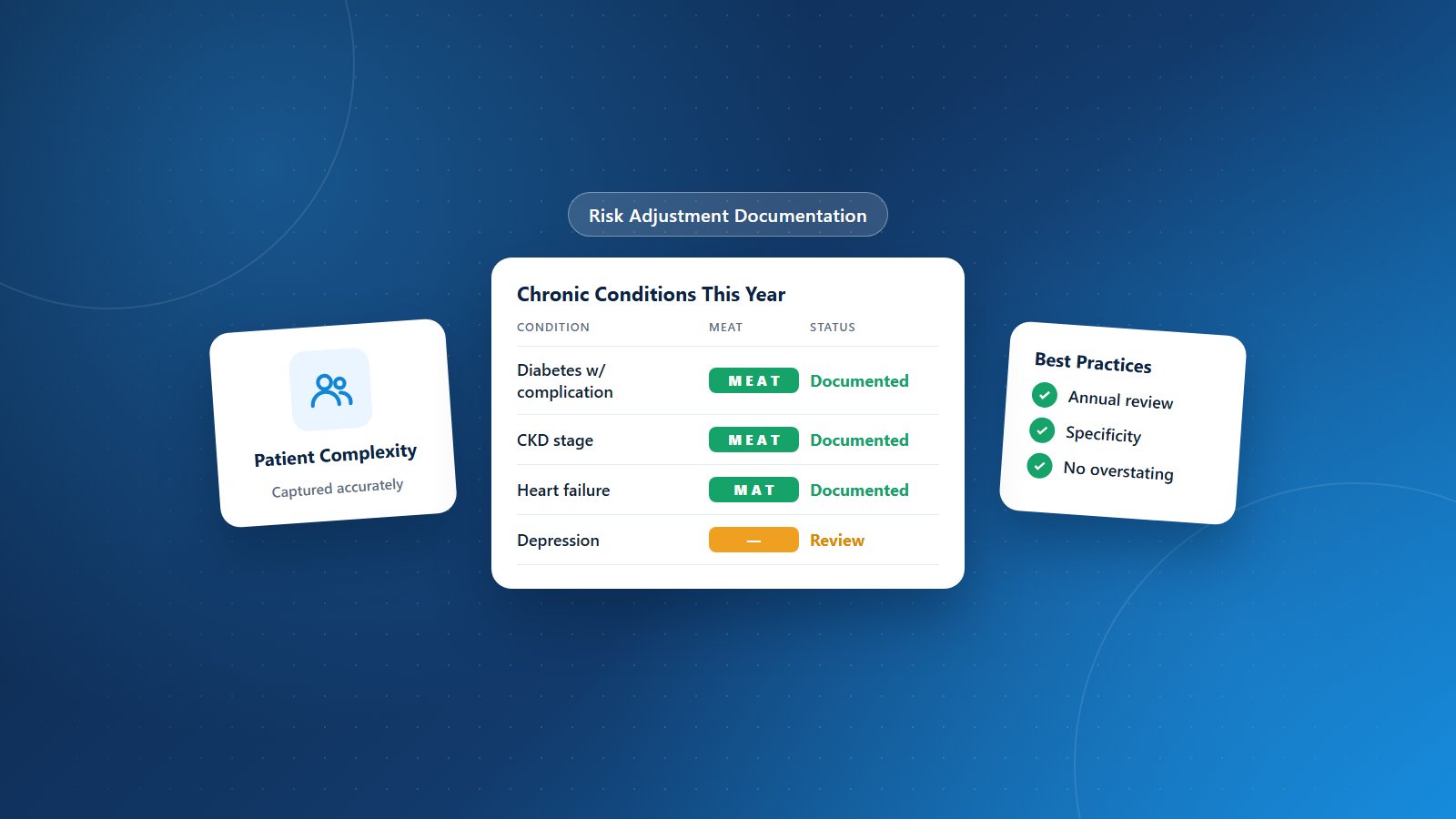
Chronic conditions don’t automatically carry forward. Each condition should be evaluated and documented during a qualifying encounter at least annually, and ideally whenever it affects care.
Best Practice 2: Use the MEAT Approach
A common framework for supporting diagnoses is MEAT: document how each condition was Monitored, Evaluated, Assessed or Treated during the visit. Listing a diagnosis without supporting detail may not hold up in an audit.
Best Practice 3: Be Specific
Specify type, severity, stage, complications and relationships between conditions when clinically supported, for example the type of diabetes and any associated complications, or the stage of chronic kidney disease.
Best Practice 4: Avoid Problem List Overreliance
Problem lists help track conditions, but diagnoses should be supported in the assessment and plan for the encounter. Outdated problem lists can also introduce resolved conditions that shouldn’t be coded.
Best Practice 5: Document Status Conditions
Conditions such as amputations, transplant status, ostomies or dialysis dependence can be relevant to patient complexity. Document them when they affect care.
Best Practice 6: Use Annual Wellness Visits Strategically
Comprehensive annual visits are an opportunity to review all chronic conditions, update documentation and close care gaps.
Best Practice 7: Never Overstate
Accuracy works both ways. Coding conditions that aren’t supported or no longer present creates compliance risk. The goal is complete and accurate documentation, not higher scores.
Best Practice 8: Educate and Audit
Provide physicians with focused education on documentation for common chronic conditions, and conduct regular documentation audits to verify accuracy.
Risk Adjustment and Medicare Advantage
For practices with many Medicare Advantage patients, plans may request records or conduct reviews. Strong documentation supports these reviews. Learn more in our guide to Medicare Advantage billing.
Documentation Support From PRCM
Physicians Revenue Cycle Management helps practices improve documentation and coding accuracy through audits, provider education and certified coding support as part of our medical billing services.
Does your documentation reflect your patients’ true complexity? Let’s connect.