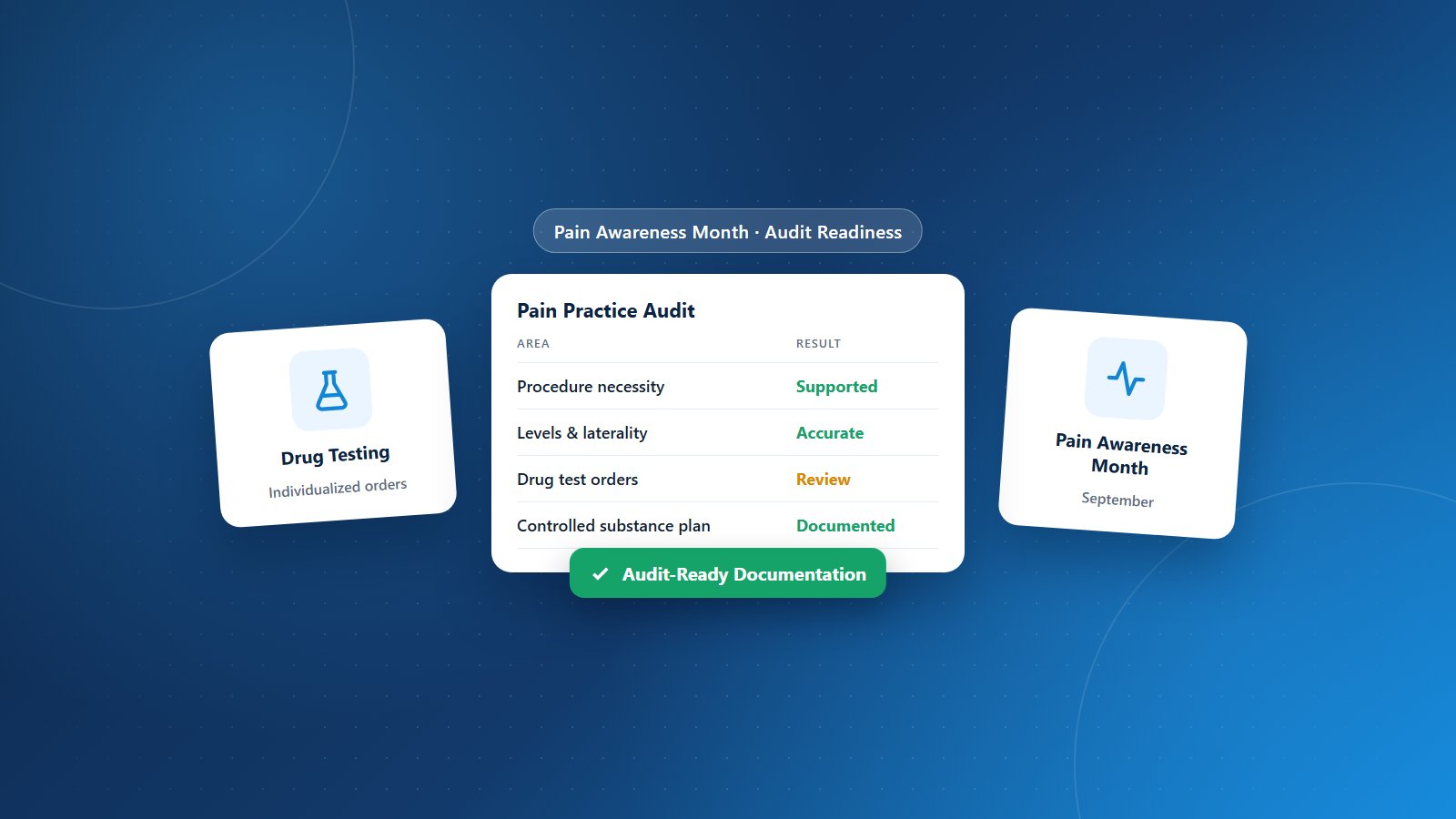
September is Pain Awareness Month. Pain management practices help patients living with chronic pain regain function and quality of life through interventional procedures, medication management and multidisciplinary care. Because the specialty involves high-value procedures, controlled substances and frequent drug testing, it receives close attention from payers. Strong documentation and regular audits are essential.
Here’s how documentation and drug testing audits reduce risk in pain management.
Why Pain Management Faces Scrutiny
- Interventional procedures are high-value and often repeated.
- Controlled substance prescribing requires careful monitoring.
- Urine drug testing is frequent and has historically been a focus of payer reviews.
- Medical necessity criteria for procedures are detailed.
Documentation Audit Focus Areas
Procedure necessity
Does documentation show conservative treatments tried, pain scores, functional limitations, imaging and the clinical rationale for each procedure? For repeat procedures, is the degree and duration of relief from prior procedures recorded?
Procedure details
Are levels, laterality, approach, imaging guidance and any drugs administered documented and coded correctly?
E/M services
Are same-day E/M services separately identifiable and properly supported?
Controlled substance management
Are treatment agreements, risk assessments, monitoring plans and reviews of prescription monitoring data documented?
Drug Testing Audit Focus Areas
Individualized orders
Testing should be ordered based on each patient’s clinical situation and risk, not by standing orders that test every patient the same way at every visit.
Medical necessity
Document why the test was ordered and how results will be used in treatment decisions.
Test type and frequency
Make sure screening (presumptive) and confirmatory (definitive) testing are used appropriately and that frequency aligns with documented risk and payer policy.
Use of results
Notes should show that results were reviewed and acted on when appropriate.
In-house vs. reference lab billing
Confirm that tests are billed by the correct entity and coded according to the testing method and number of drug classes tested.
Turning Audit Findings Into Improvement
- Update procedure and drug testing templates.
- Educate providers on documentation expectations.
- Revise drug testing policies to support individualized ordering.
- Monitor improvements with follow-up audits.
For authorization tips, read our pain management prior authorization strategies, and for lab-related guidance, our lab billing guide.
Audit Support From PRCM
Physicians Revenue Cycle Management provides pain management and toxicology-focused billing audits along with specialty billing services. See the specialties we serve.
Want the complete picture? Read our guide: Denial Prevention vs. Denial Management: Why Prevention Pays More.
This Pain Awareness Month, make sure your documentation is audit-ready. Let’s connect.