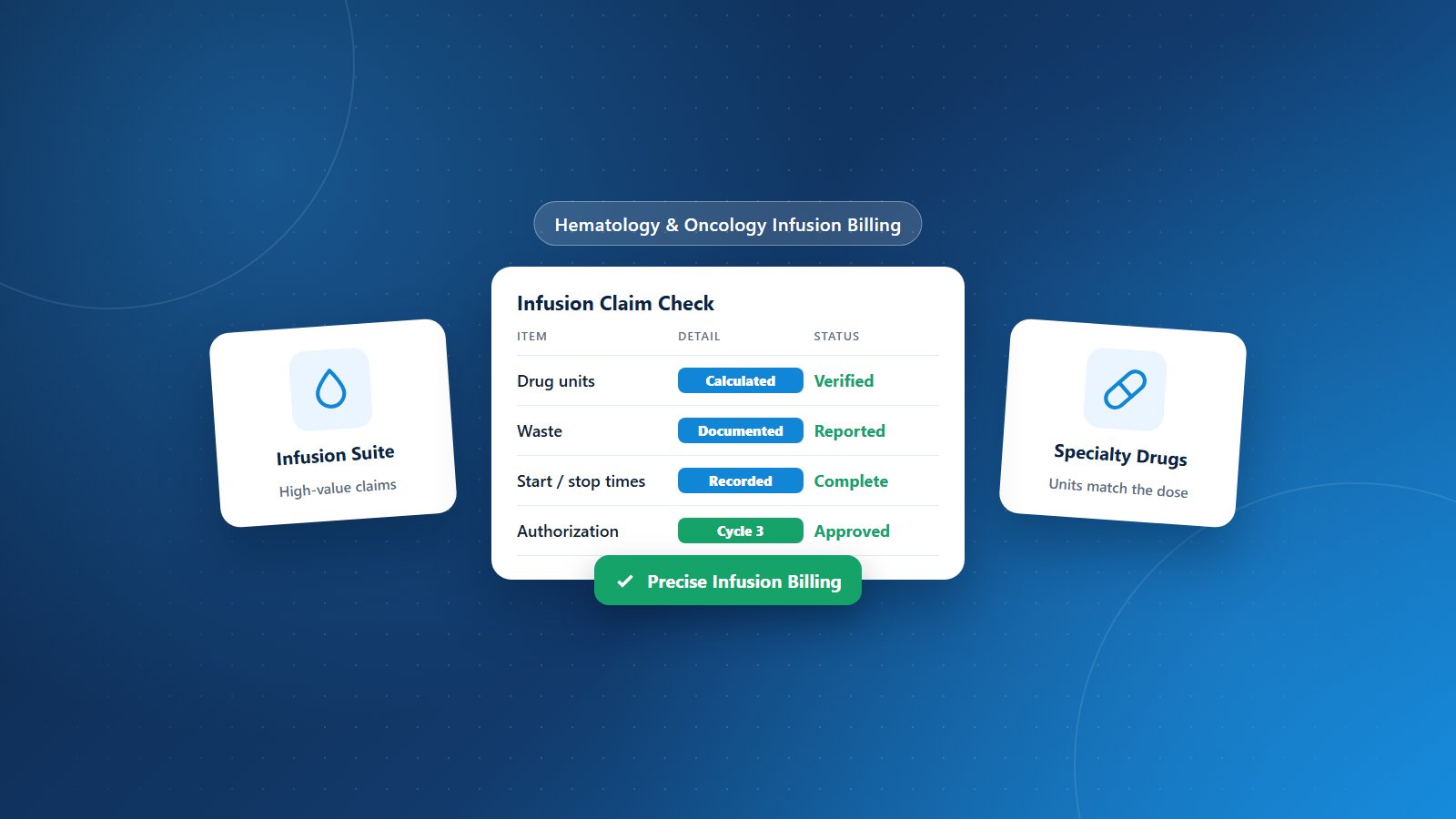
Hematology and oncology practices administer some of the most expensive drugs in medicine, including chemotherapy, immunotherapy, biologics and supportive care medications. Because a single claim can represent a significant amount of revenue, errors in drug units, administration coding or waste documentation can have an outsized financial impact. Infusion billing requires precision at every step.
Here’s how to bill drug units and document waste correctly in hematology and oncology infusion billing.
Understanding Infusion Claims
An infusion claim typically includes:
- Drug codes with units reflecting the amount administered.
- Administration codes for chemotherapy, therapeutic infusions, injections and hydration.
- Diagnosis codes supporting medical necessity.
- Waste reporting for unused portions of single-dose vials, when applicable.
Drug Unit Accuracy
Each drug code has a defined billing unit, which often differs from the vial size or the dose ordered. Units must be calculated based on the amount administered and the unit descriptor.
- Verify the billing unit for every drug in your formulary.
- Build unit calculations into your charge entry system.
- Double-check high-cost drugs before claim submission.
Waste Documentation
When part of a single-dose vial is discarded, the waste may be billable or may need to be reported according to payer rules, often with specific modifiers. Documentation should include:
- The amount administered.
- The amount discarded.
- The vial size used.
- The reason any waste occurred, when appropriate.
Payers may also require reporting when there is no waste. Follow current payer guidance for waste-related modifiers.
Administration Coding
Administration codes depend on the type of drug (chemotherapy vs. therapeutic), route, duration and sequence. Key considerations:
- Document start and stop times for every infusion.
- Identify the initial service and subsequent or concurrent services.
- Apply hierarchy rules when multiple administrations occur.
- Code hydration correctly when it’s separately reportable.
Prior Authorization
Most oncology drugs and regimens require authorization. Track authorized drugs, doses, cycles and expiration dates, and update authorization when regimens change.
Medical Necessity
Diagnosis codes must support the drug and regimen under payer policy. Document cancer type, stage, line of therapy and clinical rationale.
Drug Acquisition and Reimbursement
Compare drug acquisition costs with payer reimbursement for each drug and payer. Track inventory carefully so purchased drugs reconcile with administrations and claims.
Patient Financial Counseling
Oncology patients may face high out-of-pocket costs. Financial counselors can help with benefit explanations, assistance programs and payment arrangements.
Audit Infusion Claims
Because infusion claims are high-value, regular audits of units, waste and administration coding protect revenue and compliance. See also our infusion billing best practices for rheumatology.
Oncology Billing Support From PRCM
Physicians Revenue Cycle Management supports hematology and oncology practices with precise infusion coding, authorization management and drug reimbursement monitoring through our medical billing services. See the specialties we serve.
Protect your highest-value claims. Let’s connect.