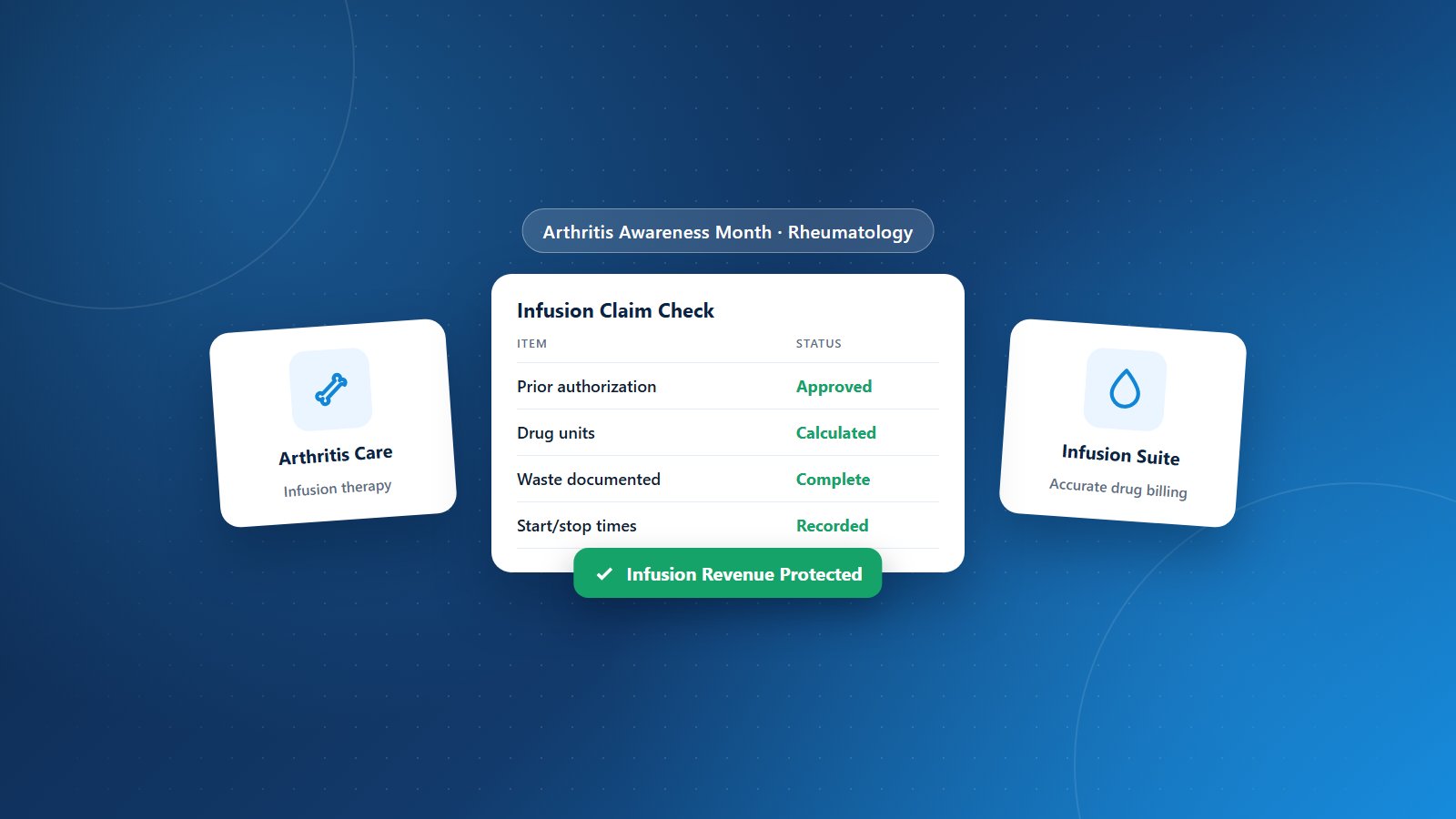
May is Arthritis Awareness Month, highlighting the millions of people living with arthritis and other rheumatic diseases. Rheumatology practices play a central role in managing these chronic, often complex conditions, and many offer in-office infusions of biologic and specialty drugs. Infusion services can be a significant part of practice revenue, but they’re also one of the most error-prone areas of rheumatology billing.
Here are best practices to help rheumatology practices code drugs and administration correctly and protect revenue.
Why Infusion Billing Is High-Risk
- Specialty drugs are expensive, so a single denial can mean a large loss.
- Drug units must be calculated precisely based on the dose administered and the billing unit for each drug.
- Administration codes depend on time, sequence and the type of infusion or injection.
- Most payers require prior authorization, often with specific clinical criteria.
- Payers may require specific drug identifiers and documentation of drug waste.
Best Practice 1: Verify Benefits and Authorization First
Before every new infusion therapy, verify whether the drug is covered under the medical benefit or pharmacy benefit, confirm authorization requirements and obtain approval. Track authorization expiration dates and the number of authorized doses so renewals happen before therapy is interrupted.
Best Practice 2: Calculate Drug Units Accurately
Drug codes have defined billing units that may not match the vial size or dose. Calculate units based on the actual dose administered and the code’s unit descriptor. Errors here either leave money on the table or create overpayment risk.
Best Practice 3: Document and Bill Drug Waste Correctly
When a single-dose vial isn’t fully used, the discarded amount may be billable or may need to be reported according to payer rules. Document the amount administered and the amount wasted in the medical record.
Best Practice 4: Code Administration Services Correctly
Infusion administration coding depends on start and stop times, whether the infusion is the initial or a subsequent service, and whether other drugs or hydration were given. Nurses should document precise times and the sequence of each drug.
Best Practice 5: Include Required Drug Identifiers
Many payers require additional drug identification information on claims. Make sure your charge entry process captures it consistently.
Best Practice 6: Support Medical Necessity
Document diagnosis, disease activity, prior treatments and response to therapy. Payers frequently review biologic claims, and strong documentation supports both authorization renewals and claim payment.
Best Practice 7: Manage Inventory and Purchasing
Buy-and-bill practices must reconcile drug purchases with administrations and reimbursements. Track inventory carefully and compare payer reimbursement with acquisition cost to understand profitability for each drug.
Best Practice 8: Audit Infusion Claims Regularly
Periodic audits of infusion claims catch unit errors, missing waste documentation and administration coding mistakes before payers do. A professional medical billing audit is especially valuable for high-dollar infusion services.
Beyond Infusions
Rheumatology patients often have multiple chronic conditions, making them strong candidates for chronic care management. Ongoing coordination supports medication adherence and better outcomes between visits.
Specialty Billing for Rheumatology Practices
Physicians Revenue Cycle Management supports rheumatology practices with coders experienced in infusion billing, authorization management and denial prevention. Our medical billing services help protect high-value infusion revenue. Explore all the specialties we serve.
This Arthritis Awareness Month, make sure your infusion billing is airtight. Let’s connect.