Ambulatory surgery centers (ASCs) offer patients convenient, high-quality outpatient surgical care, often at lower cost than hospitals. But ASC billing differs significantly from physician billing. ASCs bill facility fees, follow specific payment rules for procedures performed together, handle implants and supplies, and work with payers that each have their own requirements. Errors can be costly because each case involves substantial revenue.
Here are common ASC billing challenges and practical solutions.
Challenge 1: Procedure Coverage in the ASC Setting
Not every procedure is covered when performed in an ASC. Payers maintain lists of procedures approved for the ASC setting, and coverage can vary between payers.
Solution: Verify that each scheduled procedure is covered in the ASC setting for the patient’s payer before scheduling.
Challenge 2: Multiple Procedure Payment Rules
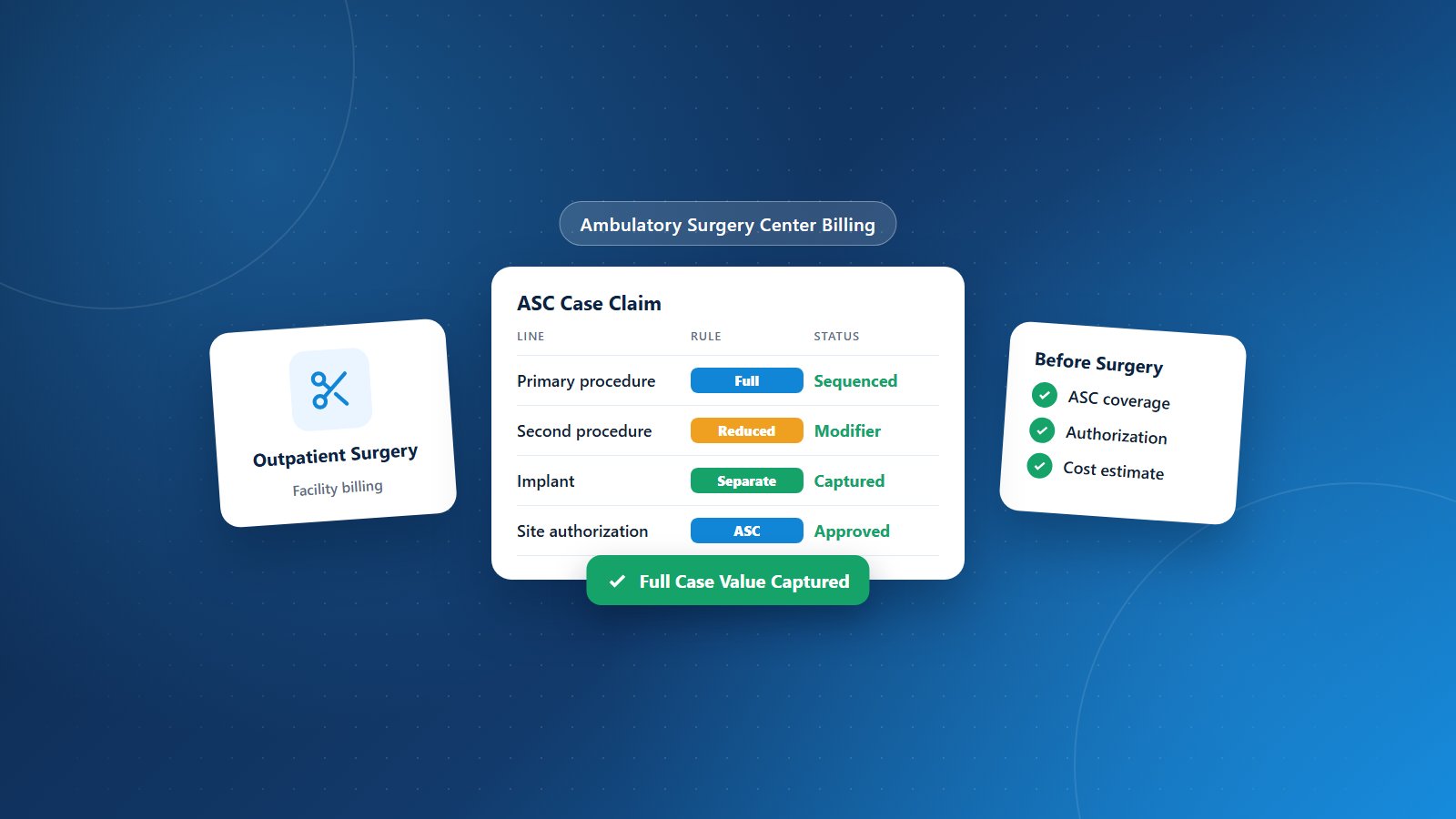
When multiple procedures are performed during the same session, payers often pay the primary procedure in full and subsequent procedures at reduced rates. Sequencing and modifier use affect payment.
Solution: Sequence procedures correctly and apply appropriate modifiers. Train coders on multiple procedure rules for each major payer.
Challenge 3: Implants and Supplies
Some implants, devices and supplies may be separately payable while others are bundled into the facility fee. Payment rules vary by payer and contract.
Solution: Track implant invoices, codes and payer rules, and make sure separately payable items are captured on claims.
Challenge 4: Prior Authorization
Many surgical procedures require prior authorization, and payers may require authorization for the specific site of service.
Solution: Verify authorization covers the procedure, provider, date and ASC location.
Challenge 5: Coordinating With Physician and Anesthesia Billing
ASC, surgeon and anesthesia claims must align in codes, dates and diagnoses. Discrepancies can trigger denials or reviews.
Solution: Share operative reports and coding promptly across all billing teams.
Challenge 6: Operative Report Turnaround
ASC claims depend on complete operative reports. Delays in documentation slow coding and claim submission.
Solution: Set expectations for timely dictation and signature, and track charge lag.
Challenge 7: Patient Financial Responsibility
Surgical patients often face significant deductibles and coinsurance.
Solution: Verify benefits, provide cost estimates in advance and collect patient responsibility before or on the day of surgery.
Challenge 8: Payer Contracts
ASC contracts vary widely in how procedures and implants are paid.
Solution: Load contract terms into your billing system and monitor payments for underpayments. Read our guide to payer contract negotiation.
ASC Billing Support From PRCM
Physicians Revenue Cycle Management supports ambulatory surgery centers with facility coding, authorization management, implant billing and payment monitoring. Our medical billing services help ASCs capture the full value of every case. See the specialties we serve.
Want cleaner ASC claims? Let’s connect.