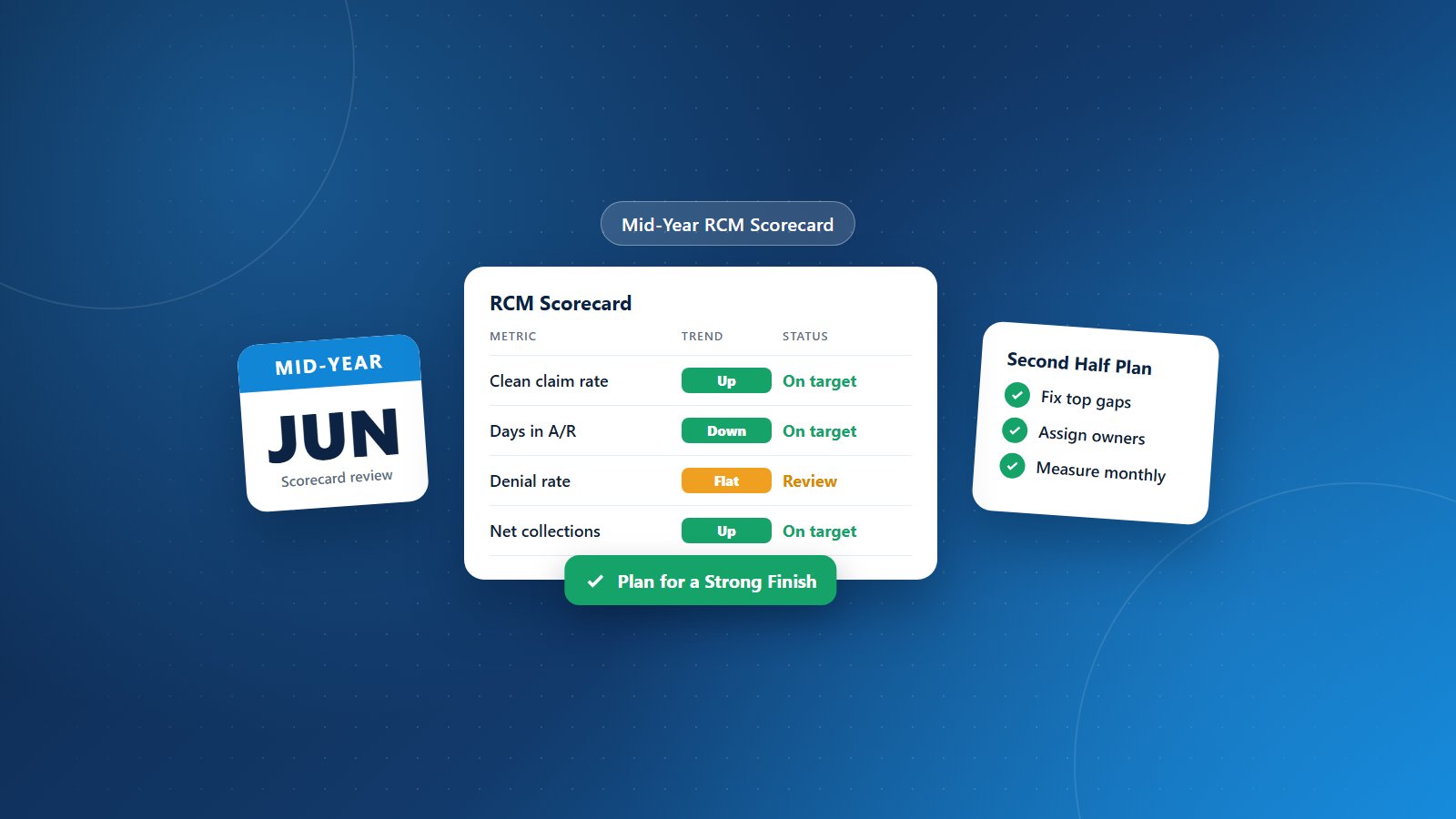
Halfway through the year is an ideal time to step back and evaluate how your revenue cycle is performing. Are claims getting paid faster or slower? Are denials rising? Are patient balances being collected? A mid-year scorecard gives you a clear picture and time to make improvements before year-end.
Use this mid-year RCM scorecard to benchmark your practice.
How to Use This Scorecard
For each metric, calculate your current result, compare it with the same period last year and with your goals, and note whether performance is improving, stable or declining. Benchmarks vary by specialty, payer mix and practice size, so focus on trends and on comparisons with similar practices.
Front-End Metrics
Eligibility-related denial rate
Measures how often claims are denied for coverage or registration issues. Rising rates point to front-desk process gaps.
Point-of-service collection rate
The share of patient responsibility collected at the visit. Higher is better.
Authorization-related denials
Tracks how often missing or invalid authorizations cause denials.
Mid-Cycle Metrics
Charge lag
The time between service and charge entry. Delays slow the entire cycle.
Clean claim rate
The percentage of claims accepted on first submission. See our guide to raising your clean claim rate.
Coding accuracy
Based on internal or external audit results.
Back-End Metrics
Days in A/R
Average time to collect payment. Lower and stable is the goal.
A/R over 90 days
The share of receivables at risk of becoming uncollectible.
Denial rate
Overall percentage of claims denied, tracked by reason.
Net collection rate
The percentage of collectible revenue actually collected.
Bad debt
Patient balances written off as uncollectible.
Cost to collect
Billing costs relative to collections. Read more about overhead and cost to collect.
Turning the Scorecard Into Action
- Identify the biggest gaps between current performance and goals.
- Find root causes for declining metrics.
- Prioritize two or three improvements for the second half of the year.
- Assign owners and deadlines.
- Re-measure monthly to track progress.
For more detail on each metric, see our guide to revenue cycle KPIs.
Mid-Year Review With PRCM
Physicians Revenue Cycle Management provides dashboards, performance indicators and practice revenue monitors, plus expert analysis to turn findings into improvements. Learn more about our revenue cycle management.
Want the complete picture? Read our guides: Denial Prevention vs. Denial Management: Why Prevention Pays More and How to Choose a Medical Billing Company: 12 Questions to Ask.
How does your revenue cycle score at mid-year? Let’s connect.