When you outsource medical billing, you share some of your most sensitive information: patient names, dates of birth, insurance details, diagnoses and treatment records. Under HIPAA, your billing company is a business associate, and the relationship must be governed by a business associate agreement (BAA). This agreement isn’t just paperwork; it defines how your patients’ information is protected.
Here’s what a business associate agreement should cover and what to expect from your billing partner.
What Is a Business Associate?
A business associate is a person or organization that performs services on behalf of a covered entity, such as a physician practice, that involve creating, receiving, maintaining or transmitting protected health information (PHI). Medical billing companies, clearinghouses, IT providers, transcription services and many software vendors are business associates.
Why a BAA Is Required
HIPAA requires covered entities to have a written agreement with business associates before sharing PHI. The BAA establishes that the business associate will appropriately safeguard information and comply with applicable HIPAA requirements. Sharing PHI with a vendor without a BAA can expose your practice to compliance risk.
What a BAA Should Include
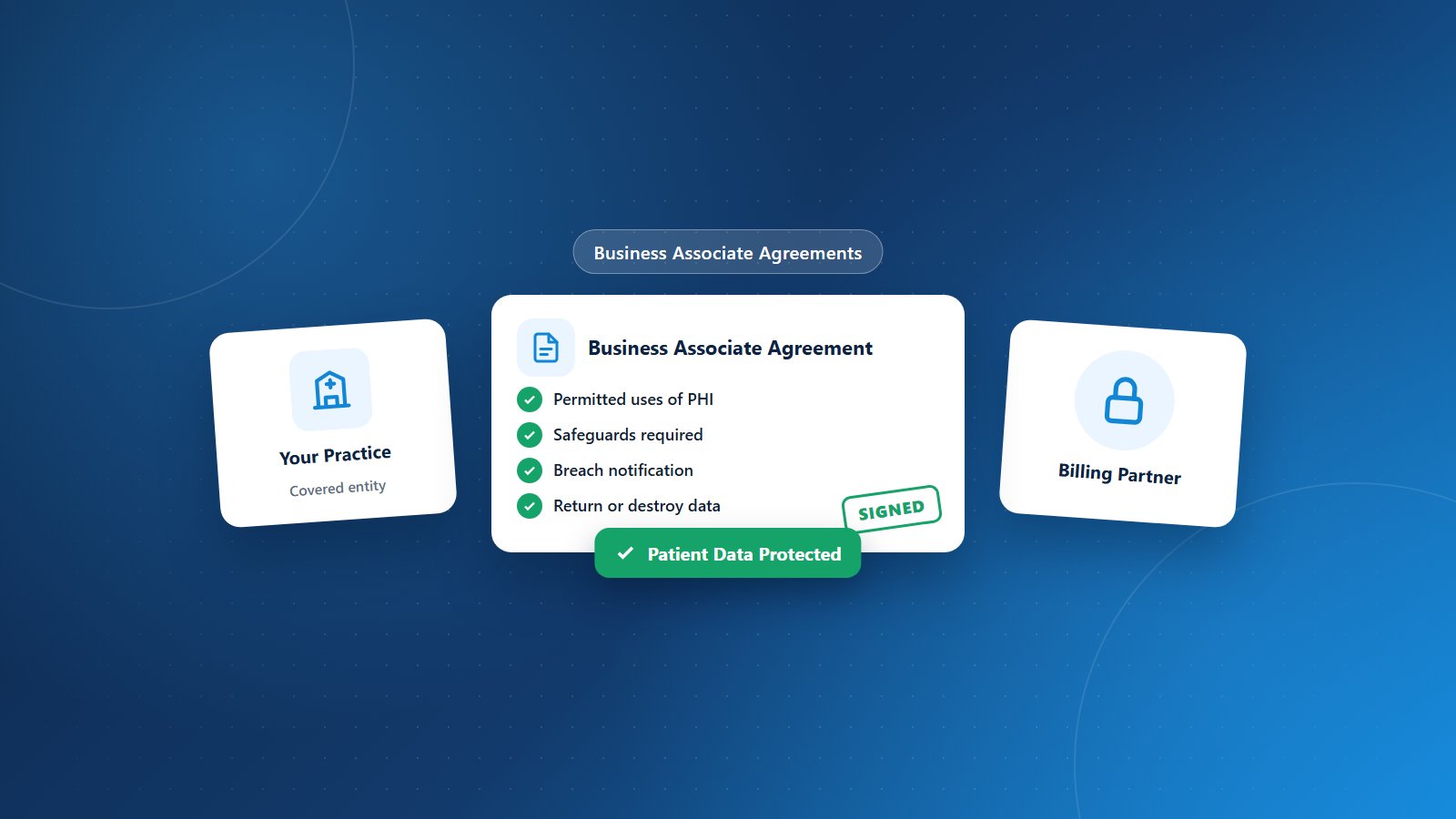
- Permitted uses and disclosures: What the billing company may do with PHI, limited to performing services for your practice.
- Safeguards: A commitment to implement appropriate administrative, physical and technical safeguards.
- Breach notification: Requirements to report breaches and security incidents to your practice.
- Subcontractors: Assurance that any subcontractors handling PHI agree to the same protections.
- Patient rights: Support for patients’ rights to access and amend their information when applicable.
- Access for compliance: Availability of records to regulators when required.
- Termination: Return or destruction of PHI when the relationship ends.
Beyond the BAA: What to Expect From Your Billing Partner
Strong security practices
Ask how the company protects data: encryption, multi-factor authentication, access controls, secure workstations, employee background checks and security training.
Regular risk assessments
Your billing partner should perform its own security risk assessments and address identified risks.
Minimum necessary access
Staff should have access only to the information needed to perform their roles.
Clear incident response
Ask how the company detects, responds to and communicates security incidents.
Secure communication
PHI should be exchanged through secure channels, never through unencrypted email or personal devices.
Questions to Ask a Billing Company
- Will you sign a business associate agreement?
- How is our data stored and protected?
- Who has access to our patient information?
- Do you use subcontractors or offshore staff, and how are they bound to HIPAA protections?
- How do you train employees on privacy and security?
- How would you notify us of a breach?
- What happens to our data if we end the relationship?
Your Practice’s Responsibilities
A BAA doesn’t eliminate your obligations. Your practice should still conduct its own HIPAA security risk assessment, train staff, maintain policies and monitor vendors.
A Trusted, Compliant Partner
Physicians Revenue Cycle Management treats patient data security as a core responsibility across our medical billing and revenue cycle management services. We work as a true partner, with every staff member working directly with the practices they serve.
Want the complete picture? Read our guide: Outsourced vs. In-House Medical Billing: A True Cost Comparison.
Want a billing partner you can trust with your patients’ information? Let’s connect.