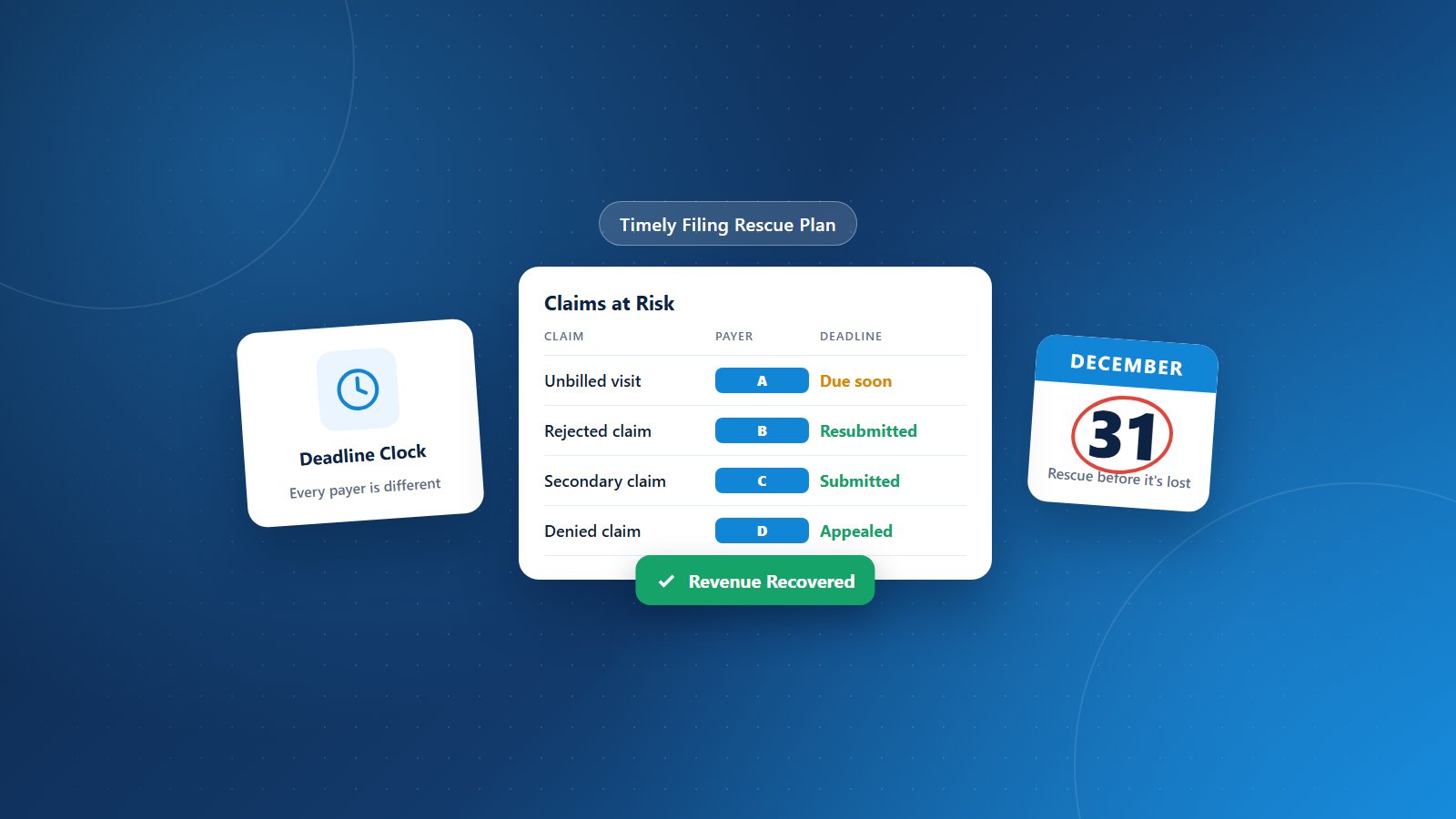
Every payer sets a deadline for submitting claims, known as the timely filing limit. Miss it, and the claim can be denied permanently, with no way to collect from the payer and, in most cases, no ability to bill the patient. Claims lost to timely filing are one of the most painful forms of revenue loss because the work was done but the payment is gone.
Year-end is the perfect time to rescue claims at risk. Here’s a timely filing action plan.
What Are Timely Filing Limits?
Timely filing limits define how long a provider has to submit an initial claim after the date of service. Payers also set deadlines for corrected claims, reconsiderations and appeals. Limits vary widely between Medicare, Medicaid and commercial payers, and individual contracts may specify their own terms.
Why Claims Miss Timely Filing
- Charges entered late because of incomplete documentation.
- Claims rejected by the clearinghouse and never corrected.
- Claims sent to the wrong payer.
- Secondary claims waiting for primary payer processing.
- Denials not worked before the appeal deadline.
- Staff turnover or coverage gaps.
Step 1: Build a Timely Filing Reference
Create a reference listing timely filing, corrected claim and appeal deadlines for each major payer, based on your contracts and payer manuals. Share it with everyone involved in billing.
Step 2: Run an At-Risk Report
Pull a report of unpaid claims by date of service and payer. Flag claims approaching each payer’s limit, prioritizing those closest to the deadline and with the highest value.
Step 3: Find Unbilled Services
Compare the appointment schedule with billed charges to find services that were never billed. Work with providers to complete outstanding documentation so claims can go out quickly.
Step 4: Clear Clearinghouse Rejections
Rejected claims never reached the payer, so the clock is still running. Review rejection reports, correct errors and resubmit.
Step 5: Work Denials Before Appeal Deadlines
Denied claims have their own deadlines for corrections and appeals. Prioritize denials by deadline and value.
Step 6: Submit Secondary Claims
Once primary payments are posted, submit secondary claims promptly with the primary payer’s remittance information.
Step 7: Keep Proof of Timely Submission
Clearinghouse acceptance reports and payer acknowledgments can prove a claim was submitted on time. Save them, because they’re often essential for overturning timely filing denials.
Preventing Timely Filing Problems
- Set internal deadlines for documentation and charge entry.
- Review clearinghouse rejections daily.
- Verify eligibility and correct payer information at registration.
- Monitor A/R aging weekly. See our guide to reading your A/R aging report.
- Cross-train staff to avoid gaps during absences.
Recover Revenue With PRCM
Physicians Revenue Cycle Management’s A/R specialists work aging claims, resolve rejections and appeal denials before deadlines pass. Our revenue cycle management team helps practices close the year without leaving revenue behind.
Want the complete picture? Read our guide: Revenue Cycle KPIs Every Practice Should Track.
Worried about claims nearing their deadlines? Let’s connect.