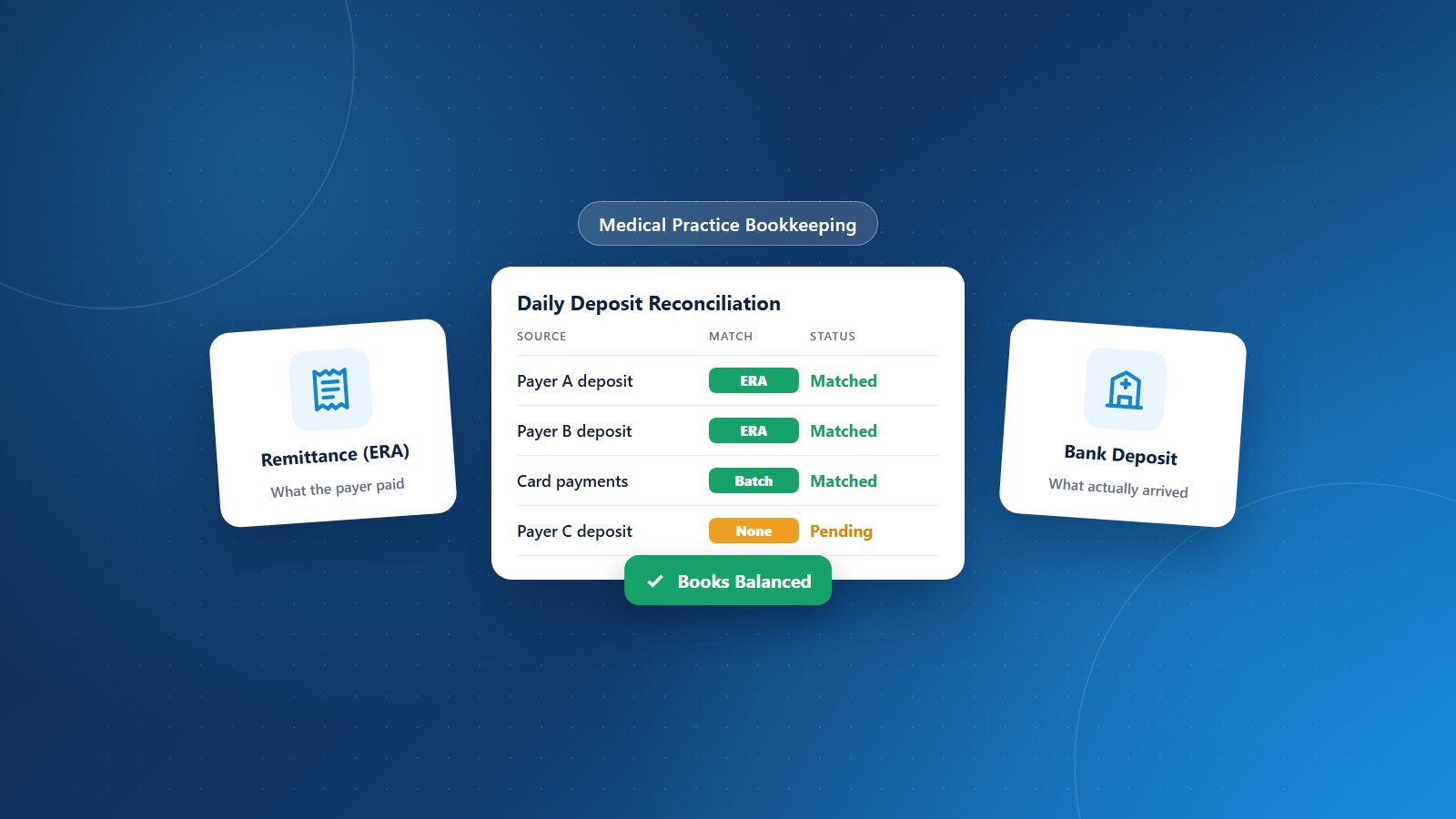
Medical practice bookkeeping has a unique challenge: revenue doesn’t arrive as neat, single payments. Insurance payers send bulk deposits covering dozens of patients, electronic remittances arrive separately from the funds, patient payments come through multiple channels and adjustments, refunds and recoupments complicate the picture. Without careful reconciliation, your books can quickly drift away from reality.
Here’s a simple process for reconciling insurance payments and deposits that keeps your practice’s financial records accurate.
Why Reconciliation Matters
- Accurate financials: You can’t make good decisions, or file accurate taxes, without reliable numbers.
- Catch missing payments: Reconciliation reveals payments that were posted but never deposited, or deposited but never posted.
- Detect errors and fraud: Regular reconciliation helps catch posting errors, misapplied payments and internal theft.
- Find underpayments: Comparing payments to expected amounts reveals payer underpayments.
Understanding the Pieces
Practice management system (PMS): Where payments are posted to patient accounts.
Electronic remittance advice (ERA): The payer’s explanation of what was paid, adjusted or denied for each claim.
Electronic funds transfer (EFT): The actual deposit into your bank account, often covering many claims.
Bank statement: The record of what actually reached your account.
Accounting software: Your general ledger and financial statements.
A Simple Reconciliation Process
Daily: Match deposits to remittances
Each day, match every bank deposit to its corresponding ERA or payment source. Make sure each ERA total matches the EFT amount and has been posted completely in the PMS.
Daily: Reconcile patient payments
Compare front-desk payments, online payments and mailed checks posted in the PMS with the day’s batch totals and card processor settlements.
Weekly: Investigate unmatched items
Research deposits without remittances, remittances without deposits and any differences. Contact payers or your clearinghouse to resolve missing information.
Monthly: Reconcile PMS to accounting
Compare total collections in your PMS with deposits recorded in your accounting system and bank statements. Differences should be explained and documented.
Monthly: Review adjustments and refunds
Review contractual adjustments, write-offs, refunds and recoupments for accuracy and appropriate approval.
Bookkeeping Best Practices
- Separate duties: The person who posts payments shouldn’t be the only person reconciling deposits.
- Use dedicated accounts: Keep practice and personal finances completely separate.
- Categorize expenses consistently using a chart of accounts designed for medical practices.
- Close the books monthly so financial statements are timely.
- Keep documentation of every reconciliation for audits and tax preparation.
Cash vs. Accrual: Understand Your Method
Many practices use cash-basis accounting, recording revenue when payments are received. Others use accrual accounting, recording revenue when services are provided. Each method affects how you read your financial statements and plan taxes. Your accountant can help determine which approach fits your practice.
Bookkeeping Support From PRCM
Physicians Revenue Cycle Management’s accounting and taxation services cover ledgers, bookkeeping, system setup, financial statements and tax returns. Because we also handle payment posting and billing, we connect your revenue cycle to your books seamlessly.
Want books you can trust? Let’s connect.