Key takeaways
- Billing problems rarely announce themselves; they show up as small shifts in denials, collections and A/R.
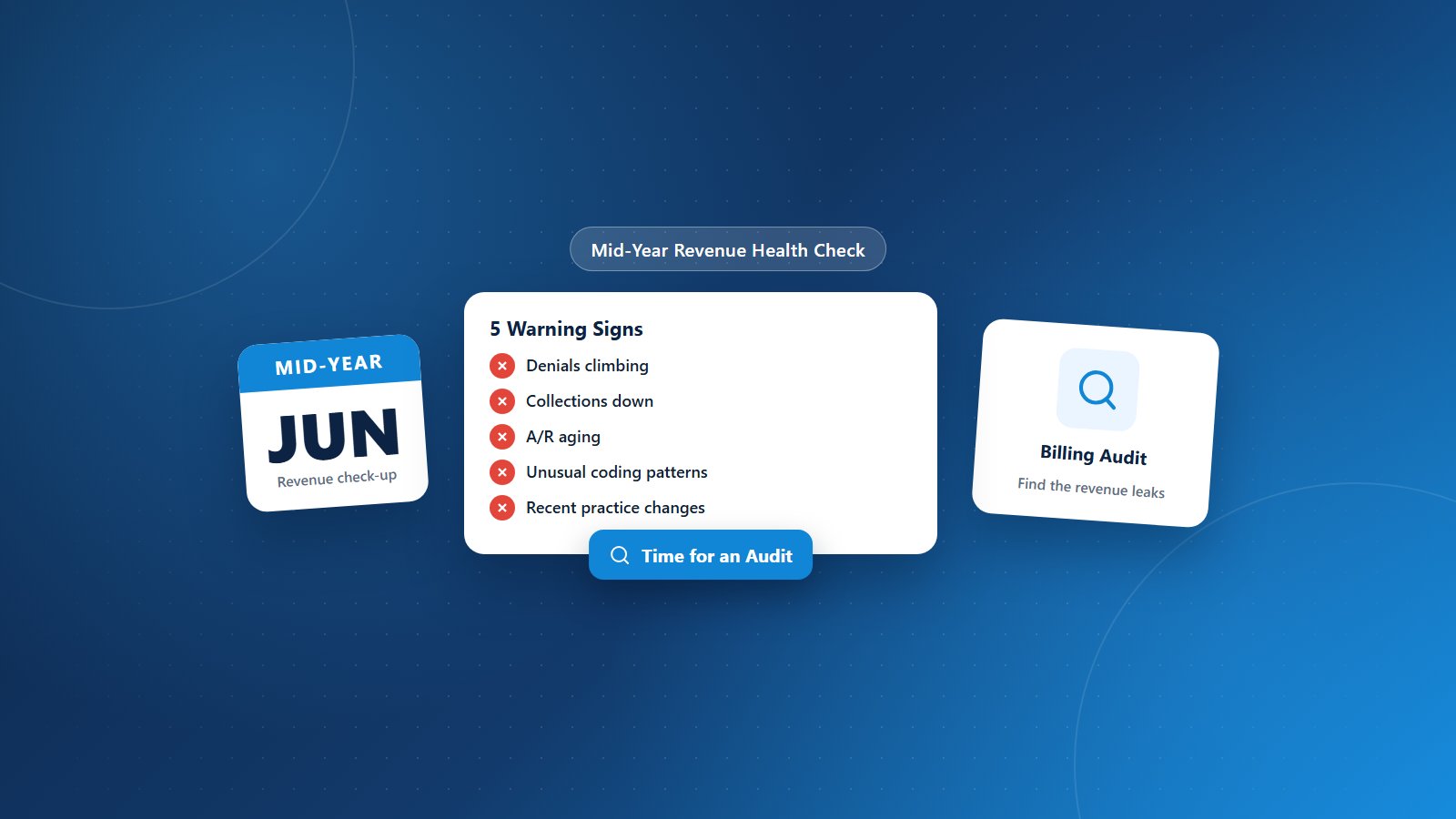
- Five warning signs point to the need for an audit: rising denials, flat collections, aging A/R, unusual coding patterns and recent practice changes.
- Mid-year is an ideal checkpoint, with enough data to see trends and time to fix them before year-end.
- Track a handful of simple metrics monthly so you spot warning signs early.
Halfway through the year is a natural checkpoint for any business. For medical practices, it’s the perfect time for a revenue health check. Billing problems rarely announce themselves loudly. They show up as small changes: collections that don’t quite match patient volume, a few more denials each week, a growing pile of aging claims. By the time the impact is obvious, months of revenue may already be lost.
Here are five warning signs that your practice needs a professional medical billing audit, plus how to measure them and what an audit will reveal.
Sign 1: Your Denial Rate Is Climbing
An increase in denials is one of the clearest indicators that something has changed, whether it’s payer policies, registration processes, coding accuracy or documentation. If your team is spending more time reworking claims than submitting new ones, it’s time to look deeper.
How to measure it: Divide denied claims by total claims submitted each month, and track the result over time. Break denials down by reason, payer and provider.
What an audit reveals: The root causes behind denials and specific fixes for each, from front-desk workflows to coding education.
Sign 2: Collections Are Down but Patient Volume Isn’t
If you’re seeing the same number of patients, or more, but collections are flat or falling, revenue is leaking somewhere. Common culprits include missed charges, undercoding, underpayments, unworked denials and claims that were never submitted.
How to measure it: Compare monthly visit counts with monthly collections, and track collections per visit over time.
What an audit reveals: Gaps between services performed, services billed and payments received.
Sign 3: Your A/R Is Aging
A growing share of accounts receivable over 90 days means claims aren’t being followed up promptly. The older a claim gets, the less likely it is to be paid at all.
How to measure it: Run an A/R aging report monthly and track the percentage of balances over 90 days, by payer.
What an audit reveals: Which payers and claim types are stuck, whether follow-up workflows are working and how much revenue is at risk of timely filing limits.
Sign 4: Your Coding Patterns Look Different From Your Peers
E/M level distributions or modifier usage that differ significantly from specialty norms can indicate undercoding (lost revenue) or overcoding (compliance risk). Payers use these comparisons to select practices for review.
How to measure it: Review the percentage of visits billed at each E/M level by provider, and how often common modifiers are used.
What an audit reveals: Whether documentation supports the codes billed and where provider education would help.
Sign 5: Something in Your Practice Has Changed
New providers, new services, a new EHR or practice management system, billing staff turnover or a change in billing company can all introduce errors. Even well-run practices benefit from a check after major changes.
What an audit reveals: Whether new workflows, templates and system settings are producing accurate claims.
A Quick Self-Assessment
| Question | If the answer is yes |
|---|---|
| Are denials higher than six months ago? | Investigate denial root causes |
| Are collections per visit declining? | Review charge capture and coding |
| Is A/R over 90 days growing? | Review follow-up workflows |
| Do providers code very differently from each other? | Review documentation and education |
| Have you changed systems, staff or services? | Validate new workflows |
| Has a payer requested records? | Get an independent review promptly |
If you answered yes to two or more, an audit is likely to pay for itself.
Other Red Flags
- Payer requests for medical records or recoupment letters
- Frequent patient complaints about billing errors
- No clear reporting on billing performance
- No audit performed in the past year
What Happens During a Billing Audit
- Define the scope: providers, services, payers and time period.
- Review a sample of claims against documentation and payer rules.
- Analyze denials, payments and A/R.
- Deliver findings with financial impact and compliance risk.
- Provide education and an action plan.
The Benefits Go Beyond Revenue
Audits help coders find and correct problem spots before payers challenge them, give administrative staff confidence that claims are accurate and support better patient care by improving documentation and tracking services.
Frequently Asked Questions
Is a mid-year audit necessary if we audit annually?
Not always, but if you see any of the warning signs above, a focused mid-year review can catch problems months earlier than waiting for the annual audit.
Can we audit ourselves?
Internal reviews are valuable for ongoing monitoring, but an external audit adds objectivity and benchmarking, especially when warning signs appear.
What does an audit cost compared with the revenue it finds?
Costs vary by scope, but audits often uncover missed charges, undercoding and unworked denials worth more than the audit itself, along with reduced compliance risk.
Get a Mid-Year Billing Audit From PRCM
Physicians Revenue Cycle Management’s medical billing audit and consulting services give practices a clear, objective view of billing performance and a roadmap for improvement. If you’d like ongoing help putting changes into practice, our revenue cycle management team can take it from there. Learn more about why every practice needs an annual audit and the revenue cycle KPIs to watch.
Seeing any of these warning signs? Let’s connect and schedule your audit.