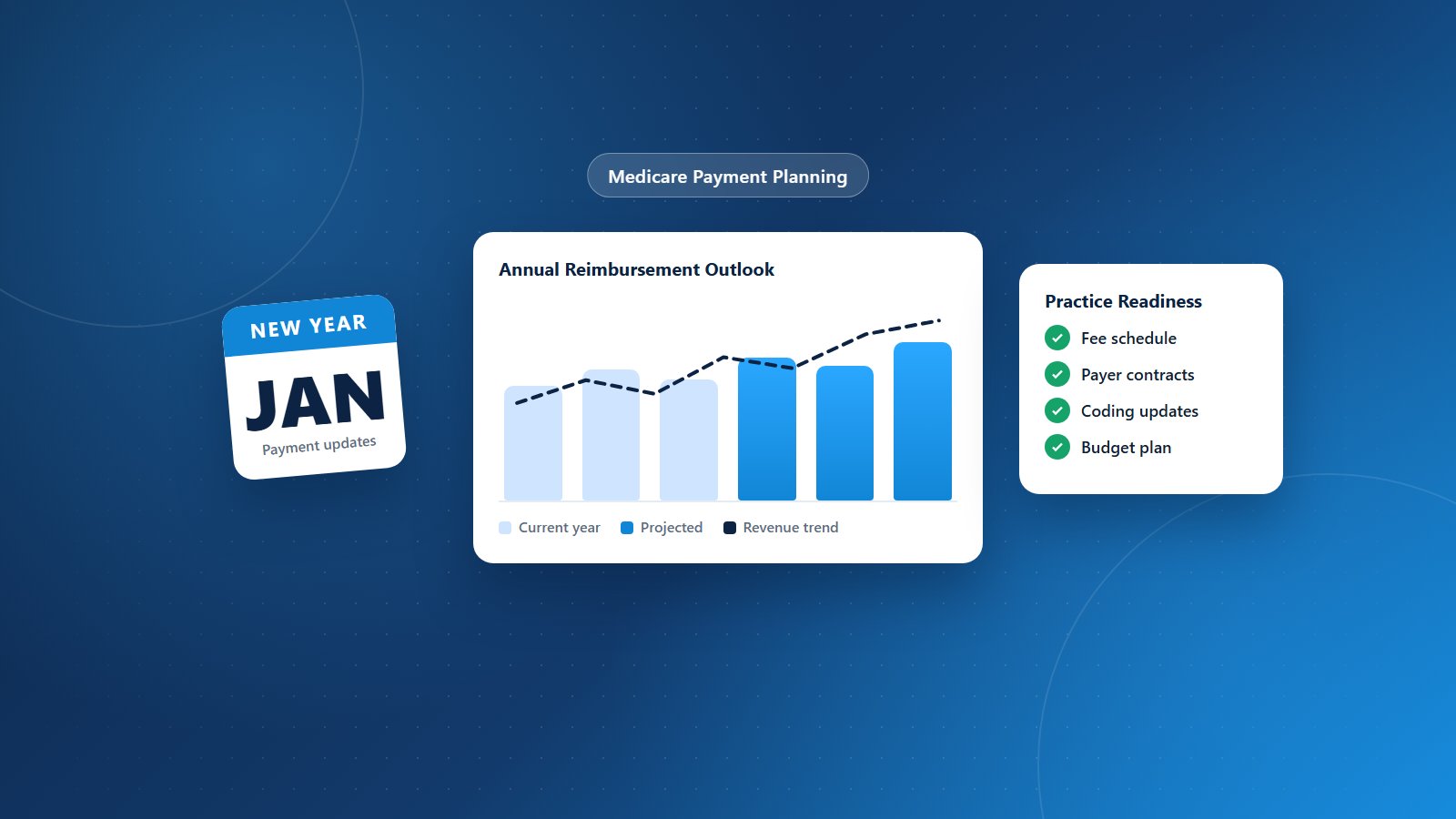
Every year, physician practices face the same question as the calendar turns: how will Medicare payment changes affect our revenue next year? Medicare reimbursement is reviewed and adjusted annually, and even small shifts can ripple through a practice’s cash flow, staffing plans and growth goals. Because many commercial payers benchmark their fee schedules against Medicare, those changes rarely stay limited to your Medicare patients.
The good news is that annual payment changes don’t have to catch you off guard. Practices that plan ahead, understand their payer mix and keep their billing operations sharp are far better positioned to absorb adjustments and protect their margins. This guide walks through practical steps to prepare your practice for Medicare payment changes for physicians, no matter what direction they take in a given year.
Why Annual Medicare Payment Changes Matter to Every Practice
Medicare payments for physician services are built from several moving parts: the relative value assigned to each service, geographic adjustments for where care is delivered, and a national conversion factor that turns those values into dollars. Each of these can be updated from year to year, along with coverage policies, documentation expectations and the list of services that can be billed.
For a practice, this means the same visit or procedure may be reimbursed differently next year than it is today. The impact depends on:
- Your specialty and service mix. Practices that rely heavily on certain procedures or diagnostic services can feel changes more sharply than those focused on office visits, and vice versa.
- Your payer mix. The larger your share of Medicare and Medicare Advantage patients, the more directly payment updates affect your bottom line.
- Your commercial contracts. Many commercial agreements are tied to a percentage of Medicare rates, so an adjustment can automatically flow into those payments too.
- Your operating efficiency. A practice with high denial rates or slow collections has less room to absorb any reduction in reimbursement.
Step 1: Understand Your Current Revenue Picture
You can’t plan for change without a clear view of where your revenue comes from today. Before the new year, pull reports from your practice management system and answer a few key questions:
- What are your top 20 billed services by volume and by total revenue?
- What percentage of your collections comes from Medicare, Medicare Advantage, Medicaid, commercial plans and self-pay patients?
- Which commercial contracts are tied to Medicare rates, and how?
- What are your current days in accounts receivable, denial rate and net collection rate?
This baseline lets you model how different payment scenarios would affect your practice. If your highest-volume services are the ones most likely to see adjustments, you’ll know where to focus your planning.
Step 2: Review Your Fee Schedule and Payer Contracts
Annual payment updates are a natural moment to review both your own fee schedule and your payer agreements.
Update your chargemaster
Your practice’s standard charges should always be at or above what any payer will reimburse. If your fees are set too low, you may be leaving money on the table with payers that pay a percentage of billed charges. Review your fee schedule at least once a year and adjust it so it reflects current market reimbursement.
Revisit commercial contracts
Look closely at contracts that reference Medicare rates. Do they use the current year’s rates or a fixed year? Do they include escalators or renegotiation clauses? Understanding these terms helps you predict how commercial payments will move and identify contracts worth renegotiating.
Step 3: Tighten Your Revenue Cycle Before the New Year
When reimbursement per service is under pressure, every claim that goes unpaid matters more. Strengthening your revenue cycle is the most reliable way to protect income regardless of what happens with payment rates.
- Reduce denials at the source. Most denials stem from registration errors, eligibility issues, missing authorizations and coding mistakes. Track your denial reasons and fix the workflows behind them.
- Work aging accounts receivable. Follow up on outstanding claims before year-end so they don’t slip past timely filing limits.
- Improve charge capture. Make sure every billable service, including care management and add-on services, is documented and billed.
- Speed up payment posting. Fast, accurate posting reveals underpayments and denials sooner, so your team can act on them.
A well-run revenue cycle management process often recovers more revenue than a modest payment adjustment takes away.
Step 4: Prepare Your Coding and Documentation
Annual updates frequently bring changes to codes, documentation guidelines and billing rules. To stay ahead:
- Schedule coding education for providers and billing staff before the new year begins.
- Update EHR templates, superbills and charge entry screens so they reflect current codes.
- Review documentation for your most common services to confirm it supports the level of service billed.
- Consider a professional medical billing audit to identify coding gaps and compliance risks before payers do.
Accurate coding ensures you are paid appropriately for the work you perform, which becomes even more important when reimbursement tightens.
Step 5: Explore Additional Revenue Opportunities
Payment changes are a good prompt to look at services your practice may be underusing. Many practices qualify to offer programs that improve patient outcomes while creating steady, recurring revenue:
- Chronic Care Management for patients with two or more chronic conditions who benefit from ongoing coordination between visits.
- Remote Patient Monitoring for patients with conditions such as hypertension or diabetes, where regular readings support better care decisions.
- Annual wellness and preventive services that help patients stay on track and keep your schedule consistent.
These services require proper setup, consent and documentation, but when implemented correctly they diversify your revenue and reduce your dependence on any single payment rate.
Step 6: Protect Your Quality Program Performance
For many practices, Medicare payments are also influenced by performance in quality reporting programs. A strong score can protect or improve future payments, while poor or missing reporting can result in reductions. Make sure you understand your reporting requirements, track your measures throughout the year rather than at the last minute, and get expert support if your team lacks the bandwidth. Our MACRA and MIPS services help practices stay on top of reporting so performance adjustments work in their favor.
Step 7: Build a Flexible Budget
With your revenue picture and payment scenarios in hand, build a budget for the coming year that can flex if reimbursement shifts. Consider:
- Modeling best-case, expected and conservative revenue scenarios.
- Reviewing overhead, including staffing, supplies, software and space, for savings opportunities.
- Timing major purchases and hires to match expected cash flow.
- Building a cash reserve to cover slower payment periods early in the year, when patient deductibles reset.
Our accounting and taxation team can help you translate payment trends into a realistic financial plan.
How an Experienced Billing Partner Helps
Keeping up with annual payment changes while running a busy practice is a lot to manage. An experienced billing partner monitors updates on your behalf, adjusts workflows and fee schedules, educates your team and keeps claims moving so changes don’t disrupt your cash flow.
At Physicians Revenue Cycle Management (PRCM), we bring more than 25 years of medical billing and practice management experience to independent physicians and multi-specialty groups. From end-to-end medical billing to audits, credentialing and financial planning, we help practices stay prepared for whatever each new year brings.
Prepare Your Practice With Confidence
Annual Medicare payment changes are a constant in healthcare, but their impact on your practice is not fixed. By understanding your revenue, reviewing contracts, strengthening your revenue cycle and exploring new services, you can turn uncertainty into a plan.
Ready to protect your practice’s revenue in the year ahead? Let’s connect to discuss how PRCM can support your billing, reporting and financial planning.