Surgical procedures often come with a global period: a defined timeframe during which related pre-operative and post-operative care is included in the payment for the surgery. For general surgeons, neurosurgeons, orthopedic surgeons, thoracic surgeons and other proceduralists, understanding global periods and the modifiers that apply within them is essential. Billing services that are included leads to denials; failing to bill services that are separately payable leaves revenue behind.
Here are the modifiers every surgical practice should know.
What’s Included in the Global Surgical Package
The global package generally includes:
- Pre-operative visits after the decision for surgery, within a defined window.
- The procedure itself.
- Typical post-operative care, including follow-up visits and routine wound care.
- Management of routine complications that don’t require a return to the operating room.
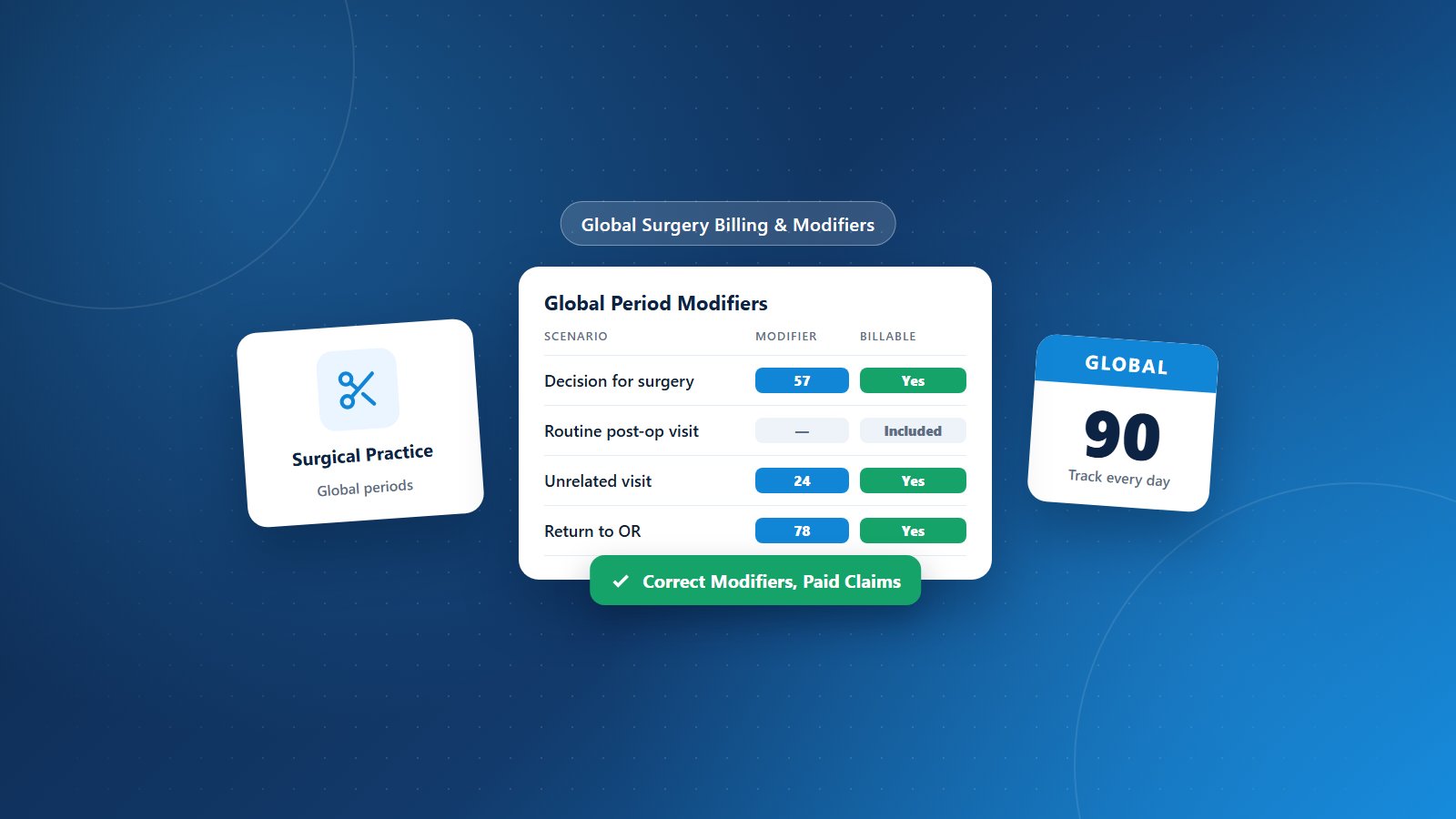
Global periods vary by procedure, commonly zero, 10 or 90 days. Check the global period for each procedure your practice performs.
Key Modifiers for Surgical Practices
Decision for surgery (modifier 57)
Used on an E/M service that resulted in the initial decision to perform a major surgery, typically on the day before or the day of surgery. Documentation should clearly show the decision was made at that visit.
Significant, separately identifiable E/M (modifier 25)
Used when a significant E/M service is provided on the same day as a minor procedure, beyond the usual pre-procedure evaluation. Read our modifier 25 guide.
Unrelated E/M during the post-operative period (modifier 24)
Used when a patient is seen during the global period for a problem unrelated to the surgery. Documentation and diagnosis should clearly show the visit isn’t related to the procedure.
Staged or related procedure (modifier 58)
Used when a procedure during the global period was planned at the time of the original surgery, is more extensive than the original, or is therapy following a diagnostic procedure.
Unplanned return to the operating room (modifier 78)
Used when a patient returns to the operating room for a related procedure, such as treating a complication, during the post-operative period.
Unrelated procedure during the post-operative period (modifier 79)
Used for a procedure during the global period that is unrelated to the original surgery.
Distinct procedural service and multiple procedures
Other modifiers indicate distinct procedures, bilateral procedures or multiple procedures in the same session. Correct use depends on documentation of separate sites, sessions or incisions.
Best Practices
- Track global periods in your practice management system so staff know when visits are included.
- Document the relationship (or lack of relationship) between post-operative visits and the surgery.
- Use specific diagnosis codes that distinguish unrelated problems.
- Train providers on when each modifier applies.
- Audit modifier usage regularly through a billing audit.
Surgical Billing Support From PRCM
Physicians Revenue Cycle Management supports general surgery, neurosurgery, thoracic surgery and other surgical specialties with global period tracking and accurate modifier use through our medical billing services. See the specialties we serve.
Want global periods and modifiers handled correctly? Let’s connect.