Federally Qualified Health Centers (FQHCs) serve millions of patients in underserved communities, providing primary care, dental, behavioral health and enabling services regardless of ability to pay. FQHCs operate under a unique payment structure that differs significantly from private practice billing. Staff who come from private practice settings often find FQHC billing rules unfamiliar and complex.
Here are the key differences in FQHC billing and how to stay compliant.
Difference 1: Encounter-Based Payment
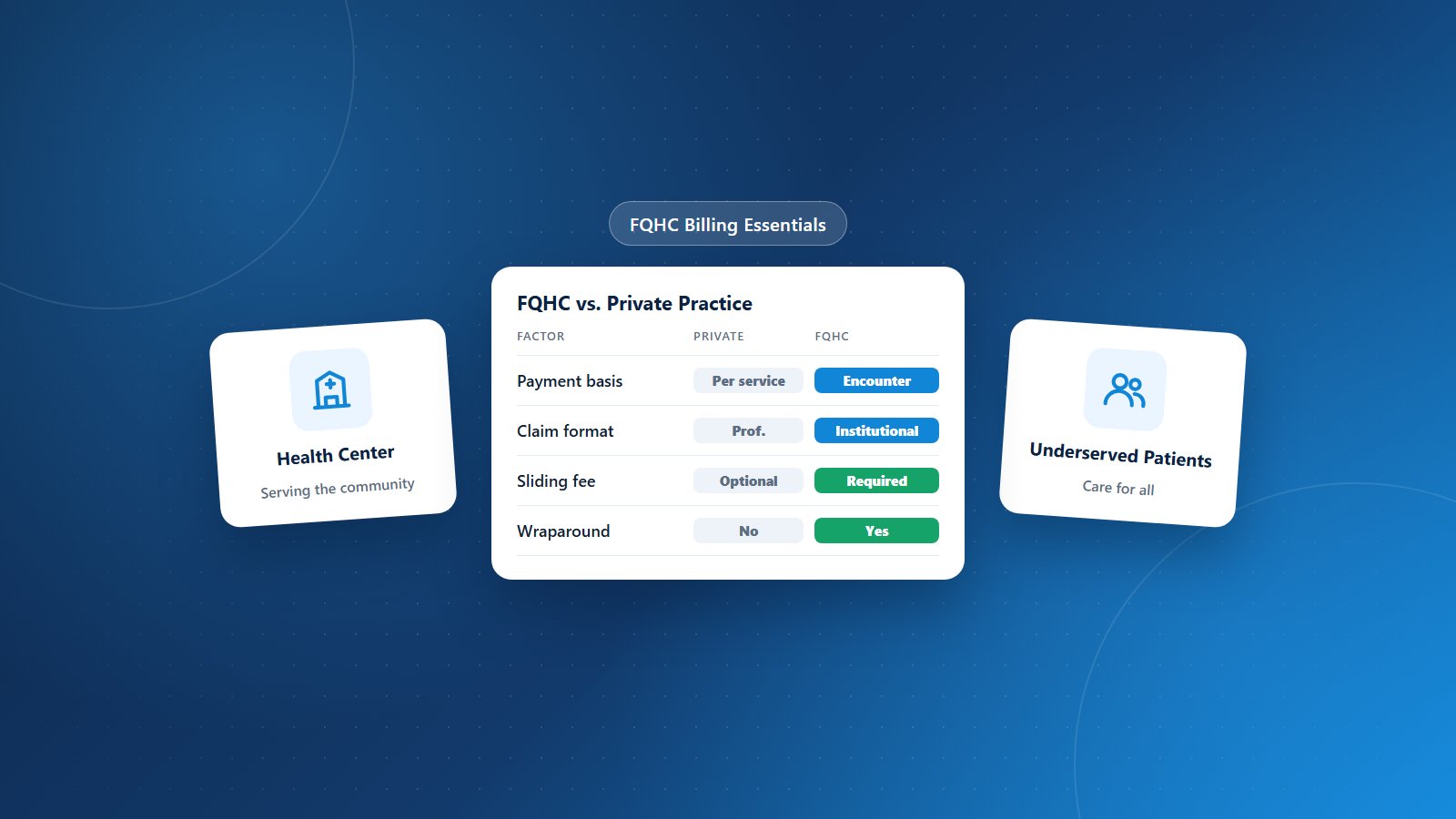
Private practices are typically paid per service through fee schedules. FQHCs are often paid per qualifying visit or encounter under prospective payment systems for Medicare and Medicaid, regardless of how many services are provided during that visit (with some exceptions). Understanding what counts as a qualifying visit is essential.
Difference 2: Qualifying Visits and Practitioners
Only face-to-face visits with certain qualified practitioners, such as physicians, nurse practitioners, physician assistants, clinical psychologists and clinical social workers, generally count as billable encounters. Services by other staff may be incident to the visit rather than separately billable.
Difference 3: Specific Claim Formats and Codes
FQHCs often bill using institutional claim formats and specific codes and revenue codes required by Medicare and state Medicaid programs. Requirements vary by payer and state.
Difference 4: Same-Day Visits
Multiple visits on the same day are generally paid as a single encounter unless specific exceptions apply, such as a medical visit and a mental health visit, or an illness or injury occurring after the first visit. Document each visit clearly.
Difference 5: Medicaid Wraparound Payments
In many states, FQHCs receive supplemental payments from Medicaid to make up the difference between managed care payments and the FQHC’s prospective payment rate. Tracking and reconciling these payments requires careful accounting.
Difference 6: Sliding Fee Discounts
FQHCs must offer sliding fee discounts based on income and family size. Billing systems must correctly apply discounts and documentation of eligibility.
Difference 7: Care Management Services
FQHCs can provide care management services such as chronic care management and behavioral health integration, often billed using FQHC-specific codes. These services support patient health and add revenue. Learn more about our chronic care management services.
Difference 8: Reporting Requirements
FQHCs have extensive reporting obligations, including cost reports and program data reporting. Billing data must be accurate and consistent to support these reports.
Best Practices for FQHC Billing
- Train staff specifically on FQHC billing rules.
- Verify Medicaid and managed care eligibility frequently.
- Document qualifying visits and practitioners clearly.
- Reconcile wraparound payments regularly.
- Audit encounter coding and same-day visit billing periodically through a billing audit.
FQHC Billing Support From PRCM
Physicians Revenue Cycle Management supports FQHCs with billing expertise, eligibility verification, care management programs and credentialing. Our medical billing services help health centers capture the revenue they need to serve their communities. See the specialties we serve.
Need FQHC billing expertise? Let’s connect.