May is Mental Health Awareness Month. Telehealth has transformed access to behavioral health care. Patients can attend therapy from home, reduce travel and stigma barriers, and keep appointments more consistently. For many psychiatry, psychology and counseling practices, virtual visits are now a core part of care. But billing behavioral health telehealth accurately requires attention to payer-specific rules that differ from in-person billing.
Here’s how to bill virtual mental health visits accurately.
1. Confirm Coverage for Telehealth Behavioral Services
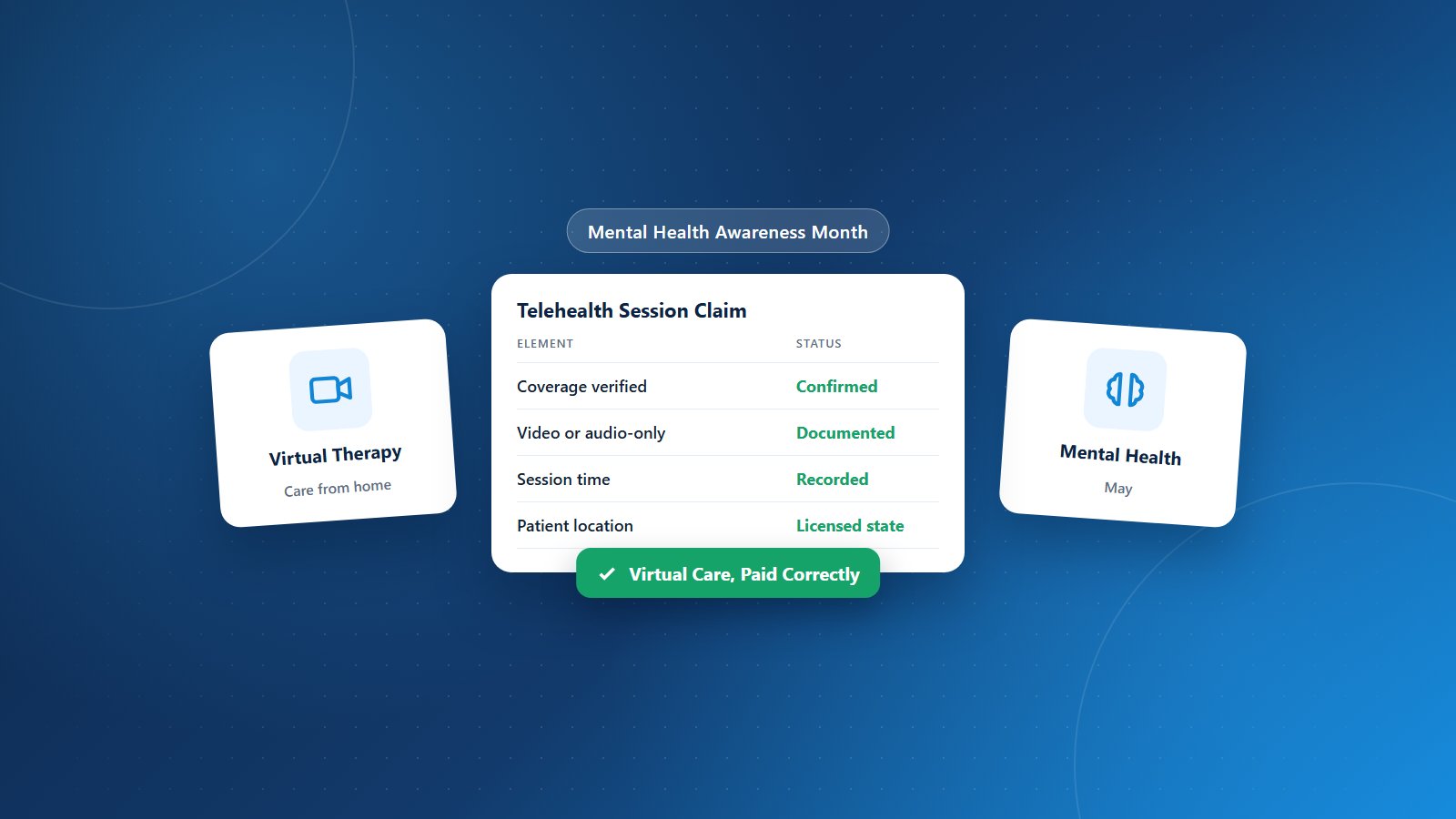
Behavioral health services are among the most widely covered telehealth services, but coverage varies by payer and plan, including whether audio-only sessions are covered and whether certain requirements apply. Verify coverage for each payer, and remember that some plans carve out behavioral health benefits to separate administrators.
2. Use the Correct Place of Service and Modifiers
Report the place of service and telehealth modifiers required by each payer. Requirements can differ for video and audio-only visits. Keep a payer reference updated as policies change.
3. Document Telehealth-Specific Elements
- That the session occurred via telehealth and whether it was video or audio-only.
- Patient location at the time of service and provider location.
- Consent to telehealth, where required.
- Session start and stop times or total time for time-based services.
- Participants present, such as family members.
4. Code Time-Based Psychotherapy Correctly
Psychotherapy codes are based on session time, the same as in-person visits. Document time accurately and select the code that matches the time range.
5. Handle E/M Plus Psychotherapy Carefully
When psychiatric providers deliver medication management and psychotherapy in the same virtual session, documentation must separate the E/M work from psychotherapy time.
6. Verify Licensure for Patient Location
Clinicians must generally be licensed in the state where the patient is located during the session. Patients who travel or attend college out of state create licensing considerations. Read our guide to telehealth credentialing across states.
7. Know In-Person Requirements
Some payers may require periodic in-person visits for patients receiving behavioral health care by telehealth, or may have specific rules for certain services. Track requirements by payer and schedule in-person visits when needed.
8. Protect Privacy
Use secure, HIPAA-compliant video platforms and confirm patients are in a private setting. Substance use disorder treatment records may require additional confidentiality protections.
9. Collect Copays Virtually
Use card-on-file or online payment links to collect copays for virtual sessions.
10. Monitor Denials
Track telehealth denials separately to catch payer policy changes quickly. For general telehealth guidance, see our telehealth billing essentials, and for specialty challenges, our behavioral health billing guide.
Behavioral Health Billing Support From PRCM
Physicians Revenue Cycle Management supports psychiatry, psychology and counseling practices with telehealth billing, credentialing and payer policy tracking through our medical billing services.
This Mental Health Awareness Month, let us handle telehealth billing. Let’s connect.