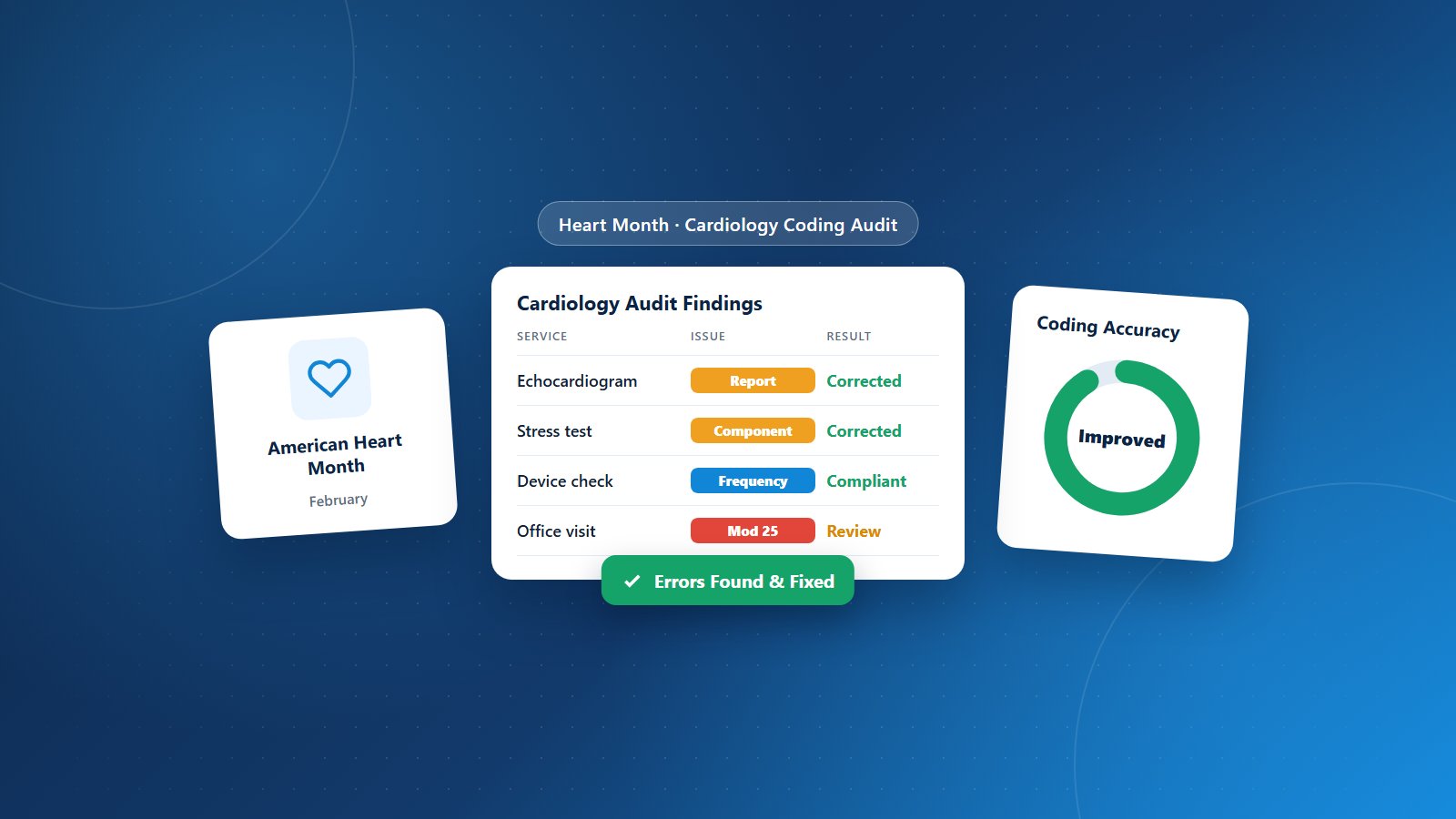
February is American Heart Month. For cardiology practices, it’s a fitting time to look closely at coding accuracy. Cardiology audits regularly uncover the same types of errors: issues that lead to denials, underpayments or compliance risk. Because cardiology services are often high-value, even a small error rate can have a significant financial impact.
Here are the top coding errors found in cardiology audits and how to correct them.
Error 1: Professional and Technical Component Mistakes
Many cardiology tests, including echocardiograms, stress tests, Holter monitors and vascular studies, have professional and technical components. Billing the global service when the practice provided only the interpretation, or vice versa, results in incorrect payments.
Fix: Map each test and location to the correct component billing and verify equipment ownership and interpretation arrangements.
Error 2: Incomplete Echocardiogram Documentation
Echo codes depend on the components performed, such as complete vs. limited studies, Doppler and color flow. Reports that don’t document required elements can’t support the code billed.
Fix: Use structured reporting templates that capture all required elements.
Error 3: Stress Test Component Coding
Stress testing often involves separate components for supervision, interpretation and tracing, along with imaging when performed. Missing or duplicated components are common.
Fix: Confirm which components were performed and by whom, and code each correctly.
Error 4: Device Monitoring Errors
Pacemaker, defibrillator and loop recorder monitoring codes differ for in-person interrogations and remote monitoring, with specific frequency and documentation requirements.
Fix: Track monitoring periods and document device type, findings and programming changes.
Error 5: E/M Level and Modifier 25 Issues
Audits often find E/M services billed with modifier 25 on the same day as tests or procedures without documentation of a separately identifiable service, or undercoded visits for complex heart patients.
Fix: Train providers on documenting medical decision making and separately identifiable services. See our modifier 25 guide.
Error 6: Medical Necessity Diagnosis Coding
Diagnostic tests require diagnoses that meet payer coverage criteria. Unspecified or mismatched diagnoses lead to denials.
Fix: Code symptoms and conditions specifically and review coverage policies for high-volume tests.
Error 7: Interventional Procedure Coding
Catheterization and interventional procedures involve detailed coding based on vessels, approach and additional services. Errors in add-on codes and bundling are common.
Fix: Use experienced interventional coders and review procedure reports carefully.
Error 8: Missing Authorization
Advanced imaging and some procedures require prior authorization. Claims without valid authorization are denied.
Fix: Verify authorization before scheduling and match approved services to those performed.
Turning Audit Findings Into Improvement
Share audit findings with providers and coders, update templates, adjust charge rules and schedule follow-up reviews. For broader denial prevention tips, read our article on common cardiology billing denials.
Cardiology Audit Support From PRCM
Physicians Revenue Cycle Management provides cardiology-focused billing audits and specialty billing services that help cardiovascular practices code accurately and protect revenue. See the specialties we serve.
This Heart Month, give your coding a checkup. Let’s connect.