Dermatology practices perform a high volume of procedures alongside office visits: biopsies, excisions, destructions, repairs, Mohs surgery and cosmetic treatments. Each comes with specific coding rules based on lesion type, size, location, technique and margin. Small details in documentation often determine the correct code, and small errors add up quickly.
Here are the most common dermatology coding pitfalls and how to avoid them.
Pitfall 1: Biopsy Coding by Technique
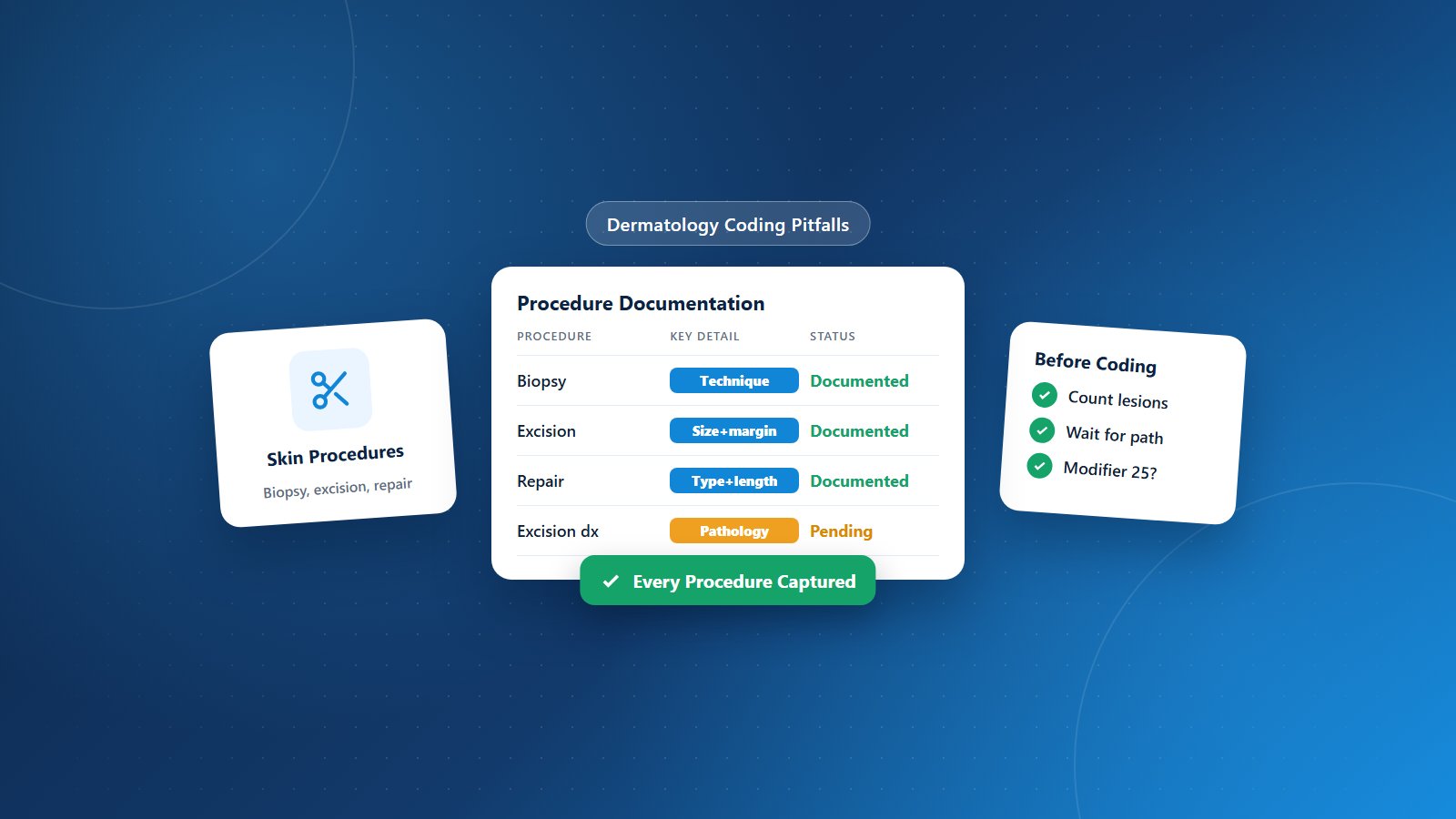
Skin biopsy codes are based on technique, such as tangential (shave), punch or incisional, with add-on codes for additional lesions. Coding all biopsies the same way or missing add-on codes leads to errors.
Avoid it: Document the biopsy technique and number of lesions for each procedure.
Pitfall 2: Excision Size and Margins
Excision codes depend on whether the lesion is benign or malignant, the anatomic location and the excised diameter, which includes the lesion plus margins. Coding from the lesion size alone undercodes the procedure.
Avoid it: Document the lesion size and the margins taken so the excised diameter can be calculated before coding.
Pitfall 3: Waiting for Pathology
Whether an excised lesion is benign or malignant affects the code. Coding before pathology is available can lead to errors.
Avoid it: Hold excision claims until pathology results are received, when practical.
Pitfall 4: Repairs
Repairs (closures) may be separately billable depending on complexity. Simple repairs are often included in excisions, while intermediate and complex repairs may be billed separately with documentation of the repair type and length.
Avoid it: Document repair type, technique and length, and understand which repairs are bundled.
Pitfall 5: Destruction Codes
Destruction of lesions such as actinic keratoses or warts uses different codes based on lesion type and number. Count lesions accurately and document them.
Pitfall 6: Modifier 25 With Procedures
Dermatology frequently involves an evaluation followed by a minor procedure on the same day. A separate E/M service is billable only when it’s significant and separately identifiable. Read our modifier 25 guide.
Pitfall 7: Multiple Procedures and Lesions
When multiple procedures are performed, modifiers may be needed to indicate distinct lesions or sites. Clear documentation of each lesion’s location and procedure supports correct coding.
Pitfall 8: Mohs Surgery
Mohs surgery codes are based on location, stages and tissue blocks. Documentation must support each stage and block, and repairs may be coded separately.
Pitfall 9: Cosmetic vs. Medically Necessary
Cosmetic procedures are generally not covered by insurance. Clearly distinguish cosmetic services from medically necessary ones and collect payment for cosmetic services directly. Use waivers when coverage is uncertain.
Pitfall 10: Diagnosis Coding
Use diagnosis codes that reflect pathology results and lesion characteristics. Uncertain or unspecified codes can trigger medical necessity denials.
Dermatology Billing Support From PRCM
Physicians Revenue Cycle Management supports dermatology practices with coders who understand biopsies, excisions, repairs and Mohs surgery. Our medical billing and audit services help dermatologists capture every procedure correctly. See the specialties we serve.
Want cleaner dermatology claims? Let’s connect.