Key takeaways
- E/M services drive most practice revenue, so level selection has a direct effect on income and compliance.
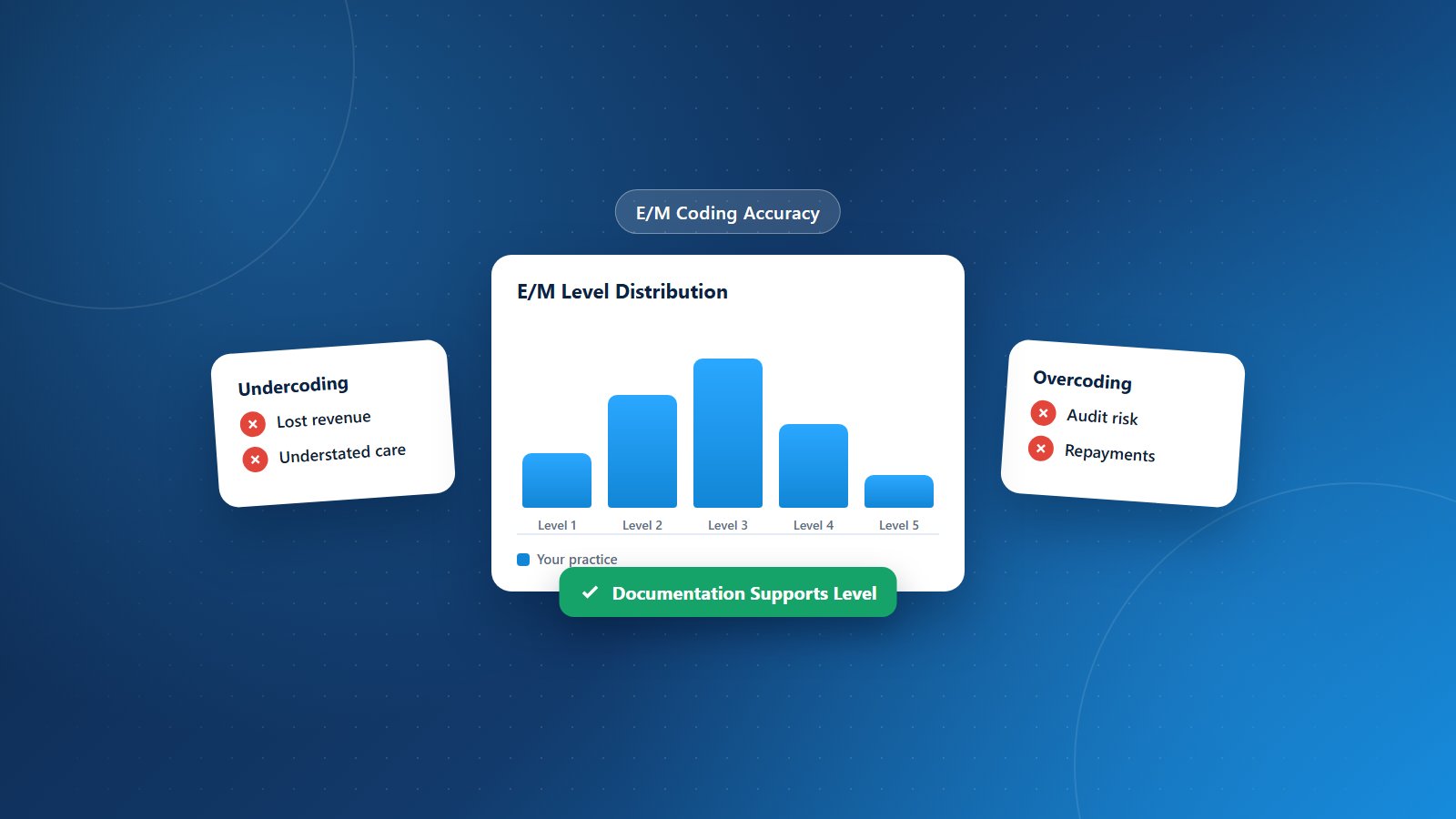
- Undercoding loses earned revenue; overcoding creates audit and repayment risk.
- For office visits, levels are generally based on medical decision making or total time, and documentation must clearly support the method used.
- Provider education, templates that reflect real work and regular audits keep coding accurate.
Evaluation and management (E/M) services are the backbone of most medical practices’ revenue. Office visits, hospital visits and consultations are billed using E/M codes, and choosing the right level for each visit has a direct impact on both revenue and compliance. Code too low, and the practice loses income it earned. Code too high, and the practice faces audit risk and potential repayment.
This guide explains how E/M levels are determined, how to document them and how to keep coding accurate across your practice.
The Cost of Undercoding
Many physicians undercode out of caution, choosing lower levels to avoid audit attention. While well-intentioned, consistent undercoding can quietly reduce practice revenue over a year, and it misrepresents the complexity of the care provided, which can also affect quality and risk comparisons.
The Risk of Overcoding
Overcoding, billing higher levels than documentation supports, can result in payer audits, recoupments and, in serious cases, investigations. Patterns of high-level coding that differ significantly from specialty norms are a common audit trigger.
How E/M Levels Are Determined
For office and many other outpatient visits, E/M level selection is generally based on either:
- Medical decision making (MDM): the complexity of problems addressed, the amount and complexity of data reviewed and analyzed, and the risk of complications or management options.
- Total time: the total time the physician or qualified practitioner spent on the patient’s care on the date of the encounter, including face-to-face and non-face-to-face activities.
Documentation should clearly support whichever method is used.
Understanding Medical Decision Making
| MDM element | What to document |
|---|---|
| Problems addressed | Each problem, its status and complexity (stable, worsening, new, uncertain prognosis) |
| Data reviewed and analyzed | Tests ordered or reviewed, external records, independent historians, discussions with other clinicians |
| Risk of management | Prescription drug management, decisions about procedures or hospitalization, social factors affecting care |
Tips for Documenting Medical Decision Making
- Describe each problem addressed and its status, not just a diagnosis list.
- Record data reviewed: tests ordered or reviewed, external records and independent historians.
- Document risk: prescription drug management, decisions about procedures or hospitalization, and social determinants affecting care.
- Show your thinking: the assessment and plan should reflect the clinical reasoning behind decisions.
Example: Same Patient, Different Documentation
A patient with diabetes and hypertension returns for follow-up. In one note, the assessment simply lists both diagnoses and “continue meds.” In another, the physician documents that blood pressure remains above goal, reviews recent lab results, adjusts one medication and explains the plan for follow-up. The care may be identical, but only the second note clearly shows the complexity of decision making. Documentation determines what the record can support.
Tips for Time-Based Coding
- Document total time spent on the date of the encounter.
- Describe the activities performed, such as reviewing records, counseling, ordering tests or coordinating care.
- Don’t count time spent on separately billed services.
- Use time when it better reflects the work, such as visits dominated by counseling or coordination.
Avoid Common E/M Mistakes
- Cloned notes: Copy-forward documentation that doesn’t reflect the current visit undermines credibility.
- Templates that inflate documentation without reflecting actual work.
- Coding based on note length rather than MDM or time.
- Missing assessments and plans for problems listed.
- Inconsistent coding between providers seeing similar patients.
Monitor Your Coding Patterns
Compare your E/M level distribution with specialty benchmarks and between providers. Significant differences aren’t necessarily wrong, since your patient population may be more or less complex, but they’re worth reviewing. Watch especially for providers who almost never bill higher levels or almost always do.
Educate and Audit Regularly
Provider education and periodic audits are the best way to ensure E/M accuracy. Audits identify both undercoding and overcoding and provide specific, actionable feedback. Learn more about annual billing audits and the signs you need one.
Frequently Asked Questions
Should we choose MDM or time?
Use whichever method the documentation supports best for that visit. Some visits are better reflected by decision making, others by time.
Does a longer note support a higher level?
Not by itself. Level selection depends on medical decision making or time, not on how much text is in the note.
How do E/M levels interact with modifier 25?
When a significant, separately identifiable E/M is performed on the same day as a procedure, modifier 25 may apply. See our modifier 25 guide.
Accurate Coding With PRCM
Physicians Revenue Cycle Management’s certified coders review documentation and support accurate E/M coding across specialties. Our medical billing services and audit services help practices capture the full value of their work while staying compliant.
Not sure if your E/M coding is accurate? Let’s connect.