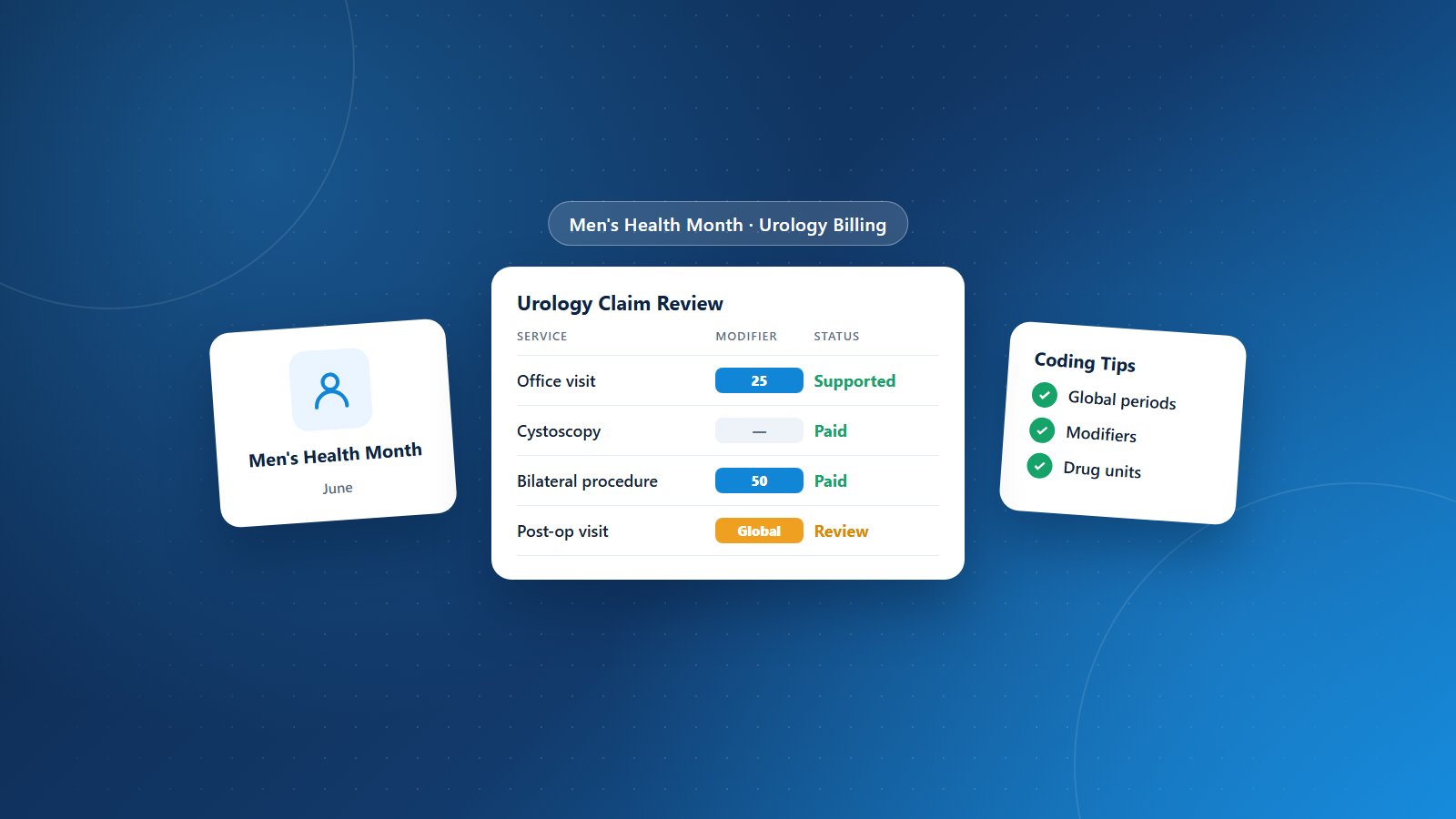
June is Men’s Health Month, an opportunity to encourage men to prioritize preventive care and address health concerns early. Urologists are central to men’s health, treating conditions from kidney stones and urinary disorders to prostate disease and cancer. Urology practices also perform a wide range of in-office and facility procedures, which makes urology billing detailed and denial-prone.
This guide covers key coding tips to help urology practices get paid accurately.
What Makes Urology Billing Complex
- A mix of office visits, in-office procedures, diagnostic testing and surgical procedures.
- Global surgical periods that affect what can be billed after procedures.
- Frequent use of modifiers for same-day services and bilateral procedures.
- Drug administration and supply billing for in-office treatments.
- Imaging and diagnostic testing with professional and technical components.
Tip 1: Understand Global Surgical Periods
Many urologic procedures include a global period during which related follow-up visits aren’t separately billable. However, unrelated problems, complications requiring a return to the operating room or decisions for surgery may be billable with the right modifiers and documentation. Track global periods in your practice management system so staff know when visits are billable.
Tip 2: Use Modifiers Correctly
Urology frequently involves same-day E/M and procedures, bilateral procedures and multiple procedures in one session. Make sure modifiers are applied only when documentation supports them, and that they’re placed on the correct code.
Tip 3: Document In-Office Procedures Thoroughly
Procedures such as cystoscopy, biopsies and catheter-related services need complete documentation of indications, technique, findings and any specimens obtained. Missing elements lead to denials and audit risk.
Tip 4: Bill Drugs and Supplies Accurately
In-office treatments may involve drugs, implants or supplies that are separately billable. Calculate drug units correctly, document waste when required and verify payer coverage before administration.
Tip 5: Verify Authorization for Procedures and Imaging
Many payers require prior authorization for certain procedures, advanced imaging and specialty drugs. Verify requirements before scheduling and confirm that what’s authorized matches what’s performed.
Tip 6: Code Diagnoses With Specificity
Specific diagnosis coding for conditions such as urinary symptoms, stones, prostate conditions and cancers supports medical necessity and accurate risk reflection. Avoid unspecified codes when documentation supports more detail.
Tip 7: Understand Screening vs. Diagnostic Services
Screening services, such as certain prostate cancer screenings, may be covered differently than diagnostic testing for symptomatic patients. Make sure the right codes and diagnoses are used and that patients understand potential cost-sharing differences.
Tip 8: Audit High-Volume Services
Regular reviews of your most common procedures and E/M services catch modifier errors, missed charges and documentation gaps. A periodic billing audit is a smart investment for procedure-heavy specialties.
Supporting Men’s Health
Urology practices can also support patients through care management programs for chronic conditions and through outreach that encourages regular checkups. Strong billing operations ensure your practice has the resources to keep expanding access to care.
Urology Billing Support From PRCM
Physicians Revenue Cycle Management supports urology practices with coders experienced in surgical, in-office and diagnostic billing. Our medical billing services help urologists reduce denials and capture every billable service. See all the specialties we serve.
This Men’s Health Month, give your practice’s revenue a checkup. Let’s connect.