May is Mental Health Awareness Month, a time to recognize the importance of mental health care and the professionals who provide it. Psychiatrists, psychologists, therapists and counselors are in high demand, yet many behavioral health practices struggle with billing. Unique codes, time-based services, authorization requirements and frequent payer audits make behavioral health billing one of the most challenging specialties to get right.
Here are the most common billing challenges for behavioral health practices and how to overcome them.
Challenge 1: Time-Based Psychotherapy Codes
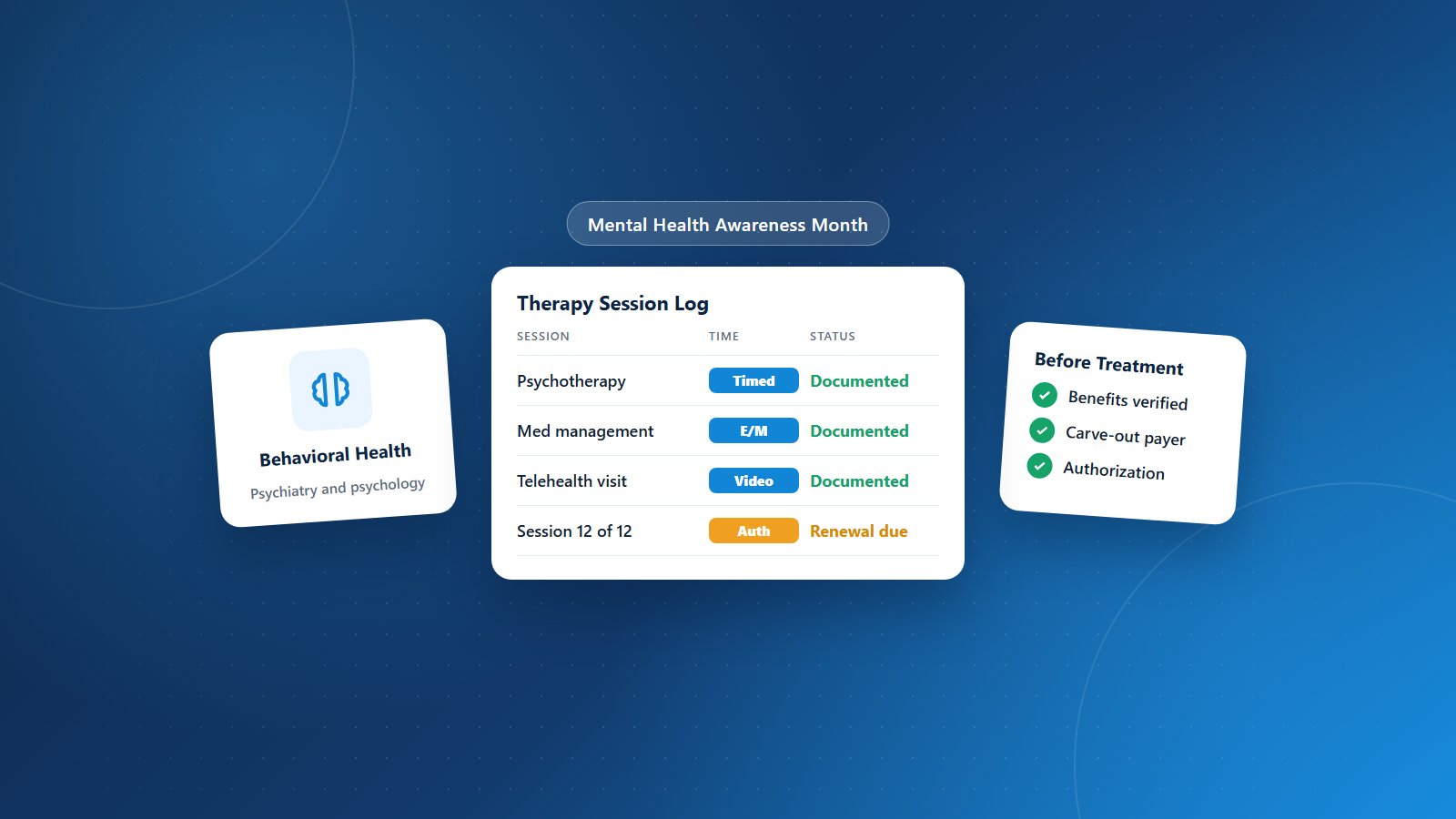
Many psychotherapy services are billed based on the time spent with the patient. Billing the wrong time increment, or failing to document start and stop times or total time, leads to denials and audit risk.
Solution: Document total face-to-face time for every session and train clinicians on the time ranges that apply to each service.
Challenge 2: Combining E/M and Psychotherapy
Psychiatrists often provide medication management and psychotherapy during the same visit. Billing both requires that each service be distinct and separately documented, with psychotherapy time not overlapping the E/M work.
Solution: Use templates that separate medical decision-making from psychotherapy and capture psychotherapy time independently.
Challenge 3: Prior Authorization and Session Limits
Many plans require authorization for ongoing therapy, psychological testing or intensive services, and some limit the number of covered sessions.
Solution: Verify benefits and authorization requirements before treatment begins, track authorized sessions and request extensions before limits are reached.
Challenge 4: Carve-Outs and Separate Behavioral Health Payers
Some health plans “carve out” behavioral health benefits to a separate administrator. Claims sent to the medical plan instead of the behavioral health payer are denied.
Solution: During eligibility verification, confirm which entity administers behavioral health benefits and update payer information accordingly.
Challenge 5: Telehealth Billing
Behavioral health is one of the most common uses of telehealth. Payers have specific rules for place of service codes, modifiers and audio-only versus video visits.
Solution: Maintain a payer-by-payer telehealth reference and review it regularly, since policies change.
Challenge 6: Credentialing Diverse Provider Types
Behavioral health practices often include psychiatrists, psychologists, licensed clinical social workers, counselors and nurse practitioners. Each provider type has different credentialing requirements and payer acceptance.
Solution: Credential every clinician with each payer before they see patients, and verify which provider types each plan covers. Our credentialing team can help.
Challenge 7: Documentation and Privacy
Behavioral health records require extra care for privacy. Psychotherapy notes kept separately may have additional protections, and substance use disorder records may be subject to stricter rules. At the same time, documentation must support medical necessity for billing.
Solution: Train clinicians on what belongs in the medical record versus separate psychotherapy notes, and ensure every billed service has documentation of medical necessity, treatment goals and progress.
Challenge 8: Collecting Patient Balances
Behavioral health patients often have recurring weekly visits, which means copays and deductibles add up quickly.
Solution: Provide clear cost estimates, collect copays at each session and offer payment plans when needed.
Integrating Behavioral Health in Primary Care
Primary care practices increasingly offer behavioral health integration and collaborative care. These care management services have their own requirements and can complement chronic care management programs.
Billing Support for Behavioral Health Practices
Physicians Revenue Cycle Management supports psychiatry, psychology and substance abuse treatment practices with specialty-trained coders, authorization management and credentialing. Our medical billing services help behavioral health providers get paid accurately so they can focus on patients. See all the specialties we serve.
This Mental Health Awareness Month, let us handle the billing. Let’s connect.