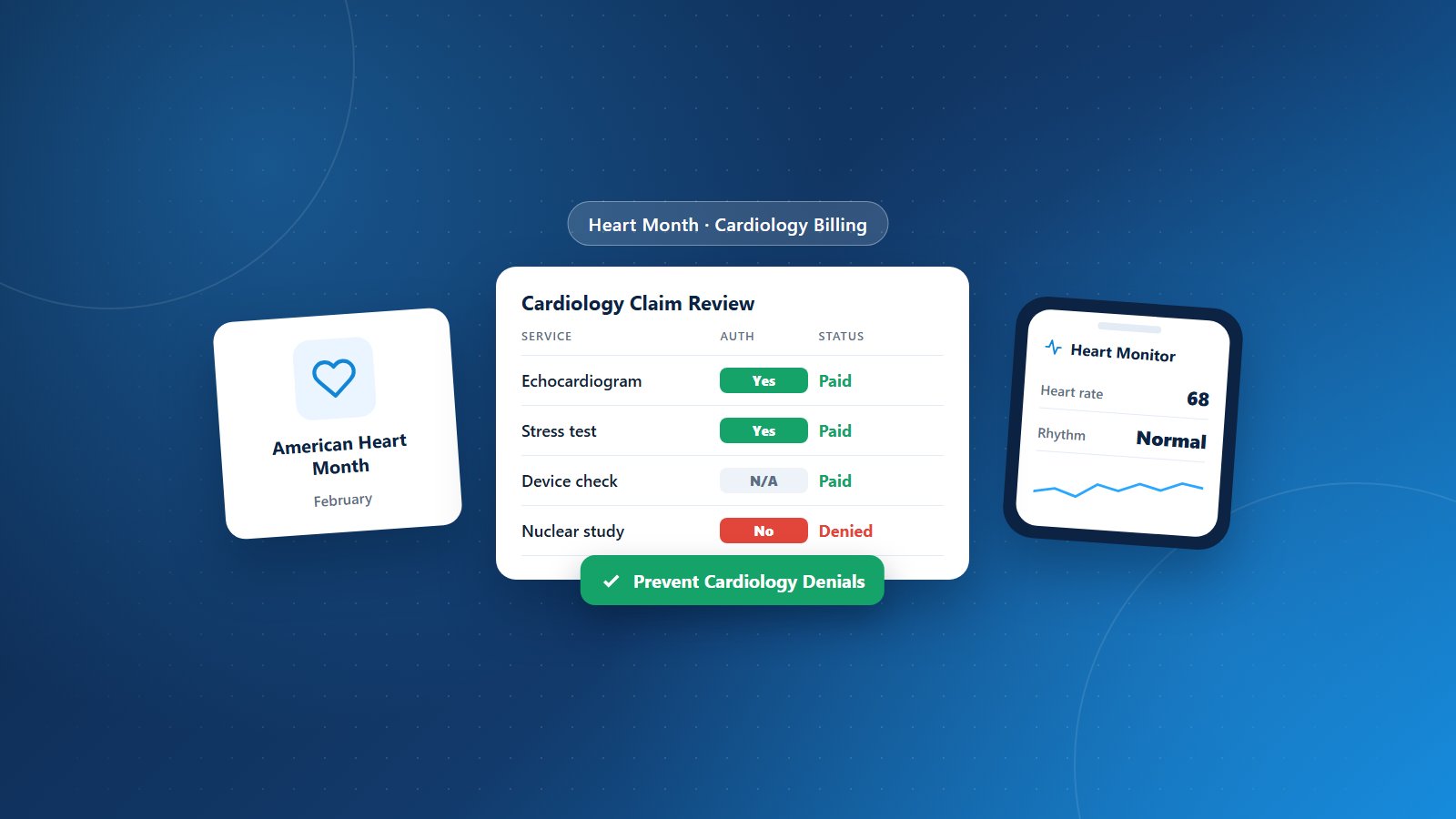
February is American Heart Month, a time when the healthcare community focuses on preventing and treating cardiovascular disease. For cardiology practices, it’s also a good moment to look at the financial health of the practice. Cardiology billing is one of the most complex areas of medical billing, with diagnostic testing, procedures, device monitoring and frequent payer scrutiny. Small errors can lead to costly denials.
Here are the most common cardiology billing denials and practical ways to prevent them.
Why Cardiology Billing Is So Complex
Cardiology practices bill for a wide range of services: office visits, echocardiograms, stress tests, Holter and event monitoring, device checks for pacemakers and defibrillators, vascular studies and interventional procedures. Many services have professional and technical components, specific documentation requirements and payer coverage policies tied to diagnosis codes. Prior authorization is common, especially for advanced imaging.
Common Cardiology Denials
1. Missing or invalid prior authorization
Advanced imaging, nuclear studies and certain procedures often require prior authorization. Denials occur when authorization wasn’t obtained, expired before the service or didn’t match the service performed.
Prevention: Build an authorization checklist by payer and service, verify authorization before scheduling and confirm that the authorized service matches what’s performed.
2. Medical necessity denials
Payers may deny diagnostic tests if the diagnosis codes submitted don’t support coverage under their policies.
Prevention: Review payer coverage policies for high-volume tests, code diagnoses to the highest specificity and make sure documentation clearly explains the reason for each test.
3. Frequency limitations
Repeat echocardiograms, stress tests and device checks may be limited in frequency. Claims submitted too soon after a prior test can be denied.
Prevention: Track test history and document clinical changes that justify repeat testing.
4. Component and modifier errors
Billing the global service when only the professional or technical component was performed, or missing required modifiers, leads to denials and overpayments.
Prevention: Clarify who owns the equipment and who performs the interpretation for each site of service, and set up charge rules accordingly.
5. Bundling and duplicate billing
Some services are bundled into others when performed together. Billing them separately triggers edits and denials.
Prevention: Use claim scrubbing tools with current edits and train coders on common cardiology bundling rules.
6. Device monitoring documentation
Remote and in-person device checks have specific documentation and timing requirements. Missing elements can lead to denials.
Prevention: Use templates that capture all required elements for device evaluations.
Building a Denial-Resistant Cardiology Workflow
- Front end: Verify eligibility, benefits and authorization before every test or procedure.
- Documentation: Ensure orders, indications and interpretations are complete and signed.
- Coding: Use certified coders familiar with cardiology services.
- Claim scrubbing: Catch errors before submission.
- Denial tracking: Analyze denials by payer, service and reason to fix root causes.
- Auditing: Review cardiology claims regularly through a medical billing audit.
Don’t Overlook Care Management Opportunities
Many cardiology patients have multiple chronic conditions and can benefit from remote patient monitoring and chronic care management. These programs support better heart health between visits and create an additional, recurring revenue stream.
Specialty Billing Support From PRCM
Physicians Revenue Cycle Management supports cardiology and cardiovascular practices with specialty-trained coders, authorization management and denial prevention. Our medical billing services help cardiology groups get paid accurately and on time. See all the specialties we serve.
This Heart Month, give your practice’s revenue a checkup. Let’s connect.