Key takeaways
- An annual billing audit compares claims with documentation and payer rules to find lost revenue and compliance risk.
- Audits uncover both undercoding and overcoding, missed charges, denial patterns and underpayments.
- January is an ideal time: a full year of data, new codes just in effect and a fresh year of goals.
- The value of an audit comes from what happens next: education, process fixes and follow-up reviews.
Most practices only think about billing audits when a payer requests records or a denial pattern becomes impossible to ignore. By then, problems have often been repeating for months, leaving revenue on the table and creating compliance risk. An annual medical billing audit flips that approach: instead of waiting for trouble, you find and fix issues on your own terms.
January is an ideal time for an audit. You have a full year of data to review, coding updates have just taken effect and you can set improvement goals for the year ahead. This guide explains what an audit covers, why it pays off and how to get the most from it.
What Is a Medical Billing Audit?
A medical billing audit is a structured review of your practice’s coding, documentation and billing processes. Auditors compare a sample of claims against the corresponding medical records and payer rules to determine whether services were coded correctly, documented sufficiently and billed appropriately.
Audits can be:
- Internal: performed by your own coding or compliance staff.
- External: performed by an independent firm that brings objectivity and broad specialty experience.
- Prospective: reviewing claims before submission to prevent errors.
- Retrospective: reviewing claims after payment to identify patterns and risk.
What an Audit Reviews
| Area | Key question |
|---|---|
| Coding accuracy | Are E/M levels, procedure codes, diagnosis codes and modifiers correct? |
| Documentation | Does the record support the services billed and show medical necessity? |
| Charge capture | Are all billable services actually being billed? |
| Claim submission | Are claims clean, timely and complete? |
| Payments | Are payers paying according to your contracts? |
| Denials | What are the leading denial reasons, and are they being worked? |
| Compliance | Do billing practices align with payer policies and regulations? |
Why Every Practice Needs an Annual Audit
1. Recover lost revenue
Undercoding, missed charges and unworked denials quietly reduce income. Many physicians code conservatively out of caution, leaving earned revenue uncollected. Audits frequently reveal revenue that’s being left behind every month.
2. Reduce compliance risk
Overcoding, cloned documentation and incorrect modifier use can lead to payer recoupments and investigations. Finding and correcting these issues proactively reduces your risk and demonstrates a good-faith commitment to compliance.
3. Improve documentation
Audit findings give providers specific, practical feedback. Instead of generic reminders to “document better,” physicians learn exactly which elements were missing in their own notes.
4. Strengthen your revenue cycle
Audits often reveal process gaps beyond coding, such as registration errors, eligibility problems, missing authorizations and slow follow-up that drive denials and delays.
5. Benefit every team
Coders learn where errors occur, administrative staff gain confidence that claims are correct, and clinicians receive feedback that supports better documentation and patient care.
Signs Your Practice May Need an Audit Now
- Rising denial rates or slower payments
- Collections falling while patient volume stays steady
- E/M level distribution very different from specialty norms
- New providers, services or billing staff
- A recent change in practice management or EHR systems
- Payer requests for records or recoupment letters
What Happens During an Audit
- Scope: Define providers, services, payers and the time period to review.
- Sampling: Select a representative sample of claims, often weighted toward high-volume or high-risk services.
- Review: Compare each claim with documentation and payer rules.
- Findings: Summarize accuracy rates, error types and financial impact by provider and service.
- Education: Share results with providers and staff in a constructive way.
- Action plan: Implement corrections, update templates and schedule follow-up monitoring.
Example: What Audit Findings Can Reveal
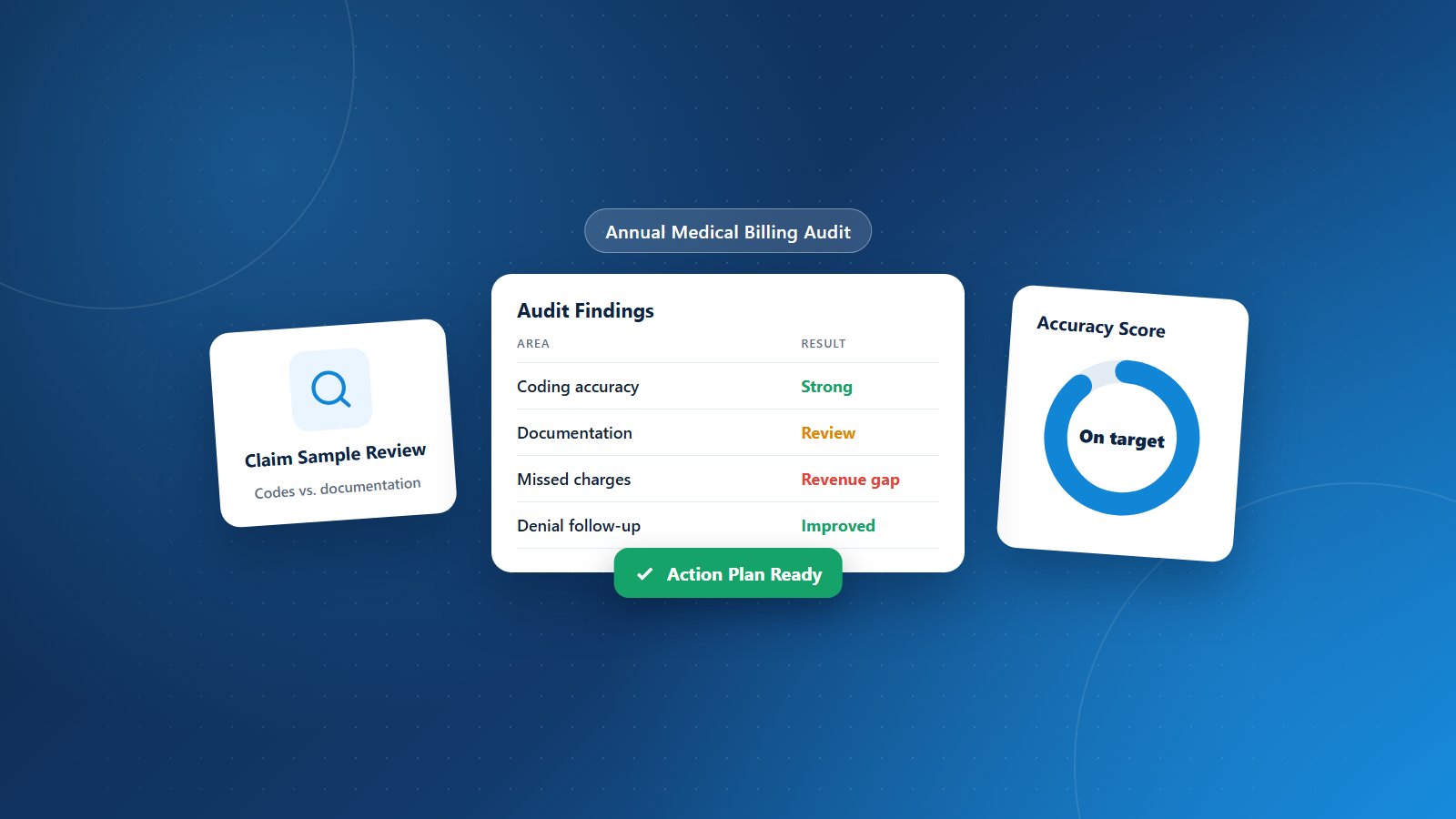
Consider a practice where collections have been flat despite steady patient volume. An audit might reveal several issues at once: established patient visits consistently coded at lower levels than the documentation supports, in-office injections documented but not billed, and a cluster of denials caused by a missing modifier for one payer. None of these problems is dramatic on its own, but together they explain the flat revenue, and each has a clear fix.
Turning Findings Into Results
An audit is only valuable if findings lead to change. Make sure your audit includes:
- Individual feedback for each provider
- Updated EHR templates and charge entry rules
- Coder training on identified error types
- Correction of past claims where appropriate and permitted
- Follow-up reviews to confirm improvements stick
Make Auditing a Habit
An annual audit sets a baseline, and periodic follow-up reviews confirm improvements are lasting. Practices that audit regularly tend to have cleaner claims, fewer denials and stronger compliance.
Frequently Asked Questions
How many claims should an audit review?
It depends on practice size and goals. Auditors typically review a representative sample per provider, with larger samples for high-volume or high-risk services.
Will an audit get my practice in trouble?
A proactive internal or external audit is a compliance best practice. If problems are found, addressing them promptly is far better than having a payer discover them first.
Can an audit increase revenue?
Often, yes. Audits frequently reveal undercoding, missed charges and unworked denials, all of which represent revenue the practice has already earned.
How long does an audit take?
Timing depends on scope, but most practice-level audits are completed within a few weeks, followed by a findings review and education.
Schedule Your Audit With PRCM
Physicians Revenue Cycle Management offers comprehensive medical billing audit and consulting services. Our experts review your coding, documentation and billing processes and deliver clear, actionable recommendations. Need ongoing support? Our medical billing services put those improvements into practice. Coding modifiers are a frequent audit finding, so see our modifier 25 guide as well.
Start the year with a clear view of your billing health. Let’s connect to schedule your audit.