Few billing modifiers cause as much confusion, or as many denials, as modifier 25. Used correctly, it allows a practice to be paid for a significant, separately identifiable evaluation and management (E/M) service performed on the same day as a procedure or another service. Used incorrectly, it triggers denials, payment delays and unwanted payer attention.
Because modifier 25 billing appears in almost every specialty, from primary care and pediatrics to dermatology, orthopedics and pain management, getting it right has a real impact on revenue and compliance. This guide explains when modifier 25 applies, what documentation supports it and how to avoid the mistakes that lead to denials.
What Is Modifier 25?
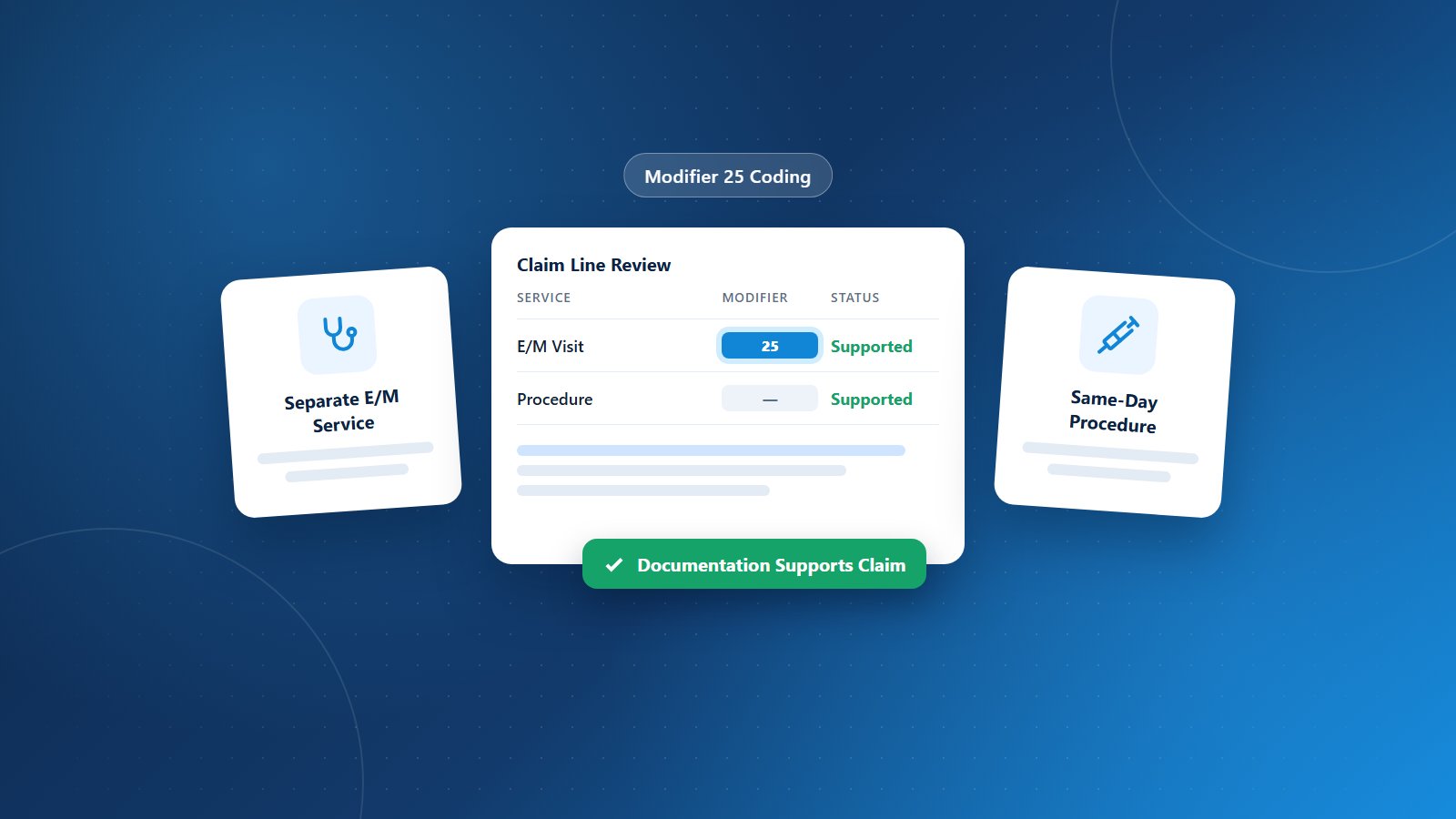
Modifier 25 is appended to an E/M code to indicate that the patient’s condition required a significant, separately identifiable E/M service above and beyond the usual pre- and post-service work associated with another procedure or service performed on the same day by the same provider.
In simple terms, every procedure already includes a certain amount of evaluation: reviewing the patient’s history related to the procedure, confirming the plan, obtaining consent and providing aftercare instructions. That work is part of the procedure’s payment. Modifier 25 tells the payer that the provider did more than that: a distinct evaluation that would stand on its own as a billable visit.
When Modifier 25 Is Appropriate
Modifier 25 is typically appropriate in situations like these:
- A procedure plus a separate problem. A patient comes in for a scheduled joint injection and also asks the provider to evaluate a new respiratory complaint. The evaluation of the new problem may support a separate E/M service.
- A preventive visit plus a problem-oriented visit. During a wellness exam, the provider addresses a new or worsening chronic condition that requires significant additional work beyond the preventive service.
- A decision for a minor procedure after a full evaluation. A patient presents with a new skin lesion; the provider performs a complete evaluation of the patient’s concerns, then decides to biopsy. Depending on the extent of the work, a separate E/M may be supported.
- Diagnostic tests or treatments on the same day. A provider evaluates a patient’s condition and orders and administers a treatment during the same encounter, where the evaluation goes beyond the treatment itself.
When Modifier 25 Is Not Appropriate
Just as important is knowing when not to use it. Modifier 25 should not be used when:
- The E/M work is limited to the usual pre-procedure assessment, such as confirming the need for a planned procedure.
- The patient was scheduled specifically for a procedure and no additional problem was addressed.
- The modifier is being appended out of habit to every visit that includes a procedure.
- It is attached to the procedure code rather than the E/M code.
Routine or automatic use of modifier 25 is one of the patterns payers look for when selecting claims for review.
Documentation That Supports Modifier 25
Strong documentation is the foundation of successful modifier 25 billing. The medical record should make it clear to any reviewer that the E/M service was distinct from the procedure. Best practices include:
- Clearly separate the problems. Document the evaluation of the separate problem in its own section of the note, or clearly distinguish it from the procedure documentation.
- Show medical decision making. Record the assessment, the conditions addressed, data reviewed and the management plan for the separate problem.
- Use accurate diagnosis codes. Different diagnoses for the E/M and the procedure help demonstrate separateness, although the same diagnosis can be appropriate when the E/M work clearly exceeds the usual pre-procedure evaluation.
- Document the procedure separately. The procedure note should stand on its own with indications, technique and outcome.
A helpful test: if you removed the procedure from the note, would the remaining documentation still support a billable E/M visit? If the answer is yes, modifier 25 is likely appropriate.
Common Modifier 25 Billing Mistakes
Practices that struggle with modifier 25 denials usually share a few recurring issues:
- Overuse. Appending modifier 25 to every visit with a procedure raises red flags and invites audits.
- Underuse. On the other hand, failing to bill a legitimately separate E/M service leaves earned revenue uncollected.
- Weak documentation. Notes that blend the evaluation and procedure together make it hard to prove the E/M was separate.
- Wrong placement. Modifier 25 belongs on the E/M code, not the procedure code.
- Ignoring payer policies. Payers can have their own rules and edits for modifier 25 claims. Some may reduce payment or request records more often.
How Payers Review Modifier 25 Claims
Because modifier 25 bypasses certain bundling edits, payers monitor it closely. Claims may be flagged for review when a provider’s modifier 25 usage is significantly higher than peers in the same specialty, or when the same diagnosis is used for both the E/M and the procedure on a high percentage of claims. Some payers apply payment reductions to E/M services billed with modifier 25 or require documentation before payment.
The best defense is consistent, accurate use backed by clear documentation. Practices should periodically compare their modifier 25 usage with specialty norms and review a sample of claims to confirm they are billed correctly.
Building a Modifier 25 Compliance Process
A simple, repeatable process can dramatically reduce modifier 25 denials:
- Educate providers. Make sure physicians and advanced practice providers understand what makes an E/M service “significant and separately identifiable.”
- Create documentation templates. EHR templates with separate sections for the E/M and the procedure make it easier to document correctly.
- Use coder review. Have trained coders review modifier 25 claims before submission, particularly for high-volume procedure codes.
- Track denials. Monitor denials and payment reductions tied to modifier 25 by payer and provider to identify patterns.
- Audit regularly. Periodic internal or external medical billing audits confirm that your process is working and catch issues before payers do.
Specialty Considerations
While the principles of modifier 25 are the same across specialties, how it plays out varies:
- Primary care and pediatrics often use modifier 25 when a sick visit is combined with a preventive exam or when vaccines are administered alongside an evaluation.
- Dermatology frequently encounters modifier 25 with biopsies, destructions and other minor procedures performed after a full skin evaluation.
- Orthopedics and pain management see it with injections performed on the same day as an evaluation of a new or different problem.
- Urology, cardiology and other specialties may use it with in-office diagnostic procedures.
PRCM supports practices across more than 40 specialties, and we tailor coding guidance to each specialty’s unique patterns.
Get Modifier 25 Right, Every Time
Modifier 25 is a legitimate and important tool that ensures providers are paid for the full scope of care they deliver. The key is using it only when the documentation clearly supports a separate, significant E/M service, and building processes that make correct use the default.
At Physicians Revenue Cycle Management, our certified coders and medical billing specialists help practices code accurately, reduce denials and stay audit-ready. Let’s connect to review your modifier usage and find revenue you may be missing.